
Your healthcare IT architecture sits under constant pressure. New data sources. New regulations. New clinical and operational demands. You need every system to speak the same language, at the same speed, without creating new risk.
For years, traditional middleware healthcare stacks carried that load. Today, modern data integration platforms promise faster connectivity, cloud flexibility, and better analytics support. The right choice shapes your interoperability strategy for the next decade.
This healthcare middleware comparison walks through how traditional middleware healthcare tools work, how modern data integration platforms differ, where each fits, and how to align them with your budget, security model, and cloud vs on-prem integration strategy.
Traditional Middleware Explained
Traditional middleware healthcare solutions grew up around HL7 v2, on-prem servers, and point-to-point interfaces. Integration engines from vendors like Cloverleaf or Rhapsody helped you connect ADT, lab, radiology, pharmacy, and billing feeds into your core EHR.
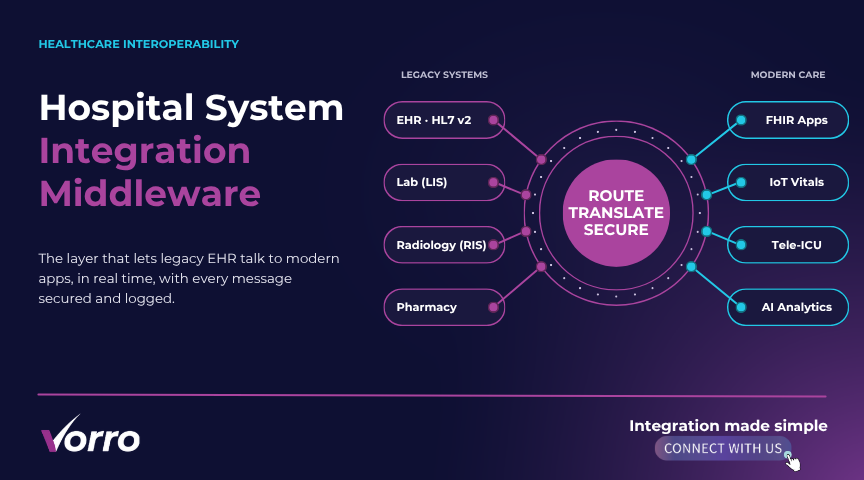
The core idea stays simple. Middleware exists between two differing systems, translates messages, and directs the flow of traffic based on defined rules. In healthcare, those rules often include HL7 v2 parsing, custom mappings, and protocol conversion.
A typical traditional middleware healthcare stack includes:
- On-prem server infrastructure in your data center
- HL7 v2 engines for ADT, orders, results, charges
- Custom scripts and mappings for every connected application
- VPNs or private network links to external partners
This approach still runs in many hospitals. One survey found that about 70% of health organizations rely on on-prem systems as core parts of their stack. At the same time, integration volume keeps rising as more apps join the ecosystem. A single hospital can pass millions of HL7 messages per day.
The traditional middleware has several advantages:
- Full support of HL7 v2 business processes
- Uptime performance in hospital networks
- Control over Infrastructure & Security Tools. However, it also has its drawbacks. For every new connection, customized work is often required. Expanding to new sites or new partners involves new servers.
Also Read: The Role of Real Time Data in Improving Patient Outcomes
Modern Integration Platforms Explained
Modern data integration platforms target a broader set of use cases. You still process HL7 messages. You also ingest FHIR APIs, flat files, cloud application data, and device telemetry, then normalize all of it into a form that drives analytics and care workflows.
These platforms often run in the cloud, with elastic capacity and subscription pricing. Cloud vs on-prem integration is no longer a binary choice. Many health systems run a hybrid model, keeping some feeds local and sending others through cloud services.
Modern data integration platforms usually provide:
- Connectors for HL7, FHIR, EDI, REST, SQL, and message queues
- Real-time and batch pipelines
- Centralized monitoring and alerting
- Built-in data quality, enrichment, and normalization
- API management to expose clean data to downstream apps
The industry push to FHIR accelerates this shift. The 21st Century Cures Act API rules drove major EHR vendors to expose FHIR endpoints, and adoption keeps growing. The ONC reported that around 88% of office-based physicians use an EHR that supports some degree of interoperability, pushing new API traffic into your environment. Modern data integration platforms help you aggregate that traffic and maintain a consistent data model across systems.
Cloud-native integration also speaks to new performance expectations. Analytics teams want near real-time data pipelines. Population health programs depend on timely feeds from hospitals, clinics, and external partners. One study showed that real-time data access can reduce care coordination delays by up to 20%, which creates both clinical and financial value.
Traditional middleware healthcare engines can participate in that model, but modern data integration platforms make it a first-class pattern. They treat interoperability, analytics, and partner APIs as parts of the same data fabric.
Feature Comparison Table
You do not pick technology in a vacuum. You pick features that align with your strategy and constraints. The table below compares traditional middleware healthcare engines with modern data integration platforms across the areas your team feels most.
As health systems move more workloads to the cloud, this feature gap widens. Gartner projects that public cloud services will reach about 679 billion dollars in spending in 2024, and healthcare participants in that growth. Modern data integration platforms fit that direction by design.
Cost & Scalability Analysis
Traditional middleware healthcare solutions often start as capital projects. You buy licenses, servers, and storage. You build interfaces with internal teams or partners. Costs concentrate up front, then return in big renewal cycles.
On paper, this looks predictable. In practice, every new interface adds labor. Each new facility or partner strains capacity. During spikes, such as flu season or major go-lives, teams scramble to keep up.
Key cost drivers for traditional middleware healthcare stacks:
- Upfront software licenses
- Server and storage hardware
- Data center power, cooling, and space
- Interface analyst and engineer time per connection
- Maintenance windows and unplanned downtime
Modern data integration platforms shift costs toward operating expense. You pay based on usage tiers, message volume, or connected endpoints. Cloud infrastructure handles scale for you. For high growth or highly variable workloads, this often lowers the total cost of ownership over time.
Cloud vs on-prem integration also affects staffing costs. In one KLAS report, health systems using cloud-based integration services reported up to 30% lower infrastructure support effort due to reduced server management and patching. That time moves to higher-value work, such as data normalization, quality, and analytics support.
At the same time, you still need deep integration expertise. Someone must understand HL7, FHIR, local code sets, and downstream use cases. Modern data integration platforms do not remove that work. They give your experts stronger tools and relieve them from low-level plumbing.
When you evaluate cost, model at least three to five years. Include:
- Expected message growth
- New facilities and service lines
- New external partners and APIs
- Analytics and AI workloads that require more data
IDC reported that global data volume grows around 23% per year. Healthcare often exceeds that due to imaging, remote monitoring, and patient-generated data. A solution that looks fine at current volume can fall behind quickly if it lacks elastic scale.
Also Read: Data Integration ROI: Platform vs In House Build – What American Hospitals Should Know
Best Fit Scenarios
The right answer for you depends on footprint, risk posture, and growth plans. A binary choice between traditional middleware healthcare engines and modern data integration platforms rarely reflects reality. Most health systems land somewhere in the middle.
When Traditional Middleware Still Fits
Traditional middleware healthcare solutions still align with some scenarios:
- You run a single primary EHR and a limited number of satellite systems.
- Your environment stays mostly on-prem, and you prefer capital investment.
- Your regulatory or contractual constraints limit cloud adoption.
- Your team has deep HL7 v2 skills and existing investments you want to amortize.
In this case, the goal becomes stabilization and rationalization. You reduce duplicate interfaces, standardize mappings, and invest in monitoring. You then extend key feeds into a separate analytics environment as needed.
When Modern Data Integration Platforms Fit Better
Modern data integration platforms align when:
- You support multiple EHRs, many specialty systems, and external partners.
- You run a cloud-first or hybrid strategy across clinical and business systems.
- You need both interoperability and advanced analytics from the same pipelines.
- You plan rapid expansion, acquisitions, or new digital front door initiatives.
You also gain flexibility for future innovations. AI workloads, predictive models, and advanced population health tools depend on high-quality integrated data. One study linked broader EHR interoperability to 9% lower readmission rates in some settings, which underlines the clinical impact of better data flow.
Modern platforms also help with external collaboration. Payers, labs, retail partners, and digital health startups expect API-based access. Traditional point-to-point feeds strain under that level of diversity. A platform that exposes standardized APIs while hiding internal complexity reduces long-term friction.
Hybrid Integration: A Practical Path
Most organizations land on a hybrid architecture, at least for the next several years. You keep traditional middleware healthcare engines where they run reliably. You introduce a modern data integration platform to aggregate feeds, support cloud workloads, and handle external APIs.
In this model:
- On-prem middleware continues to connect legacy systems.
- A centralized integration platform aggregates HL7, FHIR, and other feeds.
- Cloud analytics and applications consume clean, normalized data.
- APIs to partners route through a secure integration layer.
Over time, you shift more workloads from traditional middleware healthcare components to the modern platform as contracts renew or systems retire. You avoid risky big bang migrations while still moving toward a more agile architecture.
Conclusion
Traditional middleware healthcare engines solved a clear problem in an era of on-prem EHRs and limited external connectivity. They still play a role, especially inside controlled networks with stable system lineups.
Modern data integration platforms respond to a different reality. Multi-vendor environments. Cloud vs on-prem integration choices. API driven partners. High volume analytics and AI workloads. Security models that assume every connection needs verification, not trust by default.
The decision in front of you is not only about tools. It is about the kind of healthcare IT architecture you want to run, and how fast you need it to adapt. A thoughtful healthcare middleware comparison, grounded in your volumes, partners, and risk profile, helps you move from reactive interface firefighting to intentional data strategy.
Vorro focuses on integration for healthcare. We help teams move from brittle point-to-point connections to resilient data integration that spans traditional middleware healthcare engines and modern data integration platforms. If you want to assess your current stack, map a hybrid roadmap, or explore a cloud-ready integration layer that respects your constraints, talk with Vorro.

Anubhav is a content marketer who helps brands grow without sounding like their content was written by a committee. He is drawn to layered storytelling and long narrative arcs, and brings that same depth to complex, industry-specific content. He enjoys turning technical material into stories people can actually follow. When he is not doing that, he builds AI agents to handle the parts of content creation that everyone pretends to enjoy.