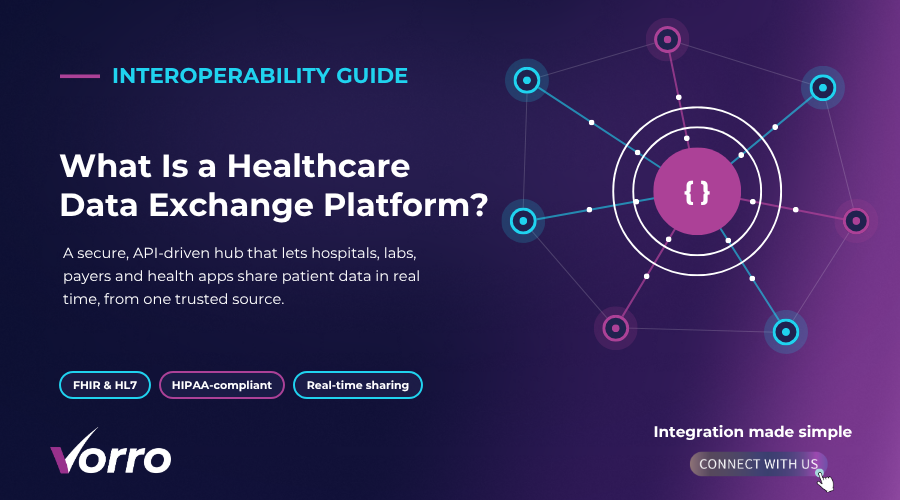
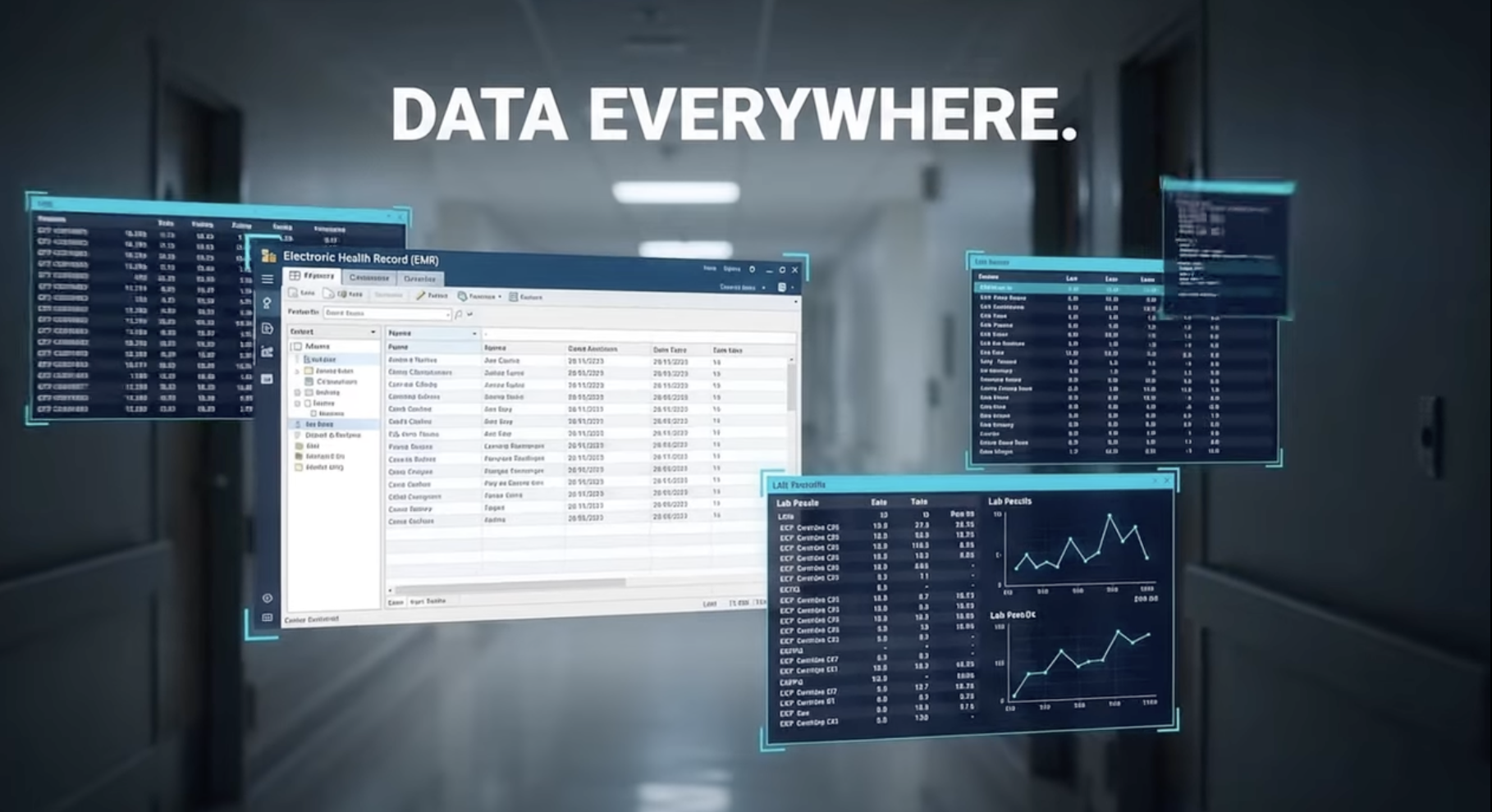
Healthcare data integration architecture is essentially the framework for deciding how your organization will share, secure, and utilize data across different systems. A fragmented architecture would mean your teams are constantly battling with interfaces, doing workarounds, and facing delays. On the contrary, a well thought out architecture ensures that each link aids clinical, operational, and financial outcomes.
Since you are at the crossroads of numerous systems, partners, and regulations, the choices you make regarding integration have a far reaching impact. The appropriate strategy is one that is founded on having clarifying architectural patterns that are in line with the enterprise goals of your business rather than vice versa.
Importance of Architecture in Healthcare Integration
Healthcare data integration architecture is more than just a technical drawing. It’s a way to set up trust, reliability, and speed for the data your doctors and staff use every day. When the data flows follow a clear healthcare system architecture, your teams are aware of the data origin, data movement, and who owns each part. Such clarity mitigates risk and fosters consistent outcomes.
An effective architecture is a good fit between data integration design patterns and business priorities. You enable quality metrics, care coordination, revenue integrity, and patient experience through consistent integration choices. You keep away from isolated connections that over time become fragile clusters of scripts and point solutions. Rather, you treat integration as an enterprise capability with shared standards and governance.
Architecture choices are also a major factor in your speed of responding to new programs or regulatory shifts. If your healthcare data integration architecture is modular, you can add new endpoints without a major overhaul. If it is stiff or unclear, each new project seems like you are doing it for the first time. Gradually, this difference increases across payers, providers, labs, and digital health partners.
Common Data Integration Architecture Patterns
Healthcare organizations typically depend on a few standard data integration design patterns to work together. Most of the time, you mix these patterns in your overall healthcare system architecture, yet each one has a main use case.
The first thing that comes to mind is point to point integration. A single source links directly with a single destination, for example, an EHR system to a laboratory system. This design seems very straightforward for only a few systems but it brings about complications as your network expands. Each new link has its own rules, formats, and error paths.
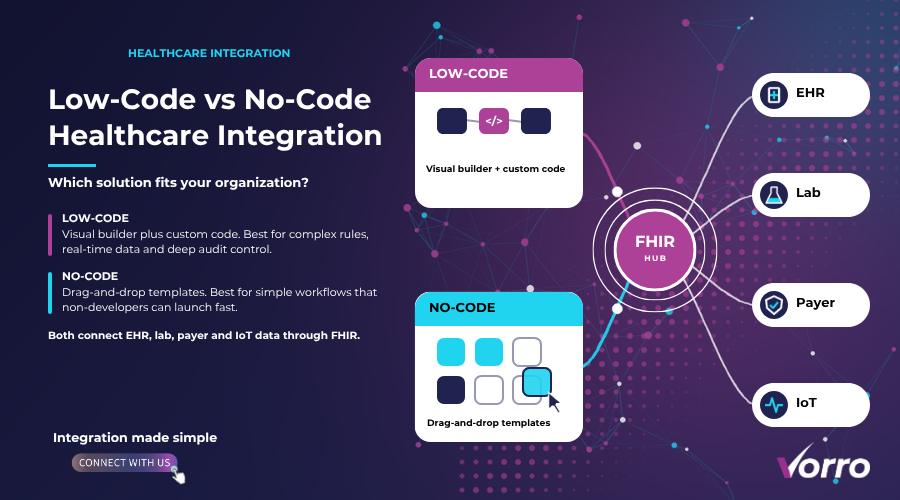
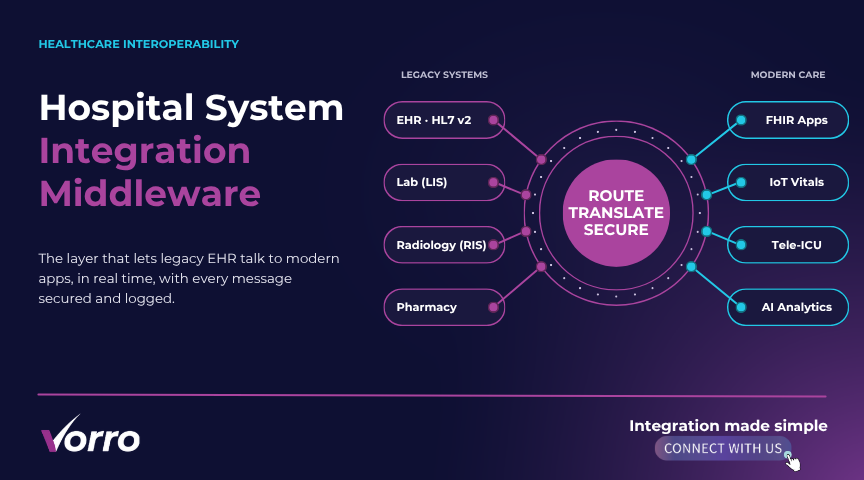
Another pattern is the hub and spoke integration. Here the central integration engine or platform becomes the hub. Systems connect to the hub rather than creating connections with each other. This gives you better control over your healthcare data integration architecture and simplifies change management as well.
The third pattern refers to data consolidation. This is where you shift data from various operational systems into a central data repository or data warehouse. Different departments such as analytics, population health, and financial reporting, take data from this single source. The integration emphasis changes from immediate real time workflow to thoroughness, quality, and traceability across different domains.
The fourth pattern is data federation or virtualization. In such a case, data stays in source systems, but users and applications get a single, unified view. You depend on integration technology to put together that view dynamically. This pattern fits with the modern scalable healthcare data architecture, particularly when your data is a mix of cloud and on, premises systems.
When you assess enterprise healthcare integration patterns, it is uncommon that you choose only one pattern. You identify the role of each pattern and then apply the same standards for security, monitoring, and governance to all of them.
Centralized vs Distributed Integration Models
Centralized integration is where the control, tooling and standards of the integration are under a single integration team or platform. In contrast, distributed integration enables each business unit or product team to independently manage their own connections. Both models significantly affect the long, term performance of the healthcare data integration architecture.
With a centralized model, you benefit from strong visibility and control. You can harmonize mapping rules, message formats, API policies, and error handling between systems. Hence, it facilitates consistent enterprise healthcare integration patterns and can substantially decrease the likelihood of repetitive work. It is suitable for organizations that prioritize tight governance, auditability, and shared services.
The downside of this governance is often manifested in the speed as perceived by the business units. These units might think that their requests for integration are getting slower as they all go through the same pipeline. As a result, to counterbalance this situation, a lot of teams decide to develop self service options on top of a centralized platform. They provide patterns, templates, and reusable components rather than constructing each interface from scratch.
In a distributed model, the individual business domains control more of their integration logic. This allows for quicker changes made close to the work process. However, eventually, you are at risk of divergence in your healthcare system architecture. Various groups choose different tools, standards, and message conventions, resulting in difficulties of support and less predictability.
The best and most feasible approach is a combination of both models. You establish the central healthcare data integration architecture, which includes main patterns, technology standards, and security rules. You also give healthcare teams the freedom to adjust and create new extensions of integrations for their requirements within that framework. Such a compromise is a great support for scalable healthcare data architecture without losing governance.
Event-Driven and API-Based Architectures
API based and event driven approaches are currently the major drivers behind the transformation of modern data integration design patterns. They are not considered as replacements of traditional message based and batch oriented workflows but rather as complements, thus co, existing with the latter.
In an event driven model, systems are free to share information by publishing events marking something significant. For example, a new hospital admission, an order being updated or patient demographic details being changed. Other systems that have subscribed to those events will get activated. This lowers the level of tight coupling, and thus, supports your healthcare systems architecture being capable of almost real time experiences.
Event driven integration is able to handle more flexible routing and scaling. Therefore, you can add new consumers of an event without changing the publisher. This pattern will cause less resistance when you add new services or analytics processes to your scalable healthcare data architecture. Besides that, it supports streaming and near real time alerting.
API based architectures depend on specific interfaces through which systems send requests or update data. APIs allow for fine granularity in data access control as well as versioning. They are in line with integrations with external partners and digital front door strategies. If you make your APIs standard in your healthcare data integration architecture, you will be enabling the reuse of APIs and minimizing your one off projects.
Several organizations choose to mix event driven messaging with APIs. Events take care of notification and decoupling. APIs are for retrieving and updating data. Combined, they establish a robust layer of your enterprise healthcare integration patterns and enhance the flexibility of clinical and business workflows.
Security and Scalability Considerations
Moreover, security must be a fundamental aspect in the design of healthcare data integration architecture rather than a mere reaction or afterthought.
The data you handle includes patient health information that is protected by law and that you exchange across systems, partners, and even regions. Therefore, for each pattern of integration, there should be a clear set of rules regarding identity, access control, encryption, auditing, and data minimization.
Centralized logging and monitoring are crucial components of such an approach. You require a thorough understanding of your message flows, API calls, and event streams. If any malfunction occurs, your teams should be able to quickly identify the location, cause, and the patients or transactions that are impacted. This level of observability enhances both security and reliability in your scalable healthcare data architecture.
The term “scalability” does not only refer to the capability of handling a higher number of messages.
It also encompasses the ability to accommodate new business models, new data domains, and new regulatory requirements.
If your healthcare system architecture is built on custom code and manual processes, then every change will require a significant amount of time and will introduce the risk of failure. On the other hand, if it is based on reusable patterns and configuration, driven integration, then changes become mere routine tasks.
For abstraction and standardization, your data integration design patterns should aim at long, term scalability.
Such patterns facilitate technical and business teams coming together to work with ease and also help in vendor and partner interoperability.
Scalability and security meet at governance. Ownership of integration assets, change control, and data stewardship is clearly defined. Then, your healthcare data integration architecture will be a reflection of the wise choices it was planned with and not a bunch of accumulated shortcuts. Gradually, this discipline is going to be a vehicle for the trust that patients have in you and it will also be a source of innovation at the enterprise level.
Vorro is a perfect partner to help you align healthcare data integration architecture with realities on the ground. Our integration platform and team are dedicated to providing a secure and scalable healthcare data architecture that integrates seamlessly with the complicated healthcare system architecture without creating any unnecessary distractions. If you are inclined to make enterprise healthcare integration patterns simpler and to use repeatable, resilient data integration design patterns as your next step, Vorro is the right partner to talk to.

Akshita is a Senior Content Writer and Marketer with over a decade of experience crafting narratives that convert, rank, and build lasting brand authority. She has worked across SaaS, FinTech, HealthTech, and Education spaces, delivering everything from HIPAA-compliant medical content to multilingual campaigns for the International Labour Organization, United Nations. Her content has reached audiences across the globe, and she has worked for Fortune 500 brands, global agencies, and startups alike. Fluent in English, Spanish, and German, Akshita brings a rare cross-cultural edge to brand communication. A literature graduate from Delhi University, she balances strategic thinking with a storyteller's instinct, but when she isn’t architecting content roadmaps, she channels her creativity into poetry and painting or dedicates her time to caring for stray animals - pursuits she credits for making her a more empathetic and perceptive communicator.