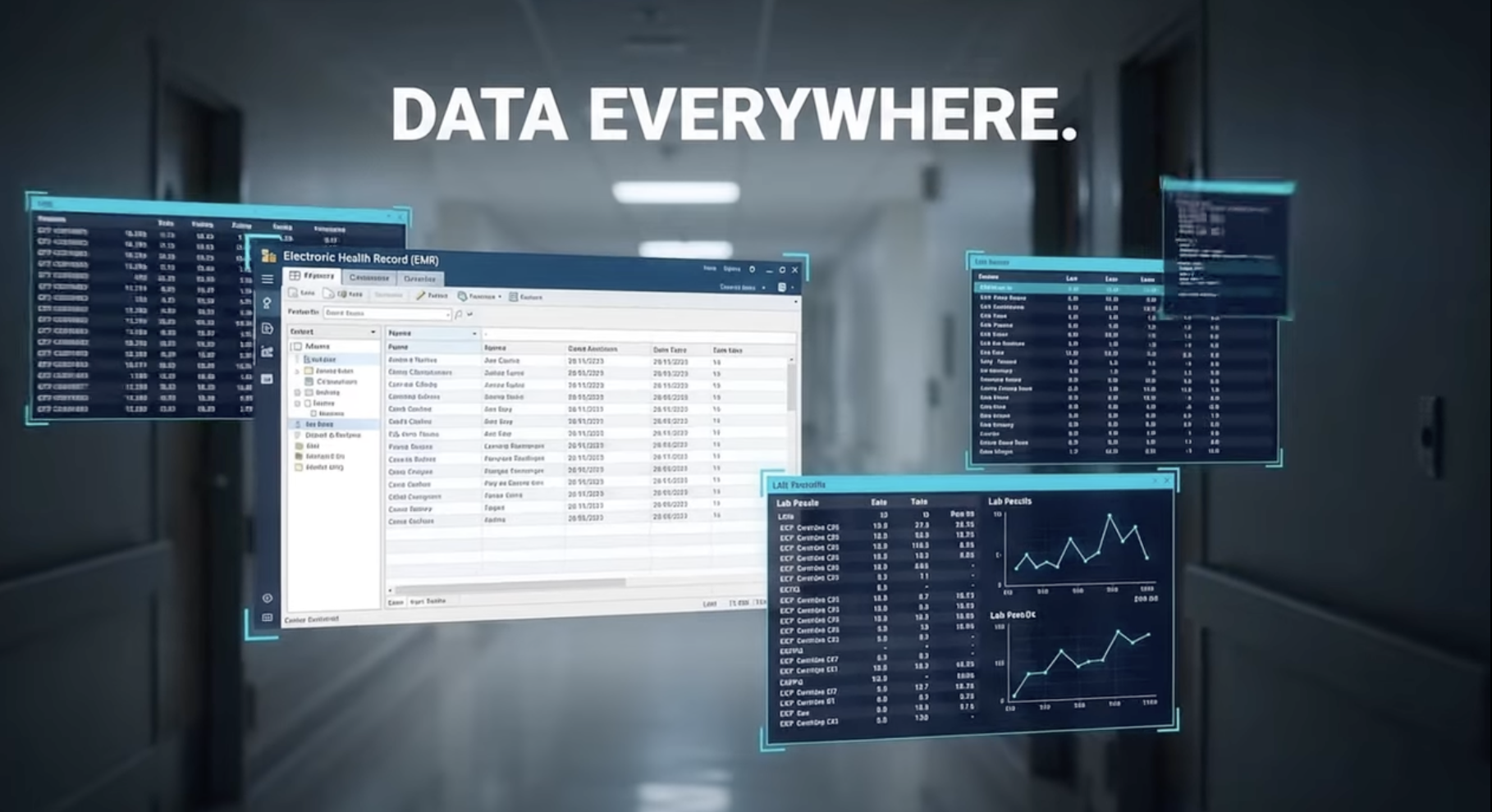
On the way to a fully digital ecosystem, healthcare executives have to face a cruel truth: we have already spent billions on digitizing medical records and yet the result is just a huge amount of “dumb data”. As a Healthcare CIO in 2026, you would be managing a landscape broken into pieces where clinical data worth 70% is still not getting used because the data is kept in proprietary format or siloed legacy systems. The “data silos” of the past are still there; only that they have changed location and are now in the cloud.
Real healthcare data transformation is no longer a thing that the most prestigious academic medical centers can afford, it is a minimum requirement for a company to survive in the market. Given the fact that the average cost of a healthcare data breach now exceeds $7.4 million and the advent of the “Agentic AI” that requires high-fidelity inputs, the stakes for your healthcare data architecture have gone up to a record level. You are not merely maintaining servers; you are the designer of a living and breathing information organism that has to be capable of supporting clinical decision, making in real, time, predictive staffing models, and personalized patient journeys.
In this strategic guide, we will go beyond the buzzwords to outline a comprehensive healthcare data integration framework. We will discuss how to develop a robust enterprise healthcare data platform that not only serves as a repository of information but also converts it into a valuable asset at the strategic level.
What is an Enterprise Healthcare Data Transformation Framework?
Essentially, a transformation framework is the “master plan” which changes the way your organization reacts to data storage to being ahead of the game with intelligence. It serves as the link between your raw clinical inputs (e.g., EHRs, labs, medical devices) and your valuable outputs such as predictive analytics and AI.
Without a proper framework, healthcare data modernization will be a chain of costly, isolated trials. A framework is the guide for healthcare data standardization, making sure that every piece of data from your 20+ facilities is compatible.
The Evolution of the Healthcare Tech Stack
We are no longer in the age of “Single Source of Truth” (the monolithic EHR), but in the epoch of the “Distributed Data Fabric.” The composition of your architecture has to be:
- Hybrid cloud realities: the key to balancing security of on, premise legacy systems with the power of scalability of the public cloud.
- Semantic interoperability: not just “moving data” but making sure that a “blood pressure” measurement in your outpatient clinic will be understood in the same way in your ICU.
- Real-time data liquidity: moving away from batch, processed reports that are 24 hours old to event, driven streams that deliver insights in milliseconds.
How to Build a Scalable Healthcare Data Integration Framework?
Designing for scale essentially means preparing your system for the unknown. The architecture you create should be sturdy enough to efficiently process the 152 billion gigabytes of data that industries are expected to generate annually by 2027, meanwhile, it must be nimble enough to allow the integration of a new AI model next week.
The 4 Pillars of a Modern Framework
- Strategic Alignment: Data projects cannot be mere experiments but must directly contribute to clinical or operational Key Performance Indicators (KPI). For example, the goal might be to lower 30-day readmissions by 15%.
- Robust Governance: This could be as simple as designating data stewards who would be accountable for defining the key entities like “Patient” and “Provider”.
- Automated Data Ingestion: This means rejecting the traditional practice of custom, coded ETL (Extract, Transform, Load) in favor of zero-code, automated workflows designed for easy use.
- API, First Connectivity: Leveraging FHIR and RESTful APIs to guarantee that your enterprise healthcare data platform remains modular and vendor-agnostic.
Why is Healthcare Data Standardization the “Hard Part”?
Every CIO knows that the technology is the easy part; it’s the semantics that break us. Healthcare data standardization refers to uniting various “dialects” of health data to a single vocabulary such as LOINC, SNOMED, CT, or RxNorm.
If you don’t standardize your data, your healthcare data transformation is only shifting the garbage from one bucket to another. Thus, suppose your cardiology department references an “ECG” and your primary care clinic uses the term “EKG.” In that case, an AI model hunting for heart disease might miss half the signs.
The Benefits of a Standardized Model
- Improved Diagnostic Accuracy: Besides, your AI models can only be as good as the data they get. For example, AI models trained on standardized data have shown up to an 11% improvement in detecting conditions like breast cancer compared to traditional methods. Also,
- Reduced Clinician Burnout: Standardized data flows enable better “ambient” documentation tools, which can help clinicians save up to 20% of their charting time.
- Effortless Regulatory Compliance: Achieving CMS interoperability mandates will become a natural outcome of your infrastructure instead of being a stress-driven project.
How to Execute Healthcare Data Modernization Without Disrupting Care?
The era of “rip and replace” is behind us. Modernization should be a “bridge and migrate” type of strategy. You can’t just shut down the EHR while you are fixing the plumbing.
A Phased Roadmap for Success
- The Inventory Phase: Discover your “dark data” and leftover silos. A system that has been around for more than 10 years is generally a modernization candidate.
- The Layering Phase: Add a middleware layer, a healthcare data integration framework that sits on top of your existing systems to access and convert data on the fly.
- The Consolidation Phase: Slowly move legacy data marts into a central “Data Lakehouse” where structured and unstructured data (e.g., radiology images and physician notes) can coexist.
- The Activation Phase: Give your clinical teams the power of self, service analytics, and AI-driven decision support tools.
What are the Real-World Outcomes of a Transformed Data Strategy?
Let’s look at the example of a big multi-state health system that decided to use a single enterprise healthcare data platform. Surgery scheduling was automated by adding a real-time AI layer, which led to a 35% increase in planning accuracy and a 21% decrease in staff overtime.
A case in point, a system which used an integrated data approach for managing the revenue cycle revealed a $13, 000 increase in reimbursement per clinician. They achieved this simply by making sure that clinical data was accurately coded and that the billing system received it without manual intervention. This is not just “IT work”; it is the financial and operational lifeblood of the organization.”
You don’t build a data-driven culture in the server room; you build it at the bedside when a clinician sees an alert they really trust.”
Conclusion: The Path to Intelligent Care
The road to healthcare data transformation is a long, distance running, not a short one. In your position as a CIO, you are aiming to establish a base that is “AI-ready” now and “future-proof” later. Concentrating on a standardized, integrated healthcare data architecture means that you are not only enhancing IT metrics, but also constructing a safer, more efficient, and more human healthcare experience.
Key Takeaways for the CIO:
- Focus on Outcomes: Begin by identifying the clinical or financial problem that you want to fix, rather than the tool.
- Standardize or Fail: Data without shared semantics is merely noise; therefore, you should make a significant investment in terminology services.
- Embrace the Hybrid Cloud: Keep your core legacy systems on-premises securely while leveraging the cloud for analytics and AI.
- Automate the Plumbing: Keep your highly-paid analysts from spending 80% of their time on data cleaning by providing them with an automated integration framework.
- Build for Trust: If the information underpins data-driven tools that are found to be consistently accurate and timely, only then will clinicians use those tools.
We at Vorro specialize in the “heavy lifting” of healthcare data transformation. Our BridgeGate platform has the capacity to solve the most complicated integration problems and makes it possible for your fragmented legacy systems to be an AI, ready unified enterprise. We are the ones who get you bridging the chasm between your data’s current location and its destination.
Is your data architecture ready to handle the volume of 2026? Get in touch with our team today if you want to find out how our framework can speed up your modernization journey.
Frequently Asked Questions
Q1. What is the difference between a data warehouse and a data lakehouse in healthcare?
A traditional warehouse is very effective for structured, historical reporting but it is not flexible. A ‘Lakehouse’ blends the features of a warehouse and a data lake. It gives you the possibility to keep raw images, notes, and structured EHR data all in one enterprise healthcare data platform that you can use for both BI and AI.
Q2. How does healthcare data standardization impact patient safety?
Standardization guarantees that vital information like allergies, medications, lab results gets communicated accurately, no matter the care setting. And thus patients are less likely to encounter medical errors that are the result of ‘mismatched’ data, e.g., when they go from a doctor’s office to an emergency room.
Q3. What is the “Integration Tax” and how do I reduce it?
The ‘Integration Tax’ refers to the overextended hours and costs your IT team is subjected to when they have to build and maintain fragile, single-purpose, point-to-point connections. One way you can get rid of this problem is by implementing a centralized healthcare data integration framework that relies on standard APIs and automated workflows.

Akshita is a Senior Content Writer and Marketer with over a decade of experience crafting narratives that convert, rank, and build lasting brand authority. She has worked across SaaS, FinTech, HealthTech, and Education spaces, delivering everything from HIPAA-compliant medical content to multilingual campaigns for the International Labour Organization, United Nations. Her content has reached audiences across the globe, and she has worked for Fortune 500 brands, global agencies, and startups alike. Fluent in English, Spanish, and German, Akshita brings a rare cross-cultural edge to brand communication. A literature graduate from Delhi University, she balances strategic thinking with a storyteller's instinct, but when she isn’t architecting content roadmaps, she channels her creativity into poetry and painting or dedicates her time to caring for stray animals - pursuits she credits for making her a more empathetic and perceptive communicator.