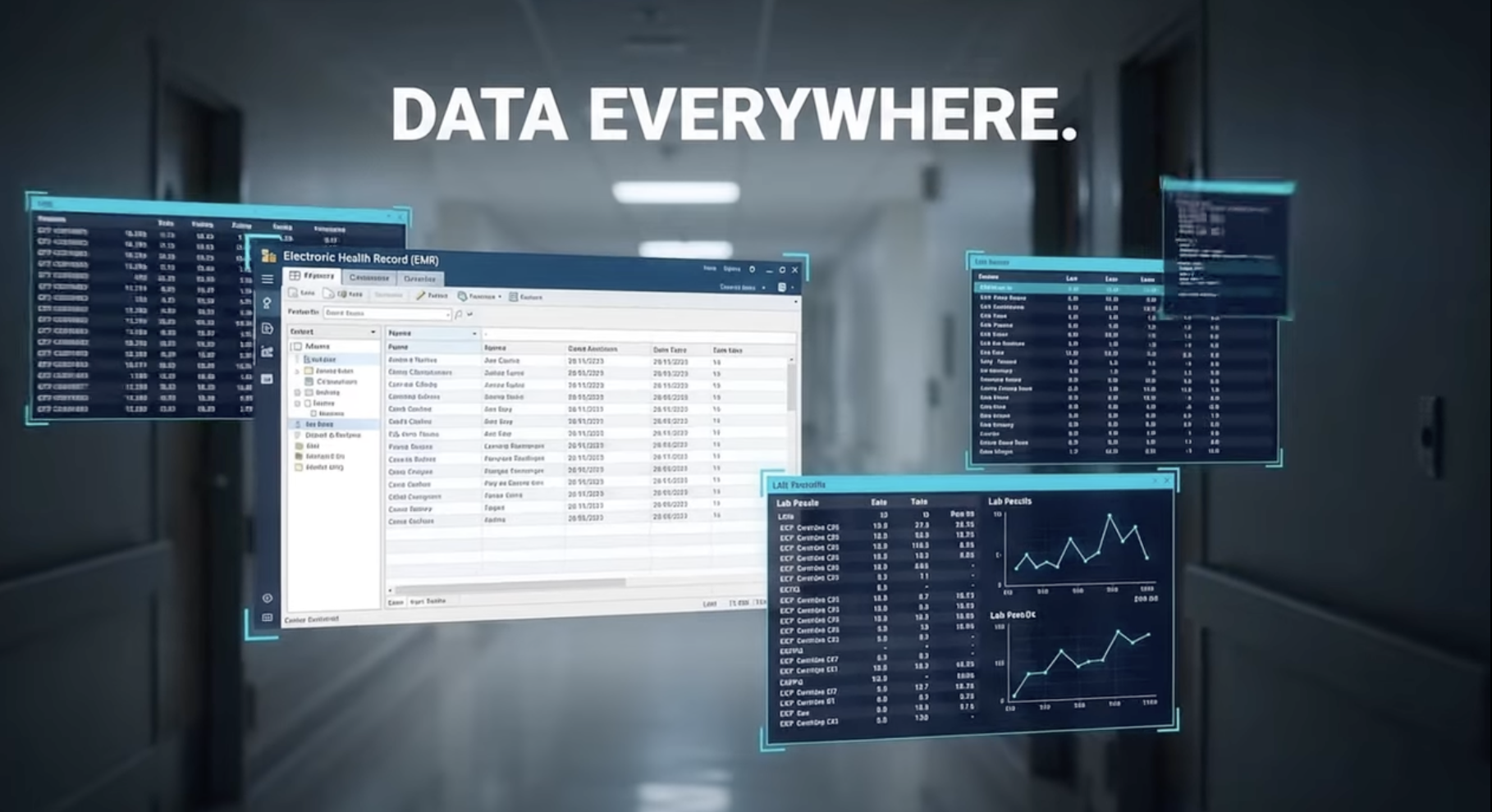
The modern health system has evolved beyond merely a collection of buildings; it is now a large, digital ecosystem that literally ‘breathes’ data. However, for many Healthcare CIOs, this ‘breath’ sounds more like a feeble gasp. Even after investing billions in digital transformation, almost 70% of healthcare data is still locked away in silos or formatted in such a way that it is nearly impossible to use it in real, time. Here, FHIR data integration is not just a technical ‘nice, to, have’ but a survival necessity.
By 2026, it will be obvious that the directive is to cease creating point, to, point connections that will become faulty as soon as a vendor updates its API. A strong, healthcare data integration architecture is required that will allow data to be considered as a fluid asset rather than a static record. Moving to the Fast Healthcare Interoperability Resources (FHIR) standard is more than just Federally mandated compliance; it is a step toward a foundation for the next decade of clinical innovation, AI deployment, and patient engagement.
In this thorough guide, we are going to explore the process of moving beyond simple connectivity to a genuinely scalable healthcare data systems strategy. Additionally, you will find out how to organize your internal framework so that it can cope with huge data inflows without compromising speed or security.
What Is a Scalable FHIR Integration Framework?
Understanding a scalable FHIR integration framework requires us to think of it more than a mere translator. Previously, HL7 v2 messages were like sending a physical letter. The letters came, but you had to open the envelope and manually file the contents.
FHIR revolutionizes this by harnessing modern web technologies (RESTful APIs) that enable systems to “query” only those data points that are of interest, like a single lab result or a specific medication list, without needing the entire medical record. A truly scalable architecture isn’t just about passing these resources along; it is about managing them.
This is done through a layer of orchestration capable of handling thousands of concurrent requests from mobile apps, partner hospitals, and internal analytics engines, etc.
The Pillars of Scalable Design
- Resource Granularity: Instead of large monolithic data transfers, you fetch only what is necessary.
- Elasticity: The capability of scaling the compute resource up during the peak hours (like morning rounds) and scaling it down when the activity is low.
- Standardized Semantics: Making sure that the term “Blood Pressure” has the same meaning in your outpatient clinic as it does in your ICU.
Why Is FHIR Interoperability Architecture Critical for CIOs?
As a CIO, your standing depends mainly on how reliable and secure your data pipeline is. A major characteristic of legacy systems is brittleness. When you put in place a formal FHIR interoperability architecture plan, you are practically putting in a “universal adapter” for the whole enterprise. This ultimately limits the technical debt that is generated each time you add a new digital health tool to your ecosystem.
The argument based on economics is just as strong. The companies that have shifted to a unified healthcare data interoperability strategy have shared that they have greatly reduced the “integration tax”, which is the time and money used just to get two systems to communicate. In a world with diminishing margins, getting back 30% of your IT staff’s capacity from manual mapping is a huge success.
Driving Clinical Outcomes
- Reduced Latency: Clinicians are able to access the necessary data in seconds rather than minutes.
- Accuracy: Automated mapping helps to eliminate human errors that may occur during manual data transcription.
- Future Proofing: With no need to redo your core infrastructure, you can simply add new AI models or remote monitoring tools.
How to Build a Modern Healthcare Data Integration Architecture?
Building for scale is a whole different ball game in terms of changing your habits. It requires moving away from a “projects” mindset and looking at “platforms” instead. So, in a way, you’re no longer just completing an integration; you’re also running a continuous information highway.
Step-by-Step Implementation Strategy
- Establish a Data Governance Foundation: Decide and communicate the ownership of the FHIR resources and the versioning methodology.
- Implement an API Gateway: This is like your security guard at the gate, handling security, rate limiting, and authentication.
- Use a Canonical Data Model: In case your source systems are not FHIR, make sure they are converted into a standardized internal format right at the beginning of the pipeline.
- Decouple Storage from Access: Your analytics group should not be going directly to your production EHR database. A FHIR server can be used to cache and serve data.
What Are the Challenges in Healthcare Data Interoperability?
However, the journey is not entirely free of challenges despite the obvious benefits. One of the major issues faced in healthcare data interoperability is “version sprawl”. Since FHIR is constantly being updated, different vendors might be supporting different versions (DSTU2 vs. R4 vs. R5).
Common Roadblocks and Solutions
- Old Systems Resistance: Legacy systems generally do not support FHIR. Employ a middleware “wrapper” to interpret legacy HL7 or flat files into FHIR resources.
- Identity Management: It is a big challenge to guarantee that the “John Smith” in System A is the same “John Smith” in System B. A strong Master Patient Index (MPI) is essential.
- Data Quality: Even FHIR cannot help if the input is “garbage.” You should have automated validation checks to maintain data accuracy before it gets into your scalable framework.
Real-World Case: Scaling During a Merger
A large health system had come under one roof by acquiring three smaller regional hospitals, each with a different EHR. The CIO decided to go with a healthcare data transformation layer that converted all the incoming data into FHIR resources rather than a multi-year “rip and replace” strategy.
They could provide “a unified clinician view” across all the sites within six months only by adopting a cloud-based healthcare data integration architecture. The cost was 40% less than a total EHR consolidation, and they kept 99.9% uptime during the transition. This is the power of a scalable approach; it is growth without the usual growing pains.
How to Ensure Security in Scalable Healthcare Data Systems?
Security in a FHIR, based setting changes the game. We no longer rely on “perimeter security” (the hospital firewall), but we are shifting to “data-level security.”
Security Best Practices
- OAuth2 and OpenID Connect: Make use of these industry standards for secure authorization.
- Audit Logging: FHIR is equipped with an “AuditEvent” resource. Take advantage of it. You need to identify who accessed which resource and at exactly what time, down to the millisecond.
- Encryption at Rest and in Transit: This is just the baseline. In order to have a scalable healthcare data system, you have to confirm that your encryption methods are efficient and do not become a bottleneck for data flow.
Conclusion: Leading the Interoperability Revolution
The transition to FHIR data integration represents more than a mere technical upgrade; it is a strategic healthcare enterprise repositioning. CIOs who decide to implement a modular, scalable architecture will see themselves capable of adopting new technology from AI, driven diagnostics to hospital, at, home models quicker than their competitors.
Key Takeaways:
- Think Platform, Not Project: Construct a framework that can expand with your organization.
- Standardize Early: Keep FHIR as your internal “lingua franca” to lessen the complexity.
- Prioritize Performance: Make sure your architecture is capable of fulfilling present medicine’s high-velocity data requirements.
- Focus on the Clinician: A doctor making a decision is still the last link of every data pipeline; therefore, ensure that the data is quick, correct, and relevant.
Vorro realizes that the future is inseparably linked with clean and accessible data. Our products are aimed at unraveling the FHIR data integration intricacies so that you can spend more time on patient care. We guide you in converting the “data gasp” into a regular and reliable pulse.
Are you sure your data architecture can take storage at the next level? We can talk about how to cut down your integration journey here.
Frequently Asked Questions
Q1. What would you say is the primary benefit of FHIR compared to HL7 v2?
It could be said that HL7 v2 is a messaging standard that exchanges entire documents. On the other hand, FHIR is a resource-oriented standard that breaks down the data into resources. This facilitates more accurate data retrieval through APIs and makes FHIR very suitable for mobile apps and modern, scalable healthcare data systems.
Q2. What is the role of a FHIR integration framework in relation to handling legacy data?
Generally, a FHIR integration framework that is properly set up implements a transformation layer. This layer functions quite similarly to an interpreter as it takes the old-fashioned data formats such as HL7 v2 or CCDA and converts the content to the language of FHIR resources. This way, the old data doesn’t get left behind in the new interoperable workflows.
Q3. Can we say that FHIR has brought about an improvement in data security?
Certainly, by using up, to, date web security mechanisms like OAuth2. To compare to older standards, FHIR is an approach that makes it possible to have “granular” security, i.e., you can give access to certain parts of the data (such as immunizations) without having to reveal the patient’s entire record.

Akshita is a Senior Content Writer and Marketer with over a decade of experience crafting narratives that convert, rank, and build lasting brand authority. She has worked across SaaS, FinTech, HealthTech, and Education spaces, delivering everything from HIPAA-compliant medical content to multilingual campaigns for the International Labour Organization, United Nations. Her content has reached audiences across the globe, and she has worked for Fortune 500 brands, global agencies, and startups alike. Fluent in English, Spanish, and German, Akshita brings a rare cross-cultural edge to brand communication. A literature graduate from Delhi University, she balances strategic thinking with a storyteller's instinct, but when she isn’t architecting content roadmaps, she channels her creativity into poetry and painting or dedicates her time to caring for stray animals - pursuits she credits for making her a more empathetic and perceptive communicator.