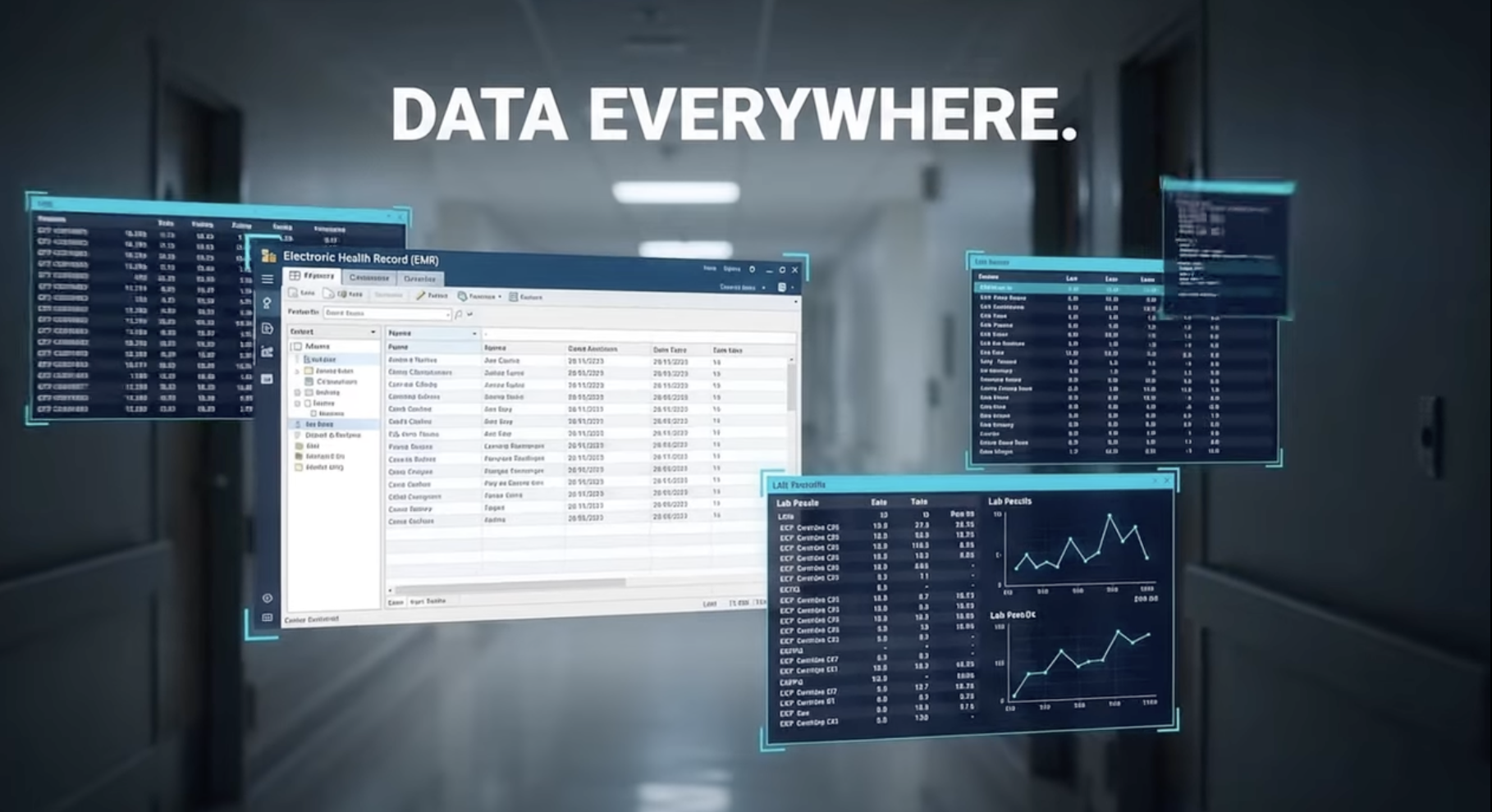
Interoperability of healthcare data is the focal point of all digital health strategies. You are under the pressure of doctors, management, and insurance companies. Each group wants to get a full set of data, accurate, and delivered on time. However, your systems do not communicate with each other, they use different data formats, and they have different workflows.
The problem is not that you need more data. What you need is integrated data that you can base your decisions on. By aligning healthcare data interoperability to unambiguous outcomes, you make it easier for clinicians to work, automate the processes and thereby, lead to better decisions everywhere in the corporation.
Why Healthcare Data Interoperability Matters
Healthcare data interoperability connects clinical, operational, and financial workflows.
When your systems are interoperable, every patient visit, order, and result seamlessly follow the care process without manual rework. Hence, you eliminate blind spots vis, a, vis clinical history, coverage, and prior services.
Healthcare data interoperability minimizes the cognitive load of clinical teams. They get to see the latest medications, allergies, labs, and notes in one go. They are not required to go after previous records or depend on partial snapshots.
Interoperability for payers and value, based teams means fewer disputes and delayed refunds. Well, structured, consistent data accelerates eligibility, risk, quality measures, and care management processes.
For IT and data leaders, healthcare data systems interoperability is a great enabler of growth. You can bring new applications, analytics tools, and partners on board without having to rework interfaces. Your architecture is a facilitator of change, not a barrier.
Challenges in Healthcare Data Interoperability
You are already aware that interoperability of healthcare data is a crucial aspect. The tricky part is in the specifics. Various standards, legacy systems, and uneven vendor support continuously try to pull you in different directions.
You are dealing with inconsistent identifiers across the facilities and lines of business. Patient, provider, and location keys vary among EHR, practice management, lab, and claims systems. Hence, record matching becomes unstable, and the downstream analytics end up getting affected.
You use a combination of protocols and formats. Older feeds are dependent on flat files and custom layouts. At the same time, newer tools are equipped with FHIR APIs, event streams, and proprietary schemas. Every single interface demands special treatment.
You are always updated with current regulatory and partner requirements. New initiatives introduce new value sets, new quality measures, and new reporting requirements. The perpetual struggle of keeping each integration in compliance with the latest regulations is exhausting the internal teams.
When there is no well, defined plan for healthcare data standardization and healthcare data integration, every new use case inevitably brings in additional complexity. The technical debt accumulates, and your team is increasingly engaged in maintenance tasks rather than working on innovation.
Role of Healthcare Data Standardization in Interoperability
Healthcare data standardization provides you with a common language. It is not a silver bullet, but it lays the groundwork for dependable exchange and reuse.
Standardization is initiated with fundamental structures. It is agreed upon that consistent models are used for patients, encounters, orders, results, and claims. Fields, code systems, and value sets are aligned so that each data element is unambiguously defined.
You specify and implement standardized vocabularies for diseases, operations, drugs, and tests. You harmonize status values, units, and reference ranges. When all parts of a system record data in a uniform manner, subsequent services are able to interpret it correctly.
Healthcare data standardization even applies to business rules. You specify the beginning and ending of encounters, how you document the primary provider, and the handling of telehealth visits. You make reporting and analytics clear by removing ambiguity.
Through a robust standard layer, you are not forced to come up with custom mappings for every new partner. It is from source formats that you translate into your standard model, not from each source to every destination. Hence, that change lessens both the amount of work and the risk.
How Healthcare Data Integration Enables Interoperability
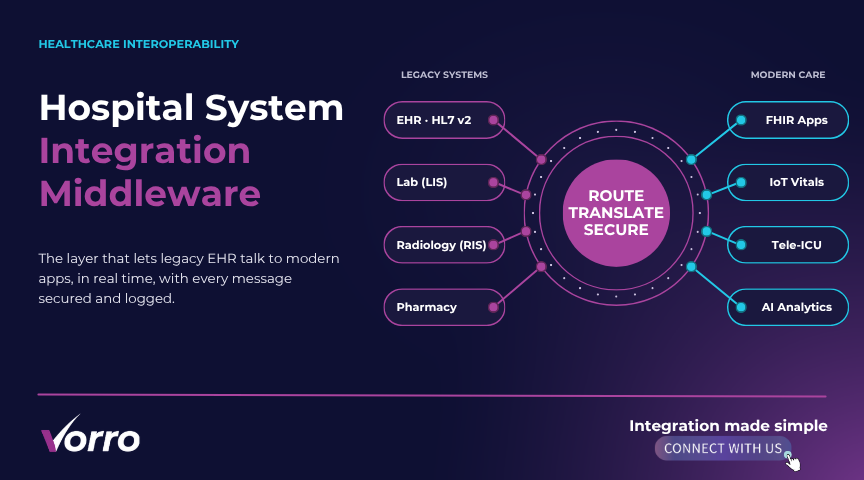
If standardization sets the vocabulary, healthcare data integration is the one that facilitates the implementation of that vocabulary. Integration is the method through which data is moved, changed, and coordinated between different systems, thus ensuring that your standards are embedded into every workflow.
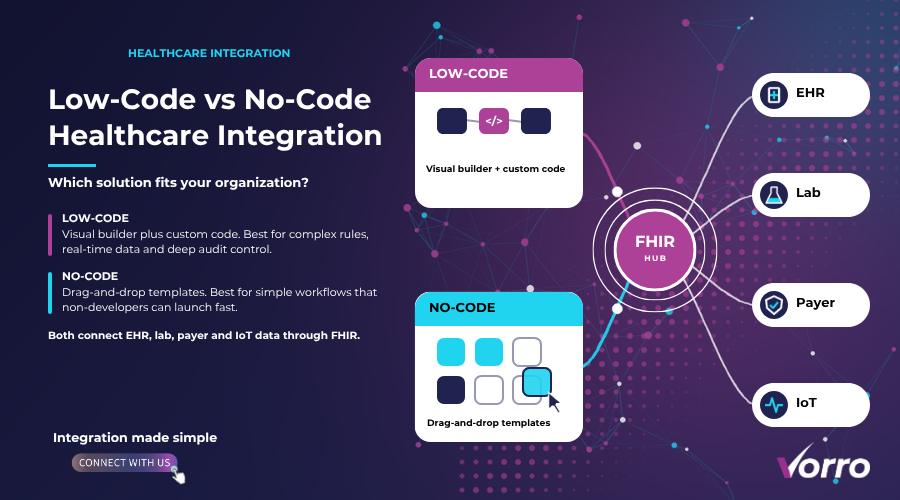
Robust healthcare data integration allows various patterns to coexist. Some scenarios require immediate or near immediate updates. On the other hand, some scenarios require a reliable batch or scheduled processing. A flexible integration layer can support both without having separate stacks. You establish canonical models and then set up mappings from each source to those models. The integration platform carries out validation, enrichment, and routing. It identifies exceptions before they go into the main systems. An integration layer that is carefully planned allows you to disentangle business logic from transport.
Your healthcare data interoperability strategy remains strong even when vendors change, partners merge, and new tools are introduced. The outcome is a well, defined path from data acquisition to data utilization. Through thoughtful healthcare data integration, systems that were never designed to be compatible with each other now support shared workflows.
Interoperable Healthcare Data Systems and Data Exchange
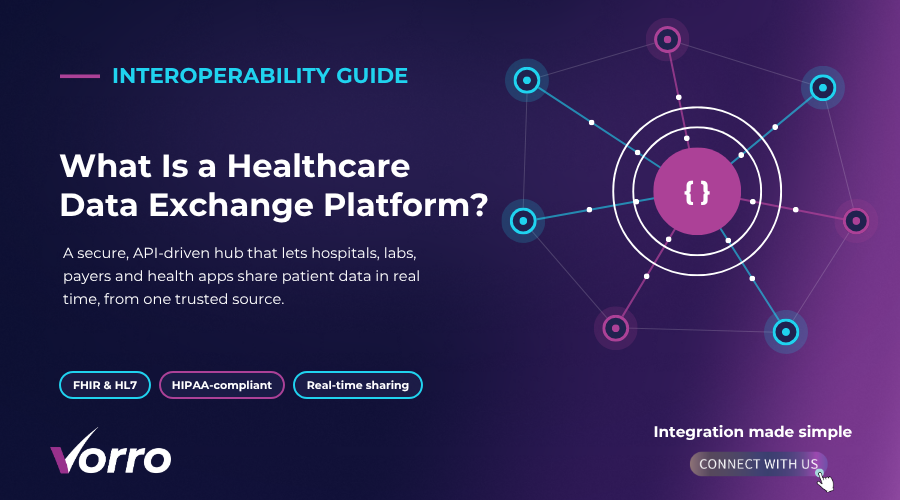
Interoperable healthcare data systems are only going to work if there is a consistent, well, regulated data exchange. Thus, you stop relying on isolated point, to, point feeds and treat your integration layer as shared infrastructure.
To begin, you choose the data domains whose information you want to be accessible at the enterprise level. Patient demographics, encounters, clinical documents, medications, labs, claims, and authorizations are some of the common starting points. Each domain should have a clear ownership and stewardship model.
Then, you set up rules for healthcare data exchange. APIs allow for real, time queries. Message queues enable event, driven workflows. File or bulk transfers are used for high volume historical loads and partner feeds. Your standards remain unchanged while the means of transport can be varied.
Along with interoperable healthcare data systems, the security and privacy of the data are also a priority. Identity, access control, and audit logging are components included within the integration layer and not just added on as an afterthought. You can identify who accessed what data, from where, and for what purpose.”
Whenever you get new applications or trading partners, you simply integrate them into the same governed exchange patterns. Such uniformity not only speeds up onboarding but also limits the generation of one, off solutions.
Clinical Data Interoperability: Key Use Cases
Clinical data interoperability has the potential to directly support and bring about measurable, quantifiable outcomes. You identify use cases and your business and clinical priorities, then organize and lay out your roadmap in phases accordingly.
A unified clinical view is one of those use cases at the very core of your work. When clinicians obtain access to the complete history that goes across EHRs, labs, and other care settings, all within a single workflow, it implies a very high level of real, time care coordination and decision making.
Healthcare data interoperability therefore acts as a bridge to smoothly integrate and merge those various sources into one coherent patient record, and the clinician will not have to waste time on double documentation. Referrals, discharge summaries, and care plans are just a few examples of document types that are exchanged between organizations through healthcare data exchange. It means that receiving teams are familiar with the context even before the visit and thus they are better prepared to see the patient rather than them seeing it afterwards.
Clinical decision support is another area, which is very much dependent on clinical data interoperability for its data backbone. In fact, rules engines and predictive models cannot perform well without consistent inputs. If you supply them with data which has been standardized and harmonized, you are actually lowering the level of false alerts and improving quality based on signal.
Population health, quality reporting, and various value, based care programs also stand to gain drastically from clinical data interoperability. On the one hand, when clinical data is aggregated and standardized, there is less need for reconciliation amongst registries, payers, and reporting agencies.
Healthcare Data Harmonization for Seamless Interoperability
Healthcare data harmonization is the next step after you standardize and integrate. You get the data in different formats from different sources. Harmonization is following the formats and the contents of a data architecture to the ones of a single data architecture so that the data then can be used equally well for both operations and analytics.
Harmonization is a process of reconciliation of differences in code systems, units, time zones, and identifiers. Through the use of mapping, normalization, and enrichment, you ensure that downstream systems are interacting with a clean, unified layer.
You also make use of longitudinal logic. You are able to connect encounters, results, and claims to the right patient and provider over time. That activity is making a clinical story out of a number of events happening once, individually, and separately.
Healthcare data harmonization is quite important for trust. If clinicians and data scientists find that data consistently behaves, they will base their decisions on that data. When partners get harmonized feeds, the integration friction is reduced.
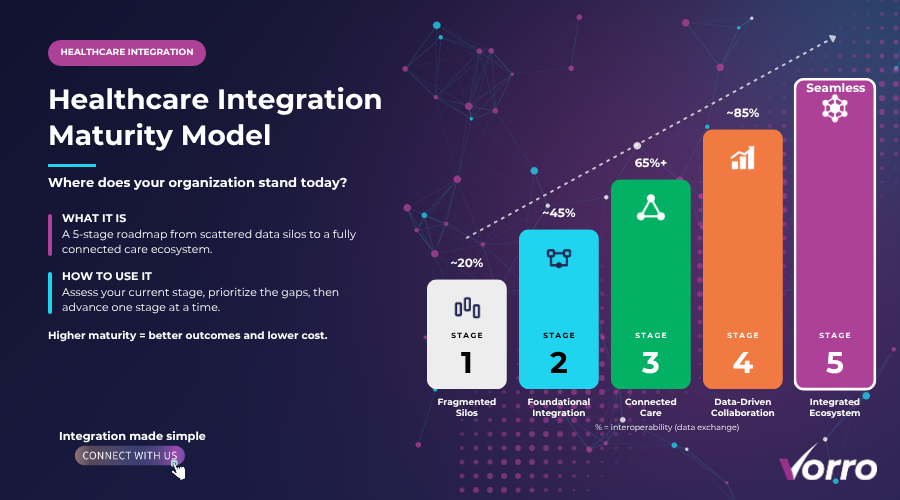
With an appropriate approach, healthcare data interoperability is a consistent capability rather than a series of unrelated projects. Standardization, healthcare data integration, interoperable healthcare data systems, healthcare data exchange, and clinical data interoperability, all merge into one operational fabric.
Vorro is here to help you construct such a fabric using a purpose built interoperability and integration platform focused on healthcare data harmonization, high quality exchange, and real clinical outcomes.
When you are geared up to make healthcare data interoperability simple and scale your connected health strategy, collaborate with Vorro to establish your next generation interoperability base.

Akshita is a Senior Content Writer and Marketer with over a decade of experience crafting narratives that convert, rank, and build lasting brand authority. She has worked across SaaS, FinTech, HealthTech, and Education spaces, delivering everything from HIPAA-compliant medical content to multilingual campaigns for the International Labour Organization, United Nations. Her content has reached audiences across the globe, and she has worked for Fortune 500 brands, global agencies, and startups alike. Fluent in English, Spanish, and German, Akshita brings a rare cross-cultural edge to brand communication. A literature graduate from Delhi University, she balances strategic thinking with a storyteller's instinct, but when she isn’t architecting content roadmaps, she channels her creativity into poetry and painting or dedicates her time to caring for stray animals - pursuits she credits for making her a more empathetic and perceptive communicator.