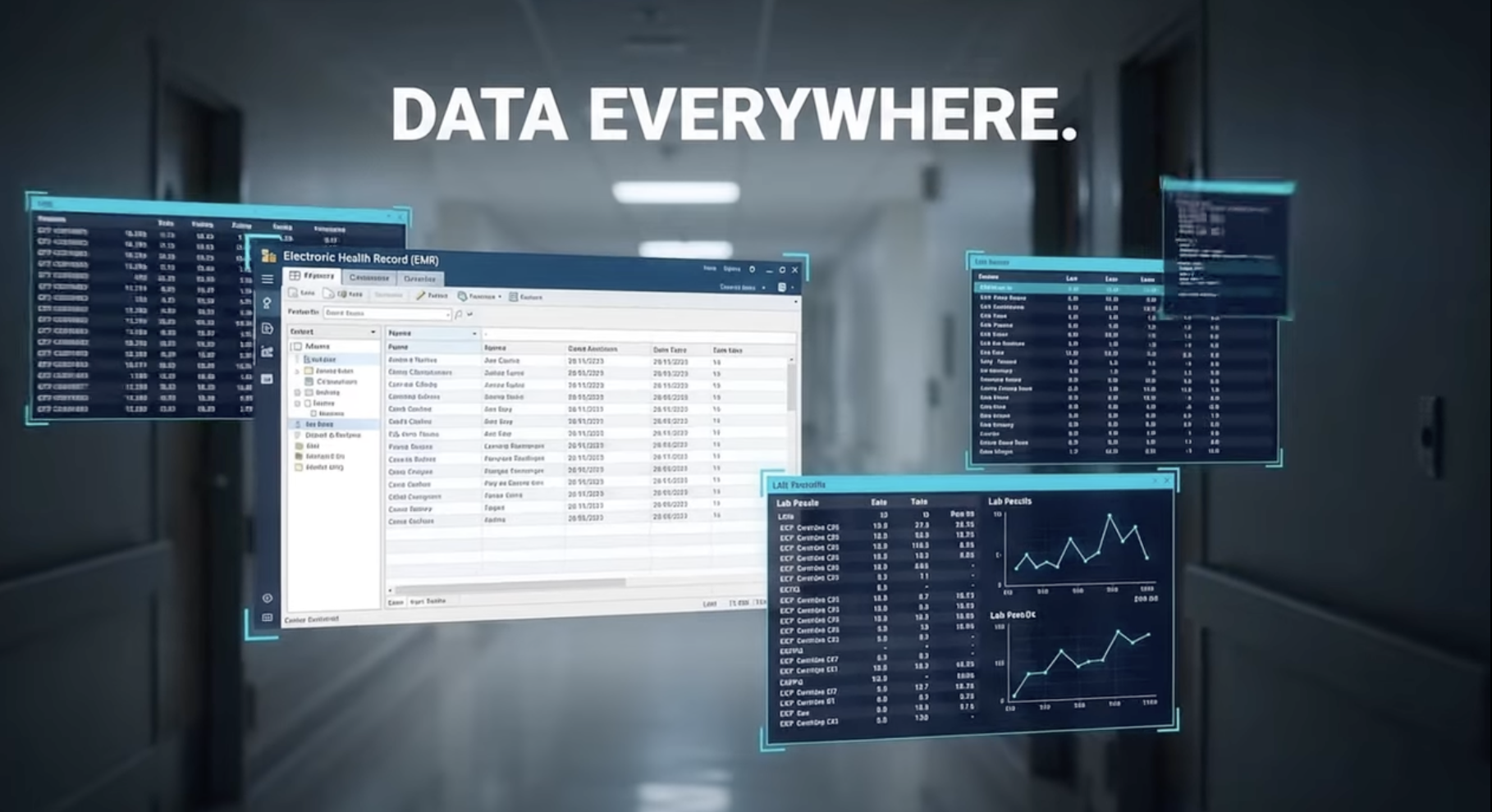
You’re constantly under pressure to provide accurate healthcare reporting while having limited time, old systems, and scattered clinical data. Every report seems to give you a run, around of different formats, interfaces, and manual steps. Unified data for healthcare reporting is like an escape path from the tangle, leading to cleaner inputs, shorter cycles, and reporting you can rely on.
Every deadline turns into a crisis when your different systems don’t communicate. And metrics always seem to open up more questions when your data is kept in separate silos. You need a way to gather everything into one consistent, governed, and reusable source of truth. Unified data for healthcare reporting gives you that base.
This method brings together your clinical, financial, operational, and patient experience data into one, single, consistent model. You experience faster reporting, fewer mistakes, and more robustness in every decision you make.
What Is Unified Data in Healthcare
Unified data in healthcare means a single, synchronized version of information from all your systems, harmonized to a common structure and understanding. Rather than extracting data separately from each point, you use one single, trusted layer that takes care of healthcare data integration for reporting in a uniform manner.
Such a unified layer generally comprises data from:
- Systems of EHR and EMR
- Laboratory and imaging devices
- Pharmacy and medication systems
- Revenue cycle and claims systems
- Patient engagement and portal tools
Integrated healthcare data takes these inputs and turns them into a common standard model with shared definitions for patients, encounters, providers, procedures, and outcomes. Codes and formats match. Identifiers are fixed throughout different systems. You no longer have to reconcile basic elements every time you create a report.
Unified data for healthcare reporting is more than just one database. It is about a robust data integration framework that automates mappings, translations, and validations, thus allowing the reporting teams to focus on the analysis rather than the technical details.
Why Unified Data Matters for Healthcare Reporting
When there is no centralized data, the reporting team members have to spend almost all their time piecing together different extracts, reconciling unmatched fields, and fixing mistakes at a later stage. Each new request prompts the same agonizing steps to be taken over again.
Centralized data for healthcare reporting changes the effort to the upstream. Rather than dealing with problems at the report layer, you address them once at the integration layer. Following that, you leverage the same reliable data across various departments and scenarios.
It is essential to have unified data as it underpins:
- Consistent definitions between quality compliance and operational reports.
- Faster turnarounds for both recurring and ad hoc reports.
- Lower reliance on manual extracting and using spreadsheets
- Greater trust in the reported metrics of clinicians and executives.
Comprehensive healthcare data also helps mitigate the risk. When regulators, payers, or leaders demand new slices of information, you are able to deliver quicker and with less surprises. You are not frantic to reconcile different numbers coming from various teams as you all work off the same source.
How Unified Data Simplifies Reporting Processes
Unified data for healthcare reporting completely changes the day, to, day working experience of your reporting teams. Tasks that previously took weeks can now be done in a structured, repeatable manner.
Standardized Data Inputs
Healthcare data integration for reporting ensures that each source contributes to a single standard. You establish common code sets, value mappings, and data types. Instead of having custom transformations in every report, you standardize only once at the integration tier.
Take procedure codes as an example: if different systems use different procedure codes, the unified data layer first converts them into a single consistent representation that your reporting tools get. Thus, analysts don’t have to guess which value to use or keep secret mapping tables in spreadsheets.
Reusable Data Models
Unified data enables the reuse of subject areas like encounters, admissions, lab results, medications, or claims. These are the models that reflect your organization’s view of care delivery and performance.
Whenever a report request comes in, your team takes the easy way out by using the existing models instead of going back to raw source fields. Integrated healthcare data is a collection that makes each build quicker.
Automated Validations and Quality Checks
Checking and validating quality of data are done automatically and inside the integration layer rather than being postponed to a last minute run in Excel or BI tools. You set rules for missing values, invalid codes, and unrealistic ranges. The system highlights problems that are near ingestion.
This method of healthcare reporting through unified data is a great way to strengthen the industry. You can find defects early, keep an eye on trends in data quality, and almost completely eliminate the risk of reporting surprises right before your deadline.
Centralized Governance and Access
Unified data also makes security and governance easier to handle. Access controls, audit trails, and approval processes are all consolidated in one place. By role, department, or use case, you decide who is allowed to see what.
Reporting teams get easier access, but still within a well, defined framework. Clinical data reporting integration is no longer reliant on the single, person who knows where the right extract is or how to run a script.
Key Benefits of Using Unified Data for Healthcare Reporting
Investing in unified data for healthcare reporting opens up clear and tangible advantages that you witness in different clinical, financial, and operational teams.
1. Faster Reporting Cycles:
Removing the integration work that is done repeatedly, reporting cycles get shorter. Teams focus on requirements, design, and insight. ETL defects and last minute reconciliations decline.
By simplifying reporting in healthcare your analysts can serve new requests without elongating the time frame. You continue to meet the leadership questions and regulatory demands.
2. Higher Data Trust and Consistency.
Unified data is a source of trust. When quality, compliance, and operations teams use the same integrated healthcare data, their figures are in agreement. Rather than wasting time on data controversies, they focus on acting upon insights.Combined with consistent definitions, the trustworthiness of performance reviews, improvement plans, and incentive programs is supported. Leaders do not hunt for the correct report anymore.
3. Reduced Manual Work and Error Risk
Manual extracts, spreadsheet joins and even custom scripts result in errors and at the same time they use up your most experienced staff time. When health care data integration for reporting is implemented, the majority of such work can be done automatically and is reproducible.
Clinical data reporting integration dramatically limits copy and paste steps, the confusion of versions and the use of workarounds on the side. You diminish the human risk in your reporting chain and at the same time, release staff for more valuable analysis work.
4. Stronger Regulatory and Quality Reporting
Compliance programs and quality initiatives rely on consistent and transparent data. Consolidated data for healthcare reporting enables you to prove definitions, show trace data lineage and confidently respond to audits.
Once a measure is changed, you can update the logic in one place and propagate it to all dependent reports. You keep your alignment without having to redo each individual deliverable.
5. Better Assistance in Population Health and Value Based Care
Combination of healthcare data also facilitates larger analytics initiatives. If you integrate clinical, claims, and social data, you will be able to produce more precise risk models and care management reports.
When you combine your integration efforts with every strategic initiative, you are basically increasing the value of your integration work. Health reporting made simple is the solid base upon which you can build higher level analytics, machine learning, or external collaborations.
Best Practices for Implementing Unified Data in Reporting
To really get the most of unified healthcare data for reporting, you have to use structured methods of implementation. Of course technology is important, but your alignment and governance are just as important.
1. Starting with high-value use cases
Initially, pick a limited bundle of reporting requirements that have a direct business impact, for instance, main quality measures, priority regulatory reports, or top management dashboards. From those, you can determine your first data domains and integration patterns. The concentration allows you to demonstrate the value quickly and adjust your data model based on real, life scenarios.
2. Standardize Definitions and Terminologies
Engage with healthcare, financial, and operational executives to establish mutually agreed definitions. Decide together what constitutes an encounter, a readmission, a patient at risk, or a closed gap in care.
Wherever possible, rely on industry standards for example, standardized code sets and value sets. Healthcare data integration for reporting depends on these agreements to remain unchanged over time.
3. Design for Reuse Across Teams
When creating integrated healthcare data, consider the needs of various departments. Create subject areas and metrics in a way that multiple teams can use them without significant changes.
Explain data structures and logic in terms that even non-technical stakeholders would get. Facilitate the process for analysts and report developers to use a unified data model.

Challenges and Considerations
Unified data for healthcare reporting brings a lot of good things to the table, yet it also creates situations that are very real and that you should deal with from the start.
1. Legacy Systems and Data Silos
Internal EHRs, tools in different departments, and small customized databases might become a huge problem when talking about integration. Besides the fact that data formats differ a lot, the solution interfaces can be fragile, and the problem of the ownership is raised to various teams.
In other words, the integrated healthcare data does not appear totally at once, it is rather an incrementally growing data.
2. Data Governance and Ownership
When you achieve unified data, you need to have very clearly defined agreements on who owns definitions, who approves changes, and who mediates the settlement of disputes.
If there is no governance, your unified model goes off at a tangent and, consequently, the consistency of the reporting anti, correlates.
Make a data governance team that is representative of the clinical, financial, IT, and operations departments that are cross, functional. Give them real authority to define and maintain the unified model.
3. Change Management for Reporting Teams
Reporting teams that have been using local extracts and their own methods for years will definitely need some time and support to adapt. New ways of working, tools, and standards might seem disruptive if they are not communicated clearly.
Put a lot of effort into training, documentation, and defining shared success metrics. Demonstrate that streamlining healthcare reporting is not only less tiring but also more impactful.
4. Security and Compliance
When data is put together in one place, it contains sensitive information, and therefore, the issue of security and privacy becomes very important. You should have solid access controls, encryption, audit logging, and surveillance.
Clinical data reporting integration should be in line with your organization’s compliance frameworks. Privacy and security leaders should be involved from the start in design and implementation.
Conclusion
Healthcare data unification for reporting is a great way to transform fragmented, manual processes into a system that is structured and repeatable. You get reporting at a faster pace, more trust, and a great base for regulatory requirements, as well as strategic initiatives.
Healthcare data integration for reporting can be a good choice if you want to lessen the burden of your analysts, bring clinical and financial alignment more closely together, and make your decisions more confident. Integrated healthcare data no longer poses a barrier but instead is an asset that benefits all stakeholders.
Vorro gives health systems, provider groups, and healthcare organizations the means to construct and operate unified data platforms that are specifically designed to meet real reporting needs. Besides clinical data reporting integration, and healthcare reporting workflows that are efficient, Vorro is all about practical results, less integration risk, and long, term viability.
If you are willing to explore the ways in which unified data can make your reporting pipelines much easier and thus help you in reaching your strategic goals, you should book a working session with Vorro.
FAQs
1. What is unified data for healthcare reporting?
Unified data for healthcare reporting refers to a single, consistent, and standard data layer that integrates all your clinical, financial, and operational systems. It brings together different formats, codes, and definitions, enabling you to create reliable and consistent reports without having to do integration work over and over again.
2. How is unified data different from a traditional data warehouse?
A traditional data warehouse is most of the time a storage and reporting solution for specific domains only. Unified data, on the other hand, is more about integrating healthcare data for reporting purposes across all core systems. It is, therefore, highly focused on standardization, clinical context, and reusable subject areas that can be used to support the majority of reporting needs.
3. What types of data feed into integrated healthcare data?
The main types of data that are usually put together in integrated healthcare data are EHR and EMR systems, lab and imaging systems, pharmacy systems, revenue cycle and claims management, and patient engagement solutions. The idea is to have a uniform and consistent picture of patients, visits, healthcare providers, and outcomes.
4. How does unified data improve regulatory and quality reporting?
Unified data enhances regulatory and quality reporting by offering common definitions, re, usable business logic, and clear lineage for each metric. You become more agile in responding to evolving requirements, ensure consistency among different teams, and eliminate manual reconciliations that delay submissions and introduce risks.
5. Why should healthcare organizations collaborate with Vorro on unified data?
Vorro is dedicated to healthcare integration and reporting needs, and has a track record of successful patterns for the integration of clinical data reporting and efficient healthcare reporting. When you work with Vorro, you get an integration backbone built for healthcare realities, so your teams can concentrate on insights and improvements rather than data plumbing.

Akshita is a Senior Content Writer and Marketer with over a decade of experience crafting narratives that convert, rank, and build lasting brand authority. She has worked across SaaS, FinTech, HealthTech, and Education spaces, delivering everything from HIPAA-compliant medical content to multilingual campaigns for the International Labour Organization, United Nations. Her content has reached audiences across the globe, and she has worked for Fortune 500 brands, global agencies, and startups alike. Fluent in English, Spanish, and German, Akshita brings a rare cross-cultural edge to brand communication. A literature graduate from Delhi University, she balances strategic thinking with a storyteller's instinct, but when she isn’t architecting content roadmaps, she channels her creativity into poetry and painting or dedicates her time to caring for stray animals - pursuits she credits for making her a more empathetic and perceptive communicator.