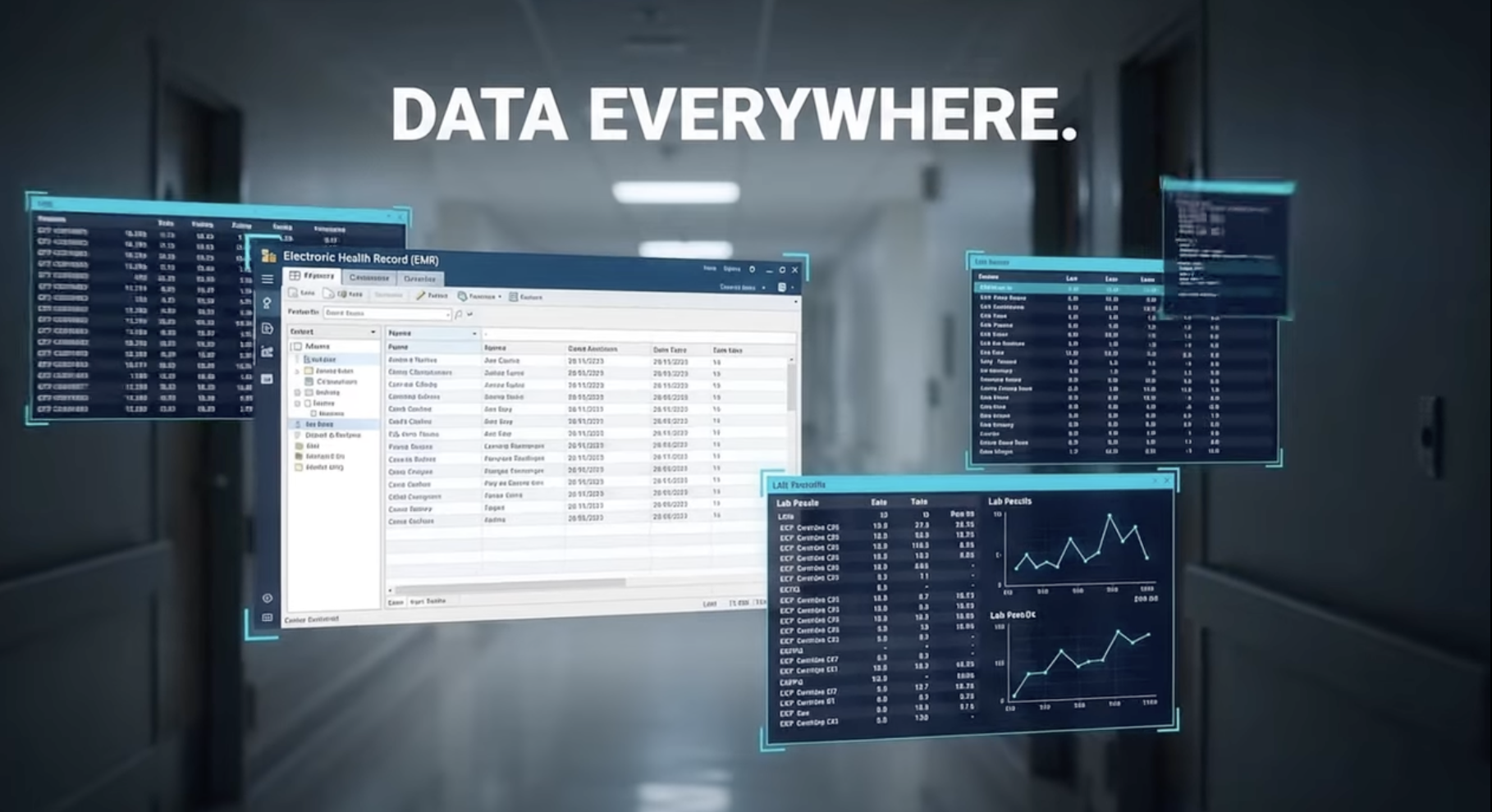
Regulatory deadlines do not wait for manual processes. If your teams scramble each quarter to pull data from EHRs, billing, labs, and claims systems, you feel the drag on productivity and compliance risk every day. Healthcare data integration for regulatory reporting gives you a different path: one where data flows, reports run on time, and teams focus on care and strategy instead of spreadsheets.
In this article, you will see how integrated data shortens reporting cycles, reduces errors, and strengthens healthcare compliance automation, all while preparing your organization for tighter regulations and higher expectations from patients, payers, and regulators.
What Is Healthcare Data Integration
Healthcare data integration for regulatory reporting connects data from multiple clinical, financial, and operational systems into a consistent, usable whole. Instead of storing information in isolated applications, you create a unified data backbone that feeds both care operations and compliance reporting.
In practical terms, healthcare regulatory data integration usually involves:
- Extracting data from EHRs, practice management, claims, pharmacy, lab, and imaging systems.
- Standardizing formats across HL7, FHIR, flat files, APIs, and legacy feeds.
- Mapping data elements to shared models for patients, encounters, providers, and procedures.
- Validating, cleansing, and enriching data so definitions line up across sources.
- Routing that data to analytics platforms, data warehouses, and reporting engines.
A mature integration layer not only moves data. It preserves lineage, enforces business rules, and gives you a single source of truth for regulatory reporting in healthcare and broader organizational insight.
What Is Regulatory Reporting in Healthcare
Regulatory reporting in healthcare refers to the structured submission of clinical, financial, and operational data to federal, state, and private entities. You perform this work to show compliance with laws, payment programs, quality initiatives, and public health requirements.
Common categories include:
- Quality and performance programs, such as CMS quality measures and value-based programs.
- Patient safety and incident reporting to authorized and state agencies.
- Public health reporting for immunizations, lab results, and disease surveillance.
- Security and privacy reports tied to HIPAA and breach notification rules.
- Financial integrity and fraud, waste, and abuse monitoring for payers and regulators.
The volume of obligations keeps rising. CMS alone oversees programs that touch over 150 million people through Medicare, Medicaid, and CHIP, which drives sustained demand for transparent and timely data. At the same time, public health reporting has expanded, and more than 60 percent of public health data comes from clinical sources, which puts added pressure on provider data flows.
Why Regulatory Reporting Is Slow Without Integration
Without strong healthcare data integration for regulatory reporting, your teams depend on manual extraction, spreadsheets, and point-to-point scripts that break when source systems change. This approach slows every step of the reporting lifecycle.
Fragmented data sources
Data sources for clinical, billing, scheduling, and claims data are often separate and come from different vendors. Each system uses its own way to store identifiers, timestamps, and codes. When analysts attempt to match this data manually, they end up spending more time correcting errors than analyzing data.
For instance, a quality metric for readmission might involve connections between inpatient encounters, follow-up care, and medication compliance. Without integration, analysts would have to search each data source individually and reconcile them, which would cause delays and inaccuracies.
Manual data preparation and validation
When data passes through a series of spreadsheets and email attachments, you lack visibility. Each reporting cycle, someone repeats the same data cleansing steps and rechecks logic for measure definitions.
This process slows reporting and increases the odds of inconsistent outputs. When regulators adjust measure logic, or file formats, your teams update every manual process. That takes effort away from improving care operations and compliance strategy.
Limited visibility and traceability
When data is passed through spreadsheets and email attachments, you lose visibility. It becomes difficult to respond to questions such as:
- Which source system provided this value?
- What transformation logic changed it?
- Who approved the data set for submission?
This lack of lineage creates risk during audits. The Office of Inspector General has reported billions in Medicare overpayments linked to poor documentation and data issues, including an estimated 2.6 billion dollars in overpayments in one Medicare Advantage audit sample period. Strong lineage helps you defend reported values and reduce those risks.
How Healthcare Data Integration Accelerates Regulatory Reporting
Healthcare data integration for regulatory reporting replaces fragmented, manual work with reusable, automated data flows. When you architect this well, every new report benefits from previous data engineering efforts.
Centralized, standardized data foundation
A robust integration platform standardizes data into consistent models before it reaches your reporting environment. You define shared concepts such as patient, provider, encounter, and procedure once. All inbound feeds map into those structures.
This approach yields faster report development, because measure definitions draw from common fields instead of many different representations of the same data point. It also enables automated healthcare reporting because queries are repeatable, pulling from stable tables or APIs.
Automated ingestion and transformation
With integration established, data ingestion occurs on schedules or near-real-time triggers. ETL and integration workflows:
- Pull new records from source systems.
- Validate formats and run data quality checks.
- Transform data fields into standard codes and formats.
- Deliver curated data sets to reporting and analytics systems.
This reduces the time between a clinical event and its availability for regulatory reporting in healthcare. In time-sensitive reporting, such as infectious disease reporting, speed is essential to protect both compliance and patient safety.
Prebuilt measure logic and reusable components
When you invest in healthcare regulatory data integration, you can embed measure logic or calculation rules inside shared services. For example, you define how to calculate a readmission within 30 days once, then reuse that logic across CMS, payer, and internal reports.
This reduces variation in reported values and shortens development cycles for new regulatory programs. Automated healthcare reporting becomes a configuration task, not a long custom build each time a new requirement appears.
Improved data quality and audit readiness
Integrated environments allow you to run continuous quality checks across data sources. You can compare counts, watch for code mismatches, and monitor feed failures before reports go out the door.
Poor data quality carries a high cost. One study estimated that healthcare organizations lose about 15 million dollars per year to bad data across operations and decision-making. Integration backed by strong validation limits that waste and gives compliance teams traceable, defensible submissions.
Key Regulatory Frameworks Impacted by Data Integration
Healthcare data integration for regulatory reporting plays a direct role in several major frameworks and programs. When you align the integration strategy with these requirements, your reporting cycles become faster and more reliable.
CMS Quality Programs and Value-Based Care
Programs such as the Merit-based Incentive Payment System and various hospital quality initiatives require detailed, measure-level reporting. Most measures combine clinical outcomes, utilization, and demographic data, often across multiple encounters.
Integrated data simplifies this work. You can assemble and measure populations through queries against unified patient and encounter tables, then export results in CMS required formats. With better data, you also reduce the risk of payment adjustments linked to quality scores. CMS has reported hospital readmission penalties affecting over 2,200 hospitals in some program years, which shows how much financial exposure is tied to measuring performance and data accuracy.
HIPAA, Security, and Breach Reporting
Regulatory frameworks for privacy and security require accurate reporting of incidents, risk assessments, and sometimes detailed data access logs. When data lives in disconnected systems, it becomes hard to assemble a full picture of who accessed what, and when.
An integrated data platform allows security and compliance teams to correlate events, track PHI usage, and respond faster to suspicious activity. With healthcare compliance automation stitched into integration workflows, you gain better monitoring and more reliable breach reporting when events occur.
Public Health and Registry Reporting
Syndromic surveillance, immunization registries, and disease-specific registries depend on timely, structured data. State and federal entities expect standard formats and codes, often via HL7 or FHIR.
Healthcare regulatory data integration gives you a way to map internal data models to those standard formats. During the COVID 19 response, public health agencies cited data gaps and inconsistent feeds as major hurdles, and HHS has stressed that improved interoperability is essential for response readiness. A GAO report noted data gaps and timeliness problems across several surveillance systems that limited early response effectiveness, with delayed data in some systems by as much as two weeks. Strong integration directly reduces such lags.
Benefits for Healthcare Organizations
Healthcare data integration benefits extend beyond pure compliance. When you modernize integration with regulatory obligations in mind, you strengthen care quality, operations, and strategic agility as well.
Shorter reporting cycles and lower manual effort
Automated healthcare reporting dramatically cuts time spent on extract and transform tasks. Analysts and compliance teams work from standardized data sets that refresh on schedules, so they can focus on interpretation and improvement plans, not data wrangling.
Across industries, organizations that adopt automation for data preparation and reporting see up to 30 percent efficiency gains in analytics and reporting functions. Healthcare tends to lag other sectors in automation, which means your organization can gain a real edge through focused healthcare compliance automation.
Higher accuracy and lower compliance risk
With a single version of truth, you reduce discrepancies between internal dashboards, payer submissions, and regulator reports. Data validation rules run consistently across all feeds, which limits miscoding, missing values, and out-of-range results.
Better accuracy matters because penalties and clawbacks can quickly exceed the cost of integration. OCR has collected over 135 million dollars in HIPAA enforcement actions since 2003, much of it tied to documentation and data handling issues that stronger integration and governance help prevent.
Stronger insight across quality, operations, and finance
When your healthcare regulatory data integration supports broad analytics, you gain a clearer view of how clinical quality, access, and financial performance interact. Reports for regulators become one output from a shared intelligence platform, not a separate silo.
This unified view helps leaders:
- Identify process issues that affect both compliance metrics and patient outcomes.
- Align staffing, care pathways, and digital investments with quality and cost trends.
- Evaluate payer contracts and value-based models using consistent, trusted data.

Conclusion
Regulatory pressure will not ease. Expectations around interoperability, timeliness, and transparency grow each year. Manual, fragmented approaches to regulatory reporting in healthcare no longer keep pace with this environment.
Healthcare data integration for regulatory reporting gives you a scalable way to meet those demands. It connects systems, standardizes data, embeds validation, and supports automated healthcare reporting across quality programs, public health, and security frameworks.
When you treat integration as core infrastructure, not a one off IT project, you reduce compliance risk, shorten reporting cycles, and give clinical and business leaders the information they need to drive stronger outcomes.
Vorro helps health systems, payers, and partners build that kind of integration foundation. Our integration platform and services focus on high-fidelity data movement, standards-based interoperability, and healthcare compliance automation at scale. If you want to move from reactive reporting to proactive, intelligence-led compliance, connect with Vorro and see how a modern integration backbone can support your regulatory strategy.
FAQs
What is healthcare data integration for regulatory reporting?
Data integration for regulatory reporting in the healthcare sector is the process of combining data from EHRs, billing, claims, lab systems, and other systems into a normalized environment for the sole purpose of filing required reports with regulators, payers, and public health agencies. It focuses on data quality, lineage, and automation so that you can produce accurate reports on predictable schedules.
How does integration support healthcare compliance reporting?
Integration facilitates healthcare compliance reporting by allowing automated data ingestion and transformation, consolidating data from multiple sources, and using the same validation rules. This makes it easier to minimize manual effort. Moreover, it reduces the cycle time for reporting and enhances accuracy. It also enables traceability for audit or inquiries from the regulator regarding particular measures or values.
What role does automation play in regulatory reporting in healthcare?
Automation allows the conversion of reporting cycles from periodic to monitored and scheduled processes. Automated healthcare reporting uses integration pipelines to pull new data, validate data quality, use measure logic, and produce files or API responses in defined formats.
Which systems should connect to a healthcare regulatory data integration platform?
The minimum set of systems that your platform should integrate includes EHRs, practice management, billing, and claims systems. In addition, many healthcare organizations choose to integrate pharmacy, lab, radiology, care management, workforce management, and CRM systems. The goal is to integrate all data sources that affect quality measures, utilization, safety reporting, or financial compliance.
How do I get started with healthcare data integration for regulatory reporting?
The first step is to assess your regulatory requirements and associate them with the data sources that are involved. Next, identify high-value business scenarios that can benefit from data integration, such as reducing manual work or mitigating risk. Finally, choose an integration partner such as Vorro that has knowledge of healthcare standards and can support real-time and batch data integrations.

Akshita is a Senior Content Writer and Marketer with over a decade of experience crafting narratives that convert, rank, and build lasting brand authority. She has worked across SaaS, FinTech, HealthTech, and Education spaces, delivering everything from HIPAA-compliant medical content to multilingual campaigns for the International Labour Organization, United Nations. Her content has reached audiences across the globe, and she has worked for Fortune 500 brands, global agencies, and startups alike. Fluent in English, Spanish, and German, Akshita brings a rare cross-cultural edge to brand communication. A literature graduate from Delhi University, she balances strategic thinking with a storyteller's instinct, but when she isn’t architecting content roadmaps, she channels her creativity into poetry and painting or dedicates her time to caring for stray animals - pursuits she credits for making her a more empathetic and perceptive communicator.