Healthcare organizations have access to more data than ever before, yet they still experience care gaps, increasing operational strain, and unpredictable outcomes. Value-based care models are intended to improve the alignment of quality and cost, but they are dependent on something that many organizations still don’t have: integrated data for value-based care that is reliable and actionable in real time.
When the clinical, financial, and operational systems of the organization remain uncoordinated, it is equivalent to working without light. Care teams are unable to understand patients’ full stories. Analysts have difficulties creating value based on care analytics that accurately represent the situation. Executives are unable to convince payers, partners, or boards of the positive impacts.
Integrated health data systems transform this situation. If you choose the right integration strategy, it is possible to connect data coming from EHRs, claims, labs, devices, and different care settings. You establish a single, reliable, and transparent source of healthcare data for a data-driven, driven value, based care model. You empower clinicians, care managers, and executives with a shared understanding that helps them make better decisions at each stage of the patient journey.
What Is Integrated Data in Healthcare
In the healthcare context, integrated data refers to the practice of assembling a variety of clinical and nonclinical system information into a connected, consistent, and workable form. It involves much more than just data aggregation. Real integration aims at structure, meaning, and context, thus enabling both people and systems to take action based on it.
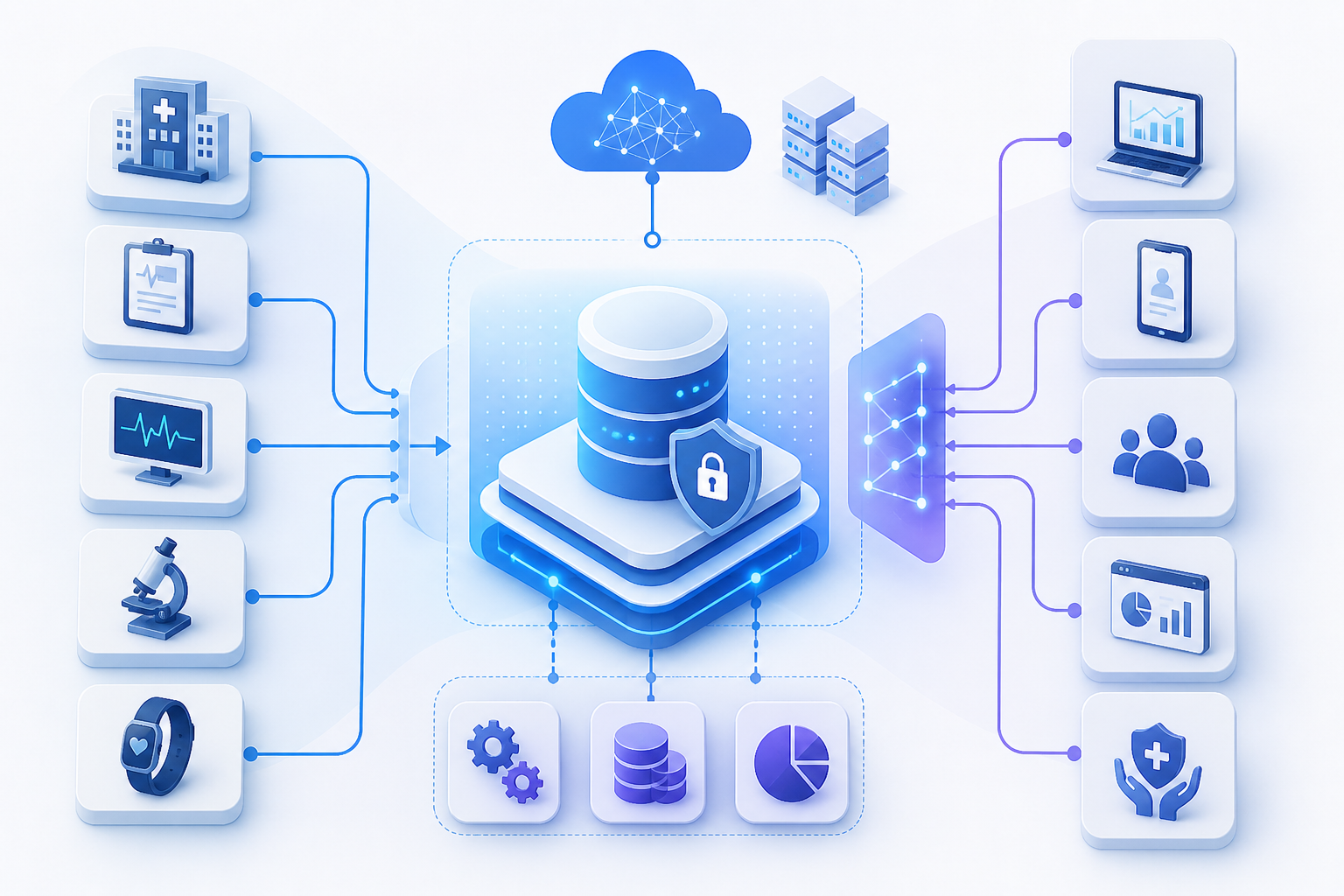
Integrated healthcare data systems, in essence, combine:
- Clinical data from EHRs, labs, imaging, pharmacy, and care management tools.
- Claims and billing information across payers and lines of business.
- Social determinants and behavioral health data were available.
- Operational data, e.g., scheduling, call centers, and care coordination notes.
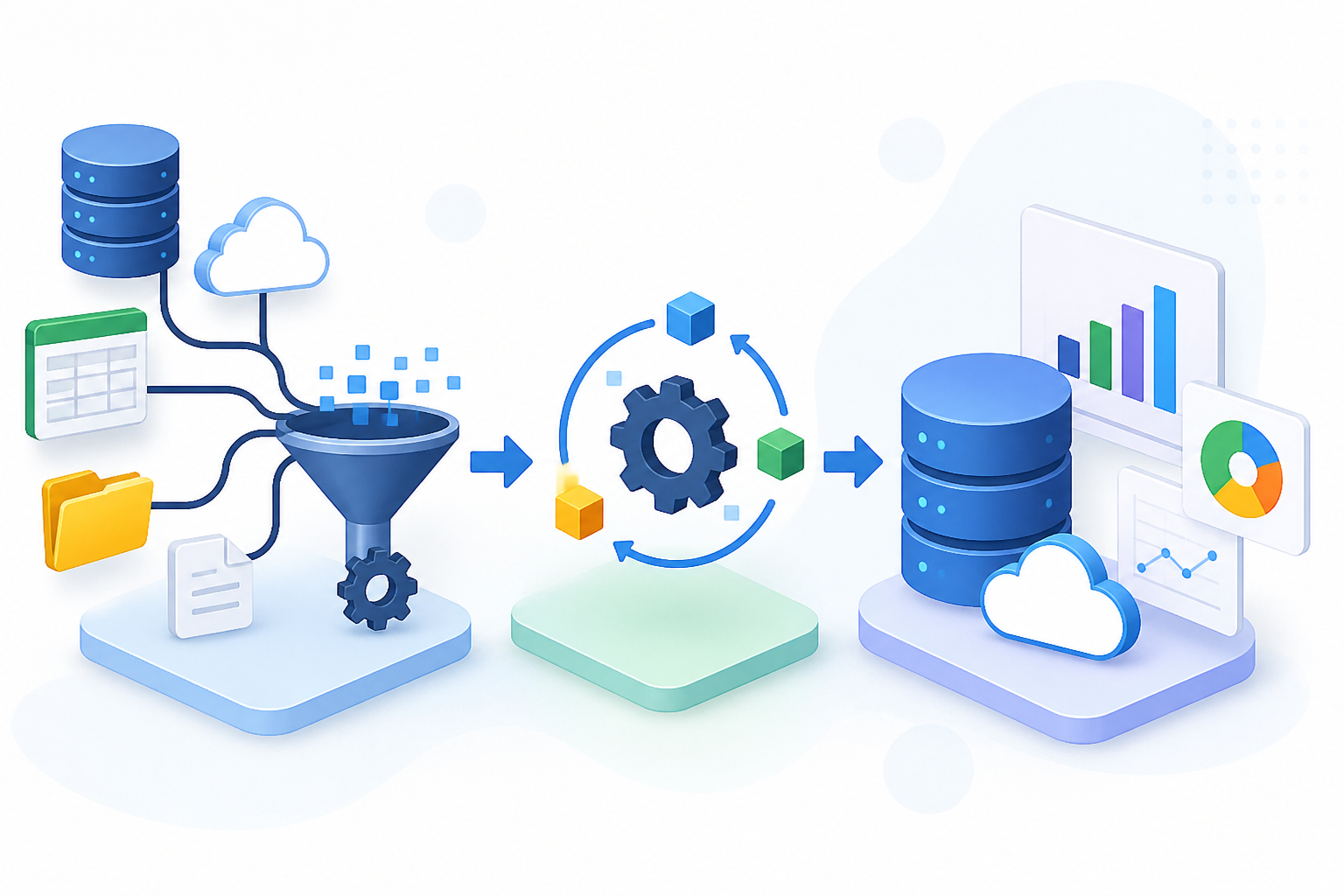
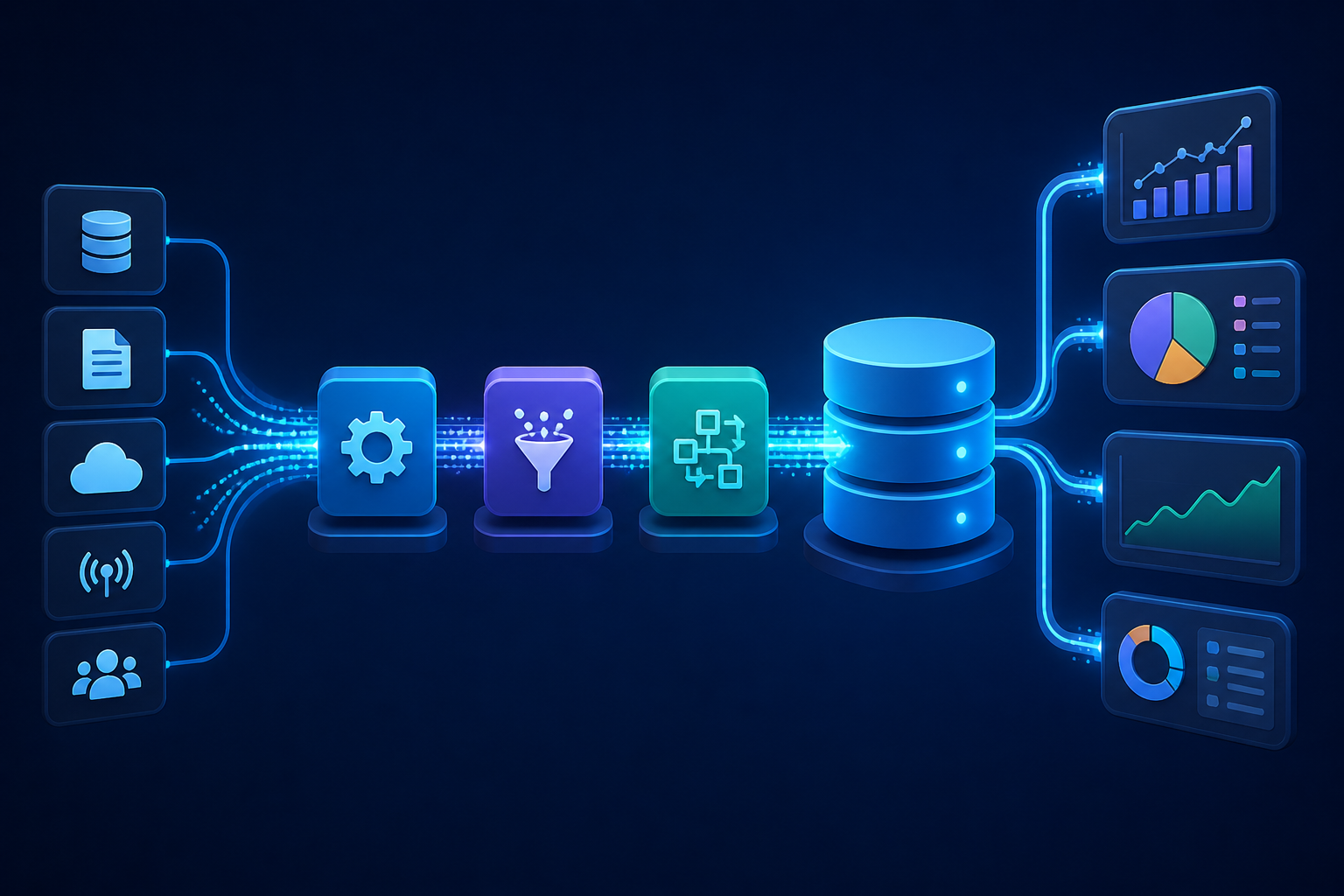
These systems standardize formats, map codes, and solve patient identity issues across different sources. They offer one dependable view of each patient and population. Such a viewpoint facilitates clinical data integration to support value-based care programs, quality reporting, and performance monitoring.
Effective healthcare data integration for value, based care has three essential qualities. It is timely, not batch data that records lag behind clinical reality. It is accurate, having strong data quality checks and governance. It is accessible, providing insight through the tools and workflows that people are already familiar with without extra clicks or logins.
Overview of Value-Based Care Models
Value, based care moves away from volume and focuses more on health outcomes and total cost. Instead of simply paying for visits or procedures, these models are designed to reward providers for keeping their patients healthier and doing so at a reasonable cost.
Common value, based care approaches include:
- Pay for performance is a method where providers get incentives for meeting certain quality and patient experience standards.
- Shared savings or shared risk agreements are where the organizations share both savings and losses that are based on the total cost of care benchmarks.
- Bundled or episode, based payments mean that one payment is made to cover all the services related to a procedure or condition during a specified period.
- Global budgets or capitation models are where providers get a certain amount per patient and are in charge of managing quality and cost within that amount. In fact, for all these methods, success depends not only on the doctors’ clinical skills. You also have to be able to identify patients at high risk, see where care is lacking, understand usage patterns, and figure out what drives costs in different care settings. This means having the right data for value, based care that is integrated and can be used for making quick and accurate decisions.
Value, based care analytics are right at the center of these kinds of frameworks. They help to turn the integrated data into risk scores, quality dashboards, care opportunity lists, and financial performance indicators. Without very good integrated data, value, based care analytics are incomplete or even misleading.
Role of Integrated Data in Enabling Value-Based Care
Healthcare data, driven value, and based care can be made possible operationally through integrated data. It is what links the patient encounters, outcomes, costs, and experiences. It converts single systems into a coordinated learning environment for your clinical and business teams.
Here is how integrated data for value, based care supports key functions.
Risk stratification and population health
Proper risk management is not possible without knowing patients who need the most attention. Integrated healthcare data systems combine EHR data, claims, pharmacy fills, and past utilization. They facilitate value-based care analytics that provide risk scores, identify rising risk, and divide populations by need.
Risk information is delivered to care teams through their regular workflows. They can simply prioritize outreach, schedule follow-up, or get care coordinators involved for the right patients at the right time. Risk models without integrated data miss key events or services from outside networks, hence leading to blind spots.
Care coordination across settings
Value, based care requires that care be coordinated across primary, specialty, post-acute, and community providers. Clinical data integration for value, based care brings discharge summaries, test results, and referrals into a shared view.
When a patient has been hospitalized, the integrated data system sends primary care, specialists, and care coordinators timely updates.
Quality measurement and reporting
Quality measures are derived from labs, vitals, medications, diagnoses, and patient engagement data. If each data type is stored in a different system, reporting turns out to be a manual task. Continuous, cleansed, and validated data from integrated value-based care pipelines perfectly match quality registries and payer portals.
Teams evaluate their compliance with preventive care, chronic disease management, and patient experience measures. They get to understand the performance at the level of provider, site, and population. Such a perspective helps them to execute well, targeted improvement efforts rather than broad and unfocused initiatives.
Financial performance and contract management
Financial success in value, based contracts is largely dependent on a clear understanding of the total cost of care and utilization patterns. Healthcare data integration for value, based care brings together claims, authorizations, and encounter data.
Executives and analysts use value, based care analytics to determine the cost at the level of cohort, service line, or condition. They monitor the progress against benchmarks and pinpoint the high-cost outliers or the utilization patterns that could have been prevented. This knowledge helps to refine the network design, care management programs, and the negotiation with payers.
Key Benefits for Patient Outcomes and Cost Efficiency
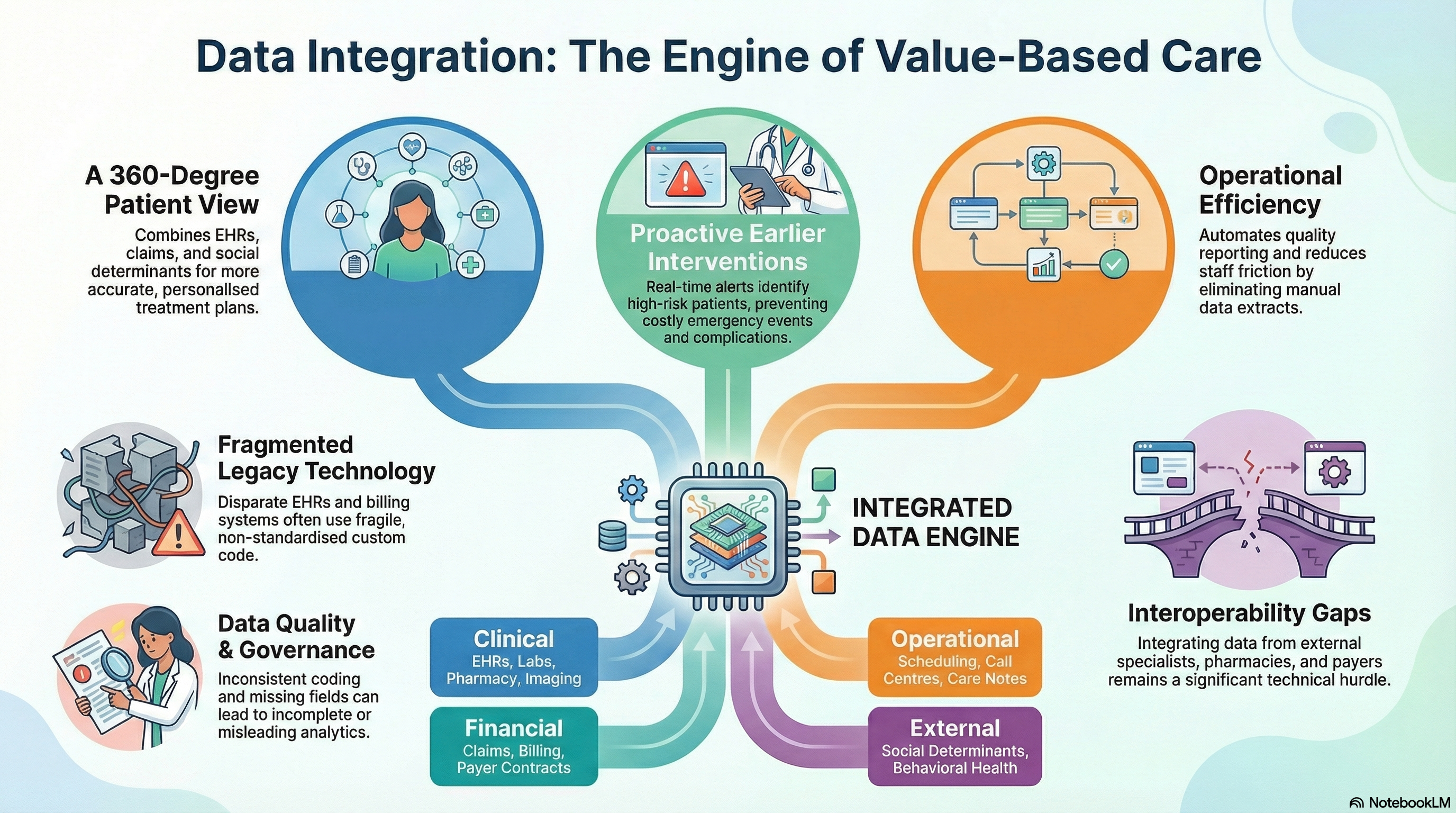
The key benefits that are impacting patient outcomes and cost efficiency include a more complete patient view for better decisions.
More complete patient view for better decisions
By integrating data, a healthcare professional has a longitudinal view of a patient. They are able to view a person’s history through different settings, including their inpatient stays and their virtual visits. When available, they can also see adherence patterns and social risk factors.
This information helps the healthcare professional make more accurate decisions regarding diagnoses, treatment plans, and follow-up. They are better able to avoid unnecessary testing, conflicting medications, and missing care gaps. Patients perceive a care experience that is more coordinated and personalized.
Earlier intervention and proactive care
Healthcare data, driven value, and care programs focus on receiving early signals. Integrated data can be used to generate alerts for escalating risk, missed appointments, or abnormal test results. Care managers get a prioritized list of patients that need to be contacted, instead of a routine report.
Knowing this, your staff can shift from simply responding after the fact to actually anticipating and preventing the problem. Necessary but possibly overlooked activities like medication reconciliation and follow-up after discharge can prevent further complications. This not only leads to better health outcomes but also lowers the likelihood of costly emergency events.
Reduced friction for patients and staff
Patients recognize firsthand through integrated data when their history is not requested at every visit. When providers do not have to log into separate portals, they encounter a new world of updated information. Care teams with a single view reduce miscommunication.
Integrated systems of healthcare data also make it easier for the administrative staff to handle quality reporting, prior authorization support, and contract monitoring with the same shared data layer.
Greater cost visibility and use of resources
Healthcare leaders who have integrated data for value, based care get an accurate picture of the cost and utilization patterns. They may recognize which combination of interventions results in better outcomes at a sustainable cost and which do not.
You can align your staffing, care management programs, and community partnerships with the areas that will make the most difference. This focused practice not only helps achieve financial sustainability but also makes it possible to deliver value, based contracts with improved patient outcomes.
Challenges in Using Integrated Data for Value-Based Care
Most organizations are aware of the potential benefits of integration. The challenge is often how to do it. Healthcare data integration for value, based care brings up technical, organizational, and governance issues.
Fragmented systems and legacy technology
Healthcare systems generally operate several EHRs, billing systems, and specialized clinical applications. Every system has its own data standards and ways of connecting. Older interfaces use customized code that is very fragile. Integration of different healthcare data systems in this case requires a vendor-neutral, flexible integration method. Otherwise, the teams will be so focused on one, off connections that won’t even work across the programs or regions that they will lose track of the big picture.
Data quality and standardization
Reliable value, based care analytics can’t be built on bad data. Upsetting user trust, inconsistent coding, missing fields, and inappropriate timestamps are some of the problems that will occur. Clinical data integration for value, based care should have validation, normalization, and mapping processes very closely integrated. An organization must establish a clinical and technical governance that is well coordinated. This governance is the one that sets the standards for vocabularies, allows for the data to be used with certain rules, and determines the methods to fix issues. When these measures are missing, then the combined data sets only grow in volume but are not dependable.
Interoperability and external data sources
Value, based care takes patients outside your own facility. Patients seek services from specialists, pharmacies, and urgent care centers that are not affiliated with the hospital. In addition, payer data is relied upon to see claims and the use of healthcare resources. Interoperability standards and APIs certainly aid in this process, but they are not sufficient on their own. You still require an integration capable of translating and aligning external data. Healthcare data integration for value-based care should be able to accommodate diverse formats and methods of connection, ranging from old-style feeds to the latest APIs.
Change management and adoption
Technology is not the only thing that generates value. Care teams and analysts must have the conviction that integrated data for value, based care is useful and that they hence incorporate this data in making decisions. That leads to the need for training, communication, and alignment with the performance incentive. If integrated data is delayed, perceived as inaccurate, or is accessible only through extra steps in the user interface, adoption will be low. It is up to the leaders to make sure that integrated data programs are designed in such a way that integrated data helps people perform their jobs easily and efficiently, rather than making things even more complicated.
Best Practices for Implementing Integrated Data in Value-Based Care
In general, successful organizations consider the integration of data as a continuous strategic capability rather than treating it as a one-off project. They ensure that the technology decisions are in line with the clinical and financial goals. They also simultaneously plan for scale and flexibility.
Start from specific value-based use cases.
Be clear about your business and clinical goals. For instance, you may want to focus on decreasing hospital readmissions in certain patient groups, raising your performance on particular quality indicators, or getting ready for a new shared risk contract that your organization will have to support.
Determine what each use case requires in terms of integrated data. Find out which systems, data types, and workflows are necessary. This clarity will make sure that your healthcare data integration for value, based care project will bring you tangible results quickly and also will gain the trust of the stakeholders.
Adopt a scalable integration platform.
Point-to-point interfaces won’t scale for integrated healthcare data systems. Step instead to an integration platform constructed for healthcare that supports standard protocols, APIs, and modern data formats.
Capacities that you will like include:
- Options for integration in real, time and batch for different scenarios.
- Ability to handle multiple data standards and message types.
- Central monitoring and management for all interfaces.
- Programs for transformation, normalization, and enrichment are built in.
Through this platform technique, the debt of integration is decreased, and the agility is improved when contracts and clinical programs change.
Build strong data governance and clinical alignment
Data governance should not be limited to IT. Make sure that clinical, operational, and analytics leaders are also part of the governance structures. Establish clear policies for data quality, coding standards, and access controls.
Engage clinicians early when talking about clinical data integration for value, based care. Ask for their preference on how information should be shown in workflows and dashboards. Use their feedback to determine data definitions and measure logic. Such an agreement leads to increased trust and usage.
Integrate analytics into daily workflows.
Value, based care analytics can be truly transformative only if they make their way into the places where people already work. The integrated data should be a source of:
- Care management tools showing risk scores and next best actions;
- EHR in, basket alerts or flags for open care gaps;
- Operational dashboards for clinic managers and service line leaders;
- Self-service analytics tools for analysts who need flexible views.
Eliminate analytics tools that are isolated and involve manual data extracts or separate logins. Integrated experiences foster ongoing use and continuous improvement.
Measure, learn, and iterate.
Dont treat integrated data for value, based care as a “once and done” project. For every single use case, carefully define the process and outcome measures that correspond to your goals. Besides checking technical performance, keep an eye on how the users adopt the system also.
Maintain communication channels with clinicians, analysts, and leaders. Every time you detect a new trend in the data, try out the interventions that are most closely aligned with the trend and evaluate the results.
This way, the organization of healthcare will be reinforced as a value, based care culture driven by data rather than a set of one-time projects.
Conclusion
Precise insight, coordinated action, and shared accountability are the pillars that will support a Value, based care success. None of these will scale without integrated data for value-based care, which includes clinical, financial, and operational systems.
When investing in integrated healthcare data systems, healthcare data integration for value-based care, and aligned governance, you are laying a groundwork for performance that can be sustained. Clinicians will have access to the whole picture of the patient. Leaders will be provided with reliable value, based care analytics. Patients will receive a consistent and coordinated experience.
Vorro assists healthcare organizations in integrating clinical, financial, and operational data into one vendor, neutral, flexible platform capable of supporting healthcare data, driven value, based care. You bring your systems in line with your strategy and lessen the gap between data and action.
If you wish to speed up your integration approach for value, based contracts, you can book an appointment with Vorro to go over your current settings and decide the steps to be taken.
FAQs
What is integrated data for value, based care?
Integrated data for value-based care are data that are linked and standardized across clinical, financial, and operational systems to assist with risk stratification, care coordination, quality measurement, and financial performance under value-based contracts. It gives regular, up, to, date information to clinicians, analysts, and leaders.
Why is healthcare data integration for value, based care so important?
Healthcare data integration for value-based care is necessary as it delivers a comprehensive and accurate database, which is essential for population health management, achievement of quality targets, cost control of the total care, and reporting of performance to payers. Making decisions without integrated data denotes relying on incomplete or obsolete information.
How do integrated healthcare data systems support clinicians?
Integrated healthcare data systems can assist clinicians by providing a continuous record of each patient, such as visits, test results, medications, and care gaps from different settings. This background makes it easier for clinicians to make the right choices, to prevent unnecessary tests or treatments, and to work together more efficiently with other providers.
What role do value, based care analytics play?
Value-based care analytics take integrated data to the next level by calculating risk scores, presenting quality dashboards, generating performance metrics, and developing worklists that can be acted upon. Besides, they enable organizations to locate vulnerable patients, analyze quality and usage patterns, evaluate contract results, and concentrate on the areas that will bring the most benefit.
How can an organization start improving integrated data for value, based care?
The starting point for a company is to choose a narrow set of value, based use cases, begin finding the systems and data required, and set up a scalable integration platform with robust governance. Achieving initial success in pinpointed programs convey confidence and create a flow of the broader integrated data initiative.
Vorro is positioned to deliver healthcare data integration and interoperability solutions that underpin value, based care models, covering everything from clinical data integration to real, time interfaces and analytics enablement. If you want to discover how Vorro may be a great partner in your integrated data strategy, check out Vorro.

Akshita is a Senior Content Writer and Marketer with over a decade of experience crafting narratives that convert, rank, and build lasting brand authority. She has worked across SaaS, FinTech, HealthTech, and Education spaces, delivering everything from HIPAA-compliant medical content to multilingual campaigns for the International Labour Organization, United Nations. Her content has reached audiences across the globe, and she has worked for Fortune 500 brands, global agencies, and startups alike. Fluent in English, Spanish, and German, Akshita brings a rare cross-cultural edge to brand communication. A literature graduate from Delhi University, she balances strategic thinking with a storyteller's instinct, but when she isn’t architecting content roadmaps, she channels her creativity into poetry and painting or dedicates her time to caring for stray animals - pursuits she credits for making her a more empathetic and perceptive communicator.