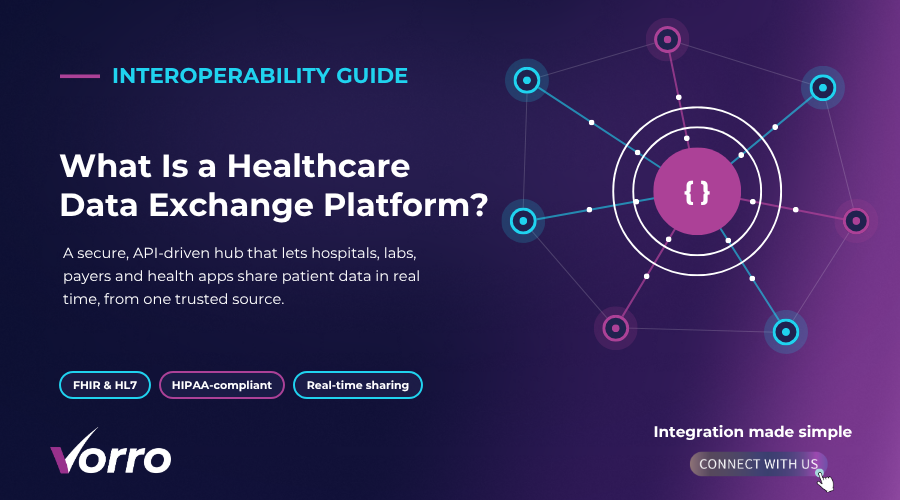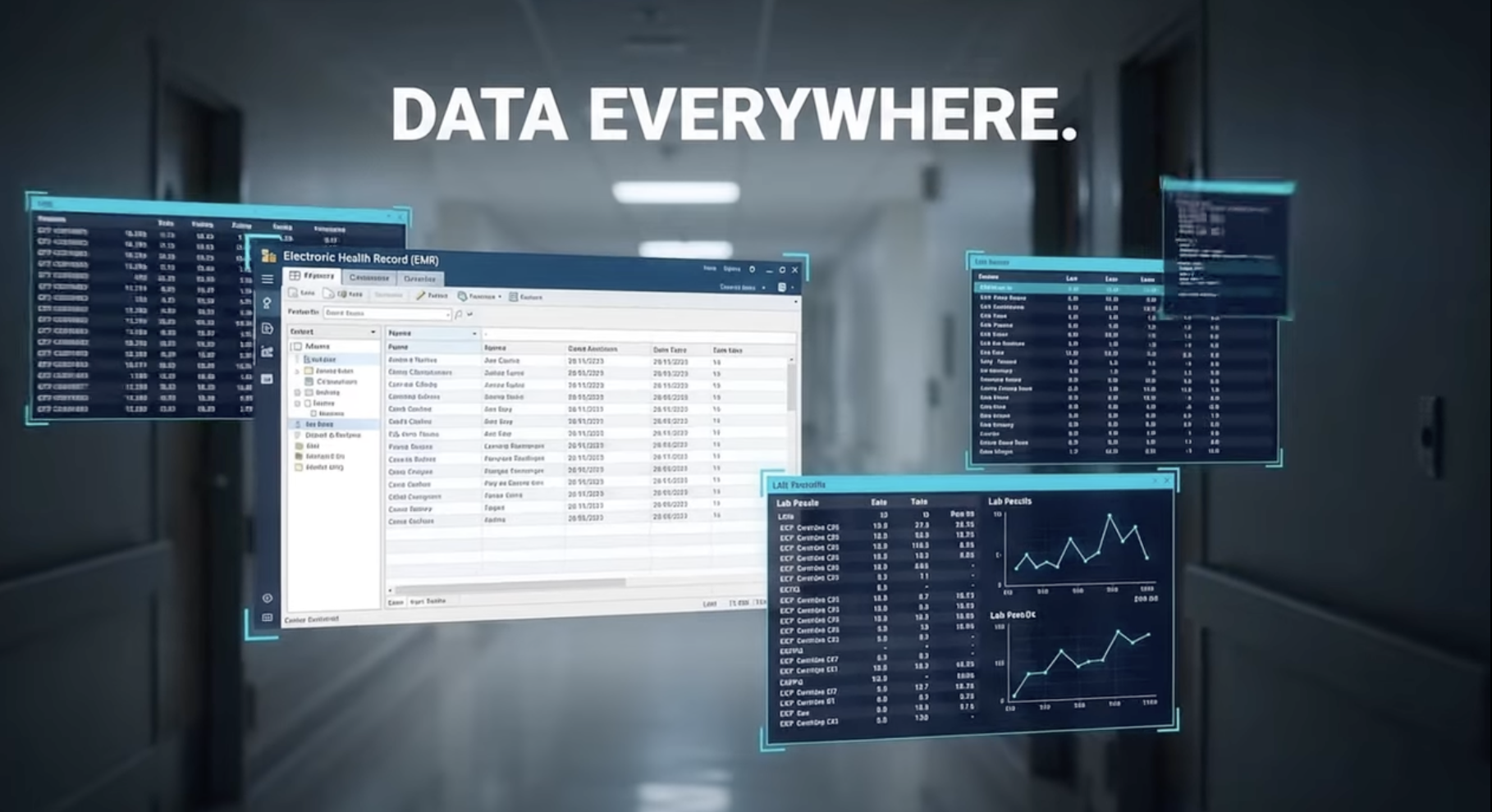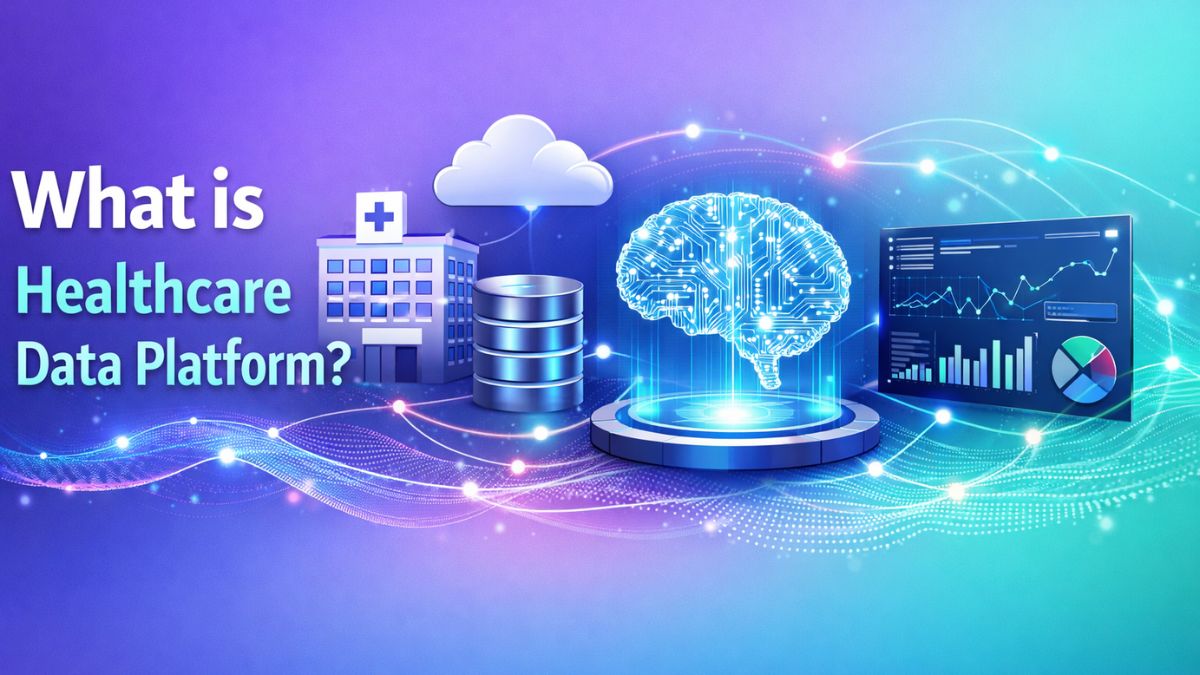
A Healthcare Data Platform is an integrated environment specially designed to unify clinical, operational, and financial data throughout healthcare organizations. This platform links source systems, standardizes the data, and makes it analytical and AI-ready. It is a system that is used for collecting, organizing, and governing the data obtained from EHRs, claims systems, lab systems, devices, CRM tools, and external partners. A robust Healthcare Data Platform is a capable tool that not only stores data but also converts the raw data into trusted, usable, and repeatable building blocks for care delivery and business outcomes.
Whereas scattered feeds and point solutions may have worked before, a Healthcare Data Platform provides a single, consistent foundation. It harmonizes the data to standard models and terminologies, handles identity, monitors lineage, and applies governance. As a result, it becomes the common truth shared between the clinical, finance, and IT teams.
Why Healthcare Organizations Need a Modern Data Platform
Your data footprint is expanding day by day. Every new application, new care models, and new regulatory requirements result in more silos and complexity. If you don’t have a modern Healthcare Data Platform, your teams will be facing difficulties with fragmented data, manual extracts, and inconsistent definitions.
A modern platform is your partner in:
- Getting rid of fragile point to point integrations.
- Enabling new care models like virtual and home, based programs.
- Meeting regulatory and reporting requirements faster.
- Getting ready for AI models that need clean, well, governed data.
You receive a common data environment that can grow in size and complexity as your systems and partnerships evolve. By using a common Healthcare Data Platform, you will not have to rebuild data pipelines for each new initiative. Instead, you will be able to reuse trusted components.
Key Features of an Enterprise Healthcare Data Platform
An enterprise healthcare data platform must be able to support very complex, multi, stakeholder environments. You require features that tackle the volume, variability, and strict regulation aspects without compromising the speed of delivery.
Some of the vital features are:
End to End Healthcare Data Integration Platform
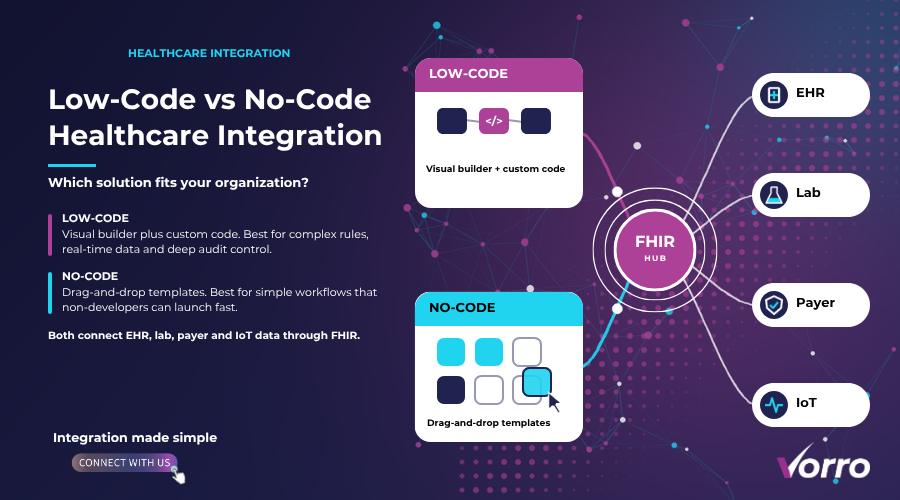
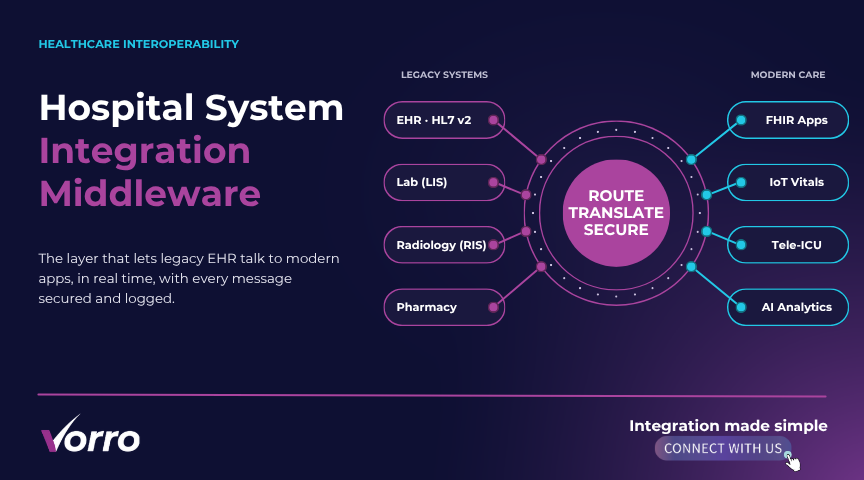
This platform must be capable of connecting a myriad of data sources such as EHRs, practice management systems, claims systems, labs, imaging, devices, HIEs, and partner systems.
Hence, a healthcare data integration platform that is efficient will be able to support different standards and protocols, such as HL7, FHIR, X12, flat files, APIs, and even internally developed sources.
It centralizes ingestion, transformation, distribution, and monitoring functionalities. You have the power to regulate data flows via configurations rather than relying on custom code, which allows your team to respond to changes more swiftly.
Robust Healthcare Data Standardization
Different systems of origin utilize various formats and codes. If there is no healthcare data standardization, your analytics and AI teams will be busy reconciling data instead of creating value.
At the core of your enterprise healthcare data platform are several features essential for it to work efficiently:
- Firstly, it should be able to normalize identifiers and patient matching logic.
- To aid interoperable data exchange, mapping local codes to standard vocabularies is another requirement for the platform.
- Moreover, the platform should be capable enough to align data to consistent data models.
- Apart from that, it should be capable of applying reusable business rules for quality and validation.
This creates a universal data ‘language’ that enables data to be communicated effectively throughout
Governance, Security, and Compliance
Trust in your Healthcare Data Platform hinges on rigorous governance and control. The platform should enable:
- Role, based access control and tracking.
- Recording and mapping the data flow from its source to its usage.
- Methods of protecting, concealing, and identifying PHI.
- Managing policies for retention and data sharing.
This provides your compliance, security, and privacy teams with the transparency and control that they need.
Flexible Data Models and Performance
A data platform for enterprise healthcare has to have storage and processing choices that are suitable to both near real, time and batch workloads. This means that it should be able to support operational data stores, analytical stores, data lakes, and performance, tuned marts.
Ideally, you can set up data models a single time and then leverage them in dashboards, APIs, applications, and data science projects.
How a Healthcare Data Platform Makes Data AI Ready
AI models require complete, consistent, and timely data. A Healthcare Data Platform helps align your data pipeline with the requirements of AI so that your models behave as expected when they are put into production. Some of the important AI readiness tasks are:
Standardized, High Quality Inputs
Strong ingestion and standardization are the first steps to preparing healthcare AI, ready data. The platform performs data quality checks, resolves identities, and maps codes to standards thus cleaning and preparing the data before it is released into the model training or inference environments. On such a stable base, your data science teams can rely on well, defined features rather than ad hoc data extracts. AI, ready healthcare data enables the model to be reused in different departments and for different use cases.
Feature Reuse and Consistent Definitions
The Healthcare Data Platform must provide access to curated, governed datasets and features. Thus, it can standardize risk scores, utilization metrics, or engagement signals that different models can use. This practice prevents the existence of conflicting definitions of key metrics and accelerates AI development cycles.
Operationalization and Monitoring
An AI, ready healthcare data environment is one that links data pipelines, model services, and downstream applications. The platform monitors data drift, schema changes, and pipeline failures so you can take action before they affect patient care or operations.
Use Cases of Healthcare Data Platforms
A reliable Healthcare Data Platform can enable a wide range of use cases across the caregiving and business areas of the healthcare industry.
Clinical and Care Management
- Use a mix of EHR, claims, and social data to locate patients with the highest needs.
- Provide care management programs with the most current and comprehensive patient info.
- Help apply risk stratification and cohort management frameworks.
Operational and Financial Performance
- Analyze patient flow, capacity, and the use of resources at different locations.
- Enable revenue cycle management and denial prevention activities with data.
- Keep track of quality measures for different programs and contracts.
Population Health and Value Based Care
- Bring together data from various providers and payers.
- Use a standardized way of representing data to assess performance across contracts.
- Provide the basis for predictive models for gaps in care and adherence through data.
AI and Advanced Analytics
- Offer AI, prepared healthcare data to assist clinical decision, making.
- Facilitate natural language processing on the notes and documents.
- Input real, time APIs that bring up insights in clinician workflows.
Benefits of Using a Healthcare Data Platform
By choosing to invest in a powerful Healthcare Data Platform, you are essentially getting the compounded benefits across various projects and teams.
The essential results are:
- Quicker delivery of analytics and AI projects by leveraging reusable data pipelines.
- Higher level of data trust due to standardization, transparency, and governance.
- Improved teamwork between clinical, operational, and analytics departments.
- Increased clinician and staff satisfaction with reliable information.
- More support for growth, partnerships, and new care models.
The answer is a solid data base that can sustain the long, term strategy, instead of treating each project as a totally different one.
Choosing the Right Healthcare Data Platform
When you review a data platform for enterprise healthcare, make sure the decision correlates with your overall strategy instead of merely your existing technology stack. Concentrate on how the platform will accommodate future integrations, AI projects, and regulatory requirements.
Here are some considerations:
- Integration depth between clinical, financial, and external systems.
- The robustness of healthcare data standardization and terminology support.
- Security, privacy, and compliance capabilities.
- Facilitating AI, ready healthcare data, including feature reuse.
- Time to value and ease of configuration for your teams.
- Evidence of working with healthcare organizations similar to yours.
On top of that, it is a must, have that the partner understands both the technical side and the clinical one. A good Healthcare Data Platform vendor will be your partner in the roadmap, will share patterns, and will help you sidestep the common integration and governance pitfalls.
Vorro offers an enterprise healthcare data platform that is purpose, built for the complex needs of both provider and payer environments. You are provided with a healthcare data integration platform, excellent healthcare data standardization, as well as AI, ready healthcare data all in one unified approach. If you are considering a Healthcare Data Platform that brings real results in care, operations, and eCommerce extensions for patient services, get in touch with Vorro and make your data foundation a reflection of your strategic objectives.

Akshita is a Senior Content Writer and Marketer with over a decade of experience crafting narratives that convert, rank, and build lasting brand authority. She has worked across SaaS, FinTech, HealthTech, and Education spaces, delivering everything from HIPAA-compliant medical content to multilingual campaigns for the International Labour Organization, United Nations. Her content has reached audiences across the globe, and she has worked for Fortune 500 brands, global agencies, and startups alike. Fluent in English, Spanish, and German, Akshita brings a rare cross-cultural edge to brand communication. A literature graduate from Delhi University, she balances strategic thinking with a storyteller's instinct, but when she isn’t architecting content roadmaps, she channels her creativity into poetry and painting or dedicates her time to caring for stray animals - pursuits she credits for making her a more empathetic and perceptive communicator.