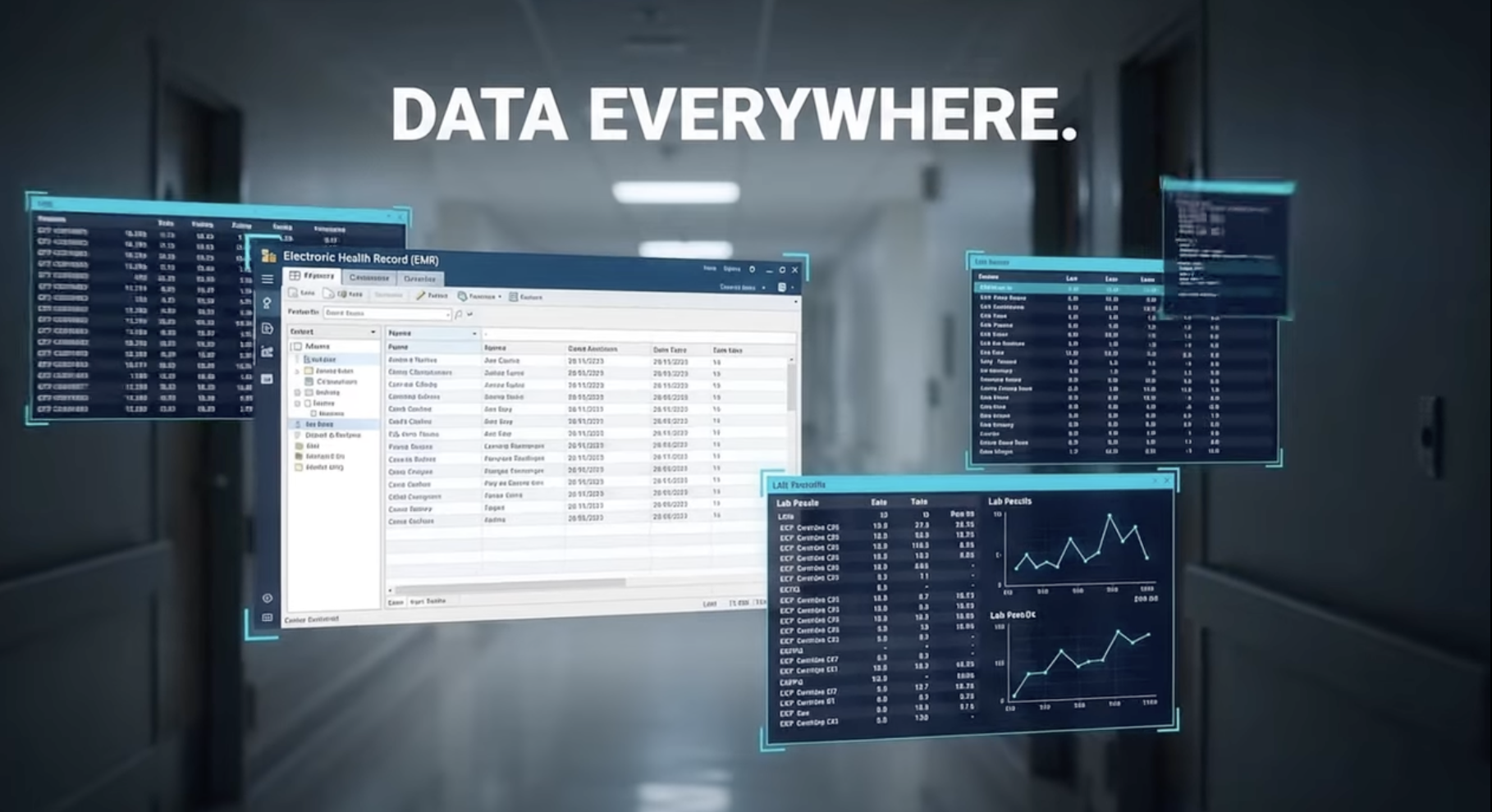

You want dependable AI, not mysterious black, box guesses. In healthcare, this means starting with a healthcare data pipeline that treats clinical data as the main asset rather than an afterthought. Every prediction, every alert, every risk score is only as good as what flows through that pipeline and in what way.
If your data is missing, inaccurate, or delayed, your models will behave in a similar way. If your pipeline is well, organized, traceable, and governed, your AI can safely back up care teams. The standard of your healthcare machine learning pipeline determines the limit to which you can use AI, ready healthcare data.
A robust healthcare data pipeline excels at three main things. First, it integrates data from various parts of the enterprise. Second, it transforms that data into uniform formats. Third, it gets that data ready in such a way that AI and machine learning have a clear and trustworthy view of patients, providers, and processes.
Why AI needs structured healthcare data pipelines
AI models are not capable of processing unstructured inputs. They depend on a data pipeline in healthcare that organizes the data and makes it uniform, predictable, and complete before it is released to either training or inference environments.
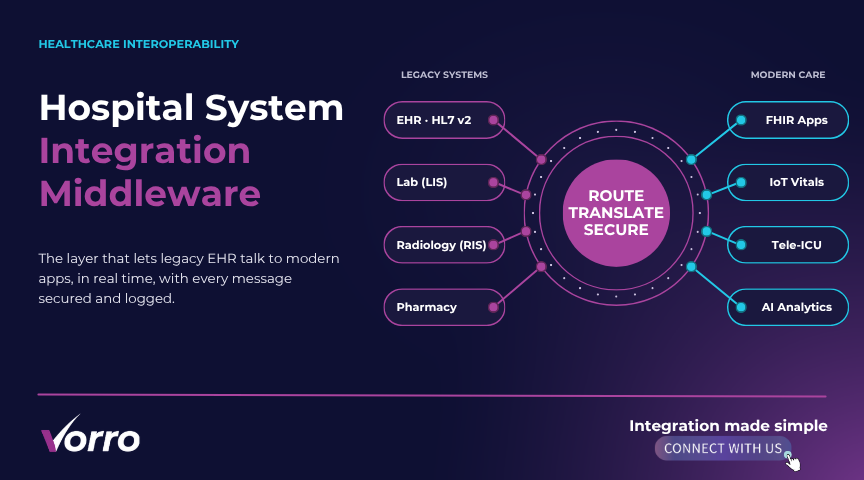
A contemporary healthcare data pipeline is a network that links EHRs, lab systems, imaging, pharmacy, claims, devices, and external data sources. Since every system has its own language, the pipeline unifies these sources and converts them into AI, compliant healthcare data that is consistent with clinical and operational logic.
To prepare healthcare data for AI, you will require more than simple ETL procedures. What you require is a reproducible method that:
Tests new data against a set of well, defined quality rules, converts codes and values to common standards, creates a complete patient record at the level of the patient, cohort records data lineage so you are aware of the source of every field. When a healthcare machine learning pipeline is fed with structured inputs, you benefit from improved model performance, simpler monitoring, and faster iteration. Furthermore, you provide clinicians with greater trust in the outputs since they can follow the trail of data from its origin through its transformation to the point where the model made a recommendation.
Data standardization challenges in healthcare AI
The major challenge in any healthcare data pipeline is standardization. Clinical data hardly ever comes clean. It is bundled with local codes, free text fields, legacy formats and inconsistent units. Without a strong standardization layer, every AI project stalls.
You are dealing with the following issues:
- Code variability: Each facility uses different versions of the clinical vocabularies. Mismatched ICD or procedure codes result in distorted labels for supervised models.
- Unit and value inconsistencies: Lab values are recorded in different units or reference ranges which, if not normalized, can mislead risk stratification or anomaly detection.
- Free text overload: Notes and narratives contain a lot of information but are only really helpful if they are converted into a structured format to facilitate machine learning in healthcare.
- Missing or sparse data: Possible incomplete history or encounter data may bias training and thus reduce model stability when applied to different populations and sites.
Repeatable mapping to common standards and robust normalization rules are the foundation of AI, ready healthcare data. For your healthcare data preparation for AI, you need to have a clear governance of which codes, units, and terminologies you accept, and how you resolve conflicts when sources disagree.
If you do not have such rigor in your healthcare data pipeline, you risk your models learning noise rather than signal. You will also encounter resistance when you try to extend models to new regions, partners, or service lines because each new source brings back the same standardization problem.
Building AI-ready healthcare data pipelines
To enable AI tech on a massive scale, you have to set up a healthcare data pipeline that is adaptable, well, managed, and geared for automation. The aim is straightforward: Make the journey from raw clinical data to AI, ready healthcare data in a way that is clear, verifiable, and reproducible.
Typically, a robust pipeline architecture comprises:
- Ingestion: Using connectors to EHRs, claims, labs, imaging, and external partners and doing standards based integration wherever possible.
- Staging and validation: Landing zones from where raw data is tested for completeness, quality, and schema drift before it is allowed to go down the line to the workflows.
- Normalization and enrichment: Using mapping engines that coordinate codes, units, and formats as also adding enrichment from reference data and registries.
- Curated AI layers: Domain, specific data marts or feature stores prepared for the main use cases, such as population health or revenue integrity.
Governance is a common thread in all these layers. You determine who owns the data domains, establish quality standards, and lineage is tracked from the original source to each transformation. This provides the healthcare machine learning pipeline with a solid base for training and monitoring.
If you consider healthcare data preparation for AI as a product rather than a project, you will not have to redo the work for each new model. The latest AI use cases can be integrated with the same curated assets, thus delivery time is shortened and risk is minimized.
Feature engineering in healthcare data pipelines
Feature engineering is the point in a healthcare data pipeline where raw events are converted into valuable signals for AI and machine learning. It essentially redefines clinical truth into different variables that are not only model ready but also align with the way care teams think and act.
Within AI, ready healthcare data layers, your teams use features that incorporate your consistent feature logic:
- Temporal features: Time since last visit, medication start and stop windows, care gaps, and trends across encounters.
- Clinical aggregations: Condition flags, comorbidity indices, lab value summaries, or medication adherence measures.
- Operational features: Appointment patterns, referral loops, and throughput metrics that affect access and utilization.
- Behavioral and social context: Signals from patient communication, social determinants, and engagement channels if permitted and governed.
A shared feature layer allows data scientists and engineers to use the same definitions in different projects. This leads to better consistency and faster model development cycles. Besides, the healthcare machine learning pipeline remains in sync with the clinical practice because you have the ability to review and validate the feature logic with the help of subject matter experts.
Integrating feature engineering into your healthcare data preparation for AI means that you will not have to deal with one, off scripts scattered across teams. The features stay with the data, have versioning, documentation, and quality monitoring that are all transparent.
Examples of AI use cases enabled by healthcare pipelines
A mature healthcare data pipeline is a valuable asset for scaling up your support capabilities beyond just clinical domains into operational ones as well. On top of that, when you have structured, AI, ready healthcare data, there are numerous use cases that you can tap into such as:
- Predictive risk and readmission models: Work with longitudinal clinical and utilization features to pinpoint patients in need of closer follow up or individuals for whom care plans should be tailored.
- Care gap and quality performance insights: Unify claims, clinical, and scheduling data to reveal preventive services not done or guideline deviations.
- Sepsis or deterioration alerts: Real time vitals and labs can be used as model inputs that help prioritize patients needing the most urgent review.
- Capacity and throughput optimization: Get features from operations such as admissions, discharges, and transfers to forecast demand and support staffing decisions.
- Revenue integrity and coding support: Correlate clinical documentation, coding data, and claims patterns to find cases of potential undercoding, or pinpoint opportunities for documentation that has been missed.
Each of these relies on steady inputs and clear transformations. If a strong healthcare machine learning pipeline is missing, then even a good model design is doomed to fail when it is scaled up from pilot environments to production.
When you put money into healthcare data preparation for AI, the whole process of one use case extending to another is smoother. Your teams get to work less on cleaning and reconciling data and more on refining models and collaborating with clinical partners.
How Vorro helps you modernize your healthcare data pipeline
Vorro is committed to the help and transformation layer that enables healthcare data to be AI, ready. You receive a healthcare data pipeline that is a seamless fit for interoperability, governance, and quick model deployment, without your teams being forced to tear down and rebuild everything work again.
Vorro links up your clinical and administrative systems, harmonizes data across these systems, and also facilitates data that has been carefully selected and features that are used to feed your healthcare machine learning pipeline. You remain in the driving seat when it comes to models and analytics strategy, with Vorro being the company that speeds up the technical foundation that supports those priorities.
Should you wish to bring your healthcare data pipeline in line with your AI and machine learning roadmap, have a word with Vorro about constructing an AI- ready healthcare data base.

Akshita is a Senior Content Writer and Marketer with over a decade of experience crafting narratives that convert, rank, and build lasting brand authority. She has worked across SaaS, FinTech, HealthTech, and Education spaces, delivering everything from HIPAA-compliant medical content to multilingual campaigns for the International Labour Organization, United Nations. Her content has reached audiences across the globe, and she has worked for Fortune 500 brands, global agencies, and startups alike. Fluent in English, Spanish, and German, Akshita brings a rare cross-cultural edge to brand communication. A literature graduate from Delhi University, she balances strategic thinking with a storyteller's instinct, but when she isn’t architecting content roadmaps, she channels her creativity into poetry and painting or dedicates her time to caring for stray animals - pursuits she credits for making her a more empathetic and perceptive communicator.