By Akshita Kohli · November 25, 2025
Introduction
Healthcare CIOs sit at the crossroads of innovation, regulation, and patient care. The last decade has seen an explosion of data in healthcare: EMRs, HIEs, payer portals, RCM systems, population health platforms, and IoT-enabled medical devices all generate massive volumes of information daily. According to IDC, global healthcare data is projected to grow at 36% CAGR through 2025, faster than in any other industry.
Yet this abundance creates as many challenges as opportunities. Most organizations are data-rich but insight-poor. Fragmentation, inconsistent standards, and siloed reporting make it hard for CIOs and executive teams to leverage data for meaningful decisions. In fact, a HIMSS survey revealed that 56% of healthcare executives feel their organizations are underutilizing BI and analytics tools.
Meanwhile, external pressures are mounting:
- Compliance requirements (HIPAA, HITECH, CMS) grow more complex each year.
- Value-based care models require advanced analytics on outcomes and cost efficiency.
- Cybersecurity threats and breaches highlight the need for reliable, auditable data.
- Patient expectations demand personalized, data-driven experiences.
It is often the case that large-scale BI initiatives come to a halt. The projects get out of hand as they go beyond the scope, it becomes a nightmare to integrate across the old systems, and the setting of “perfect data” objectives always delays the implementation. What is the outcome? BI becomes related to complexity rather than to value.
But the fact is: a BI ROI of 12 months is not necessary. With the proper approach, CIOs can deliver tangible results in just 30 days. By focusing on fast wins only — projects that, for example, bring visible value quickly — CIOs are able to generate momentum, get the executive board’s trust and confidence, and create a foundation for a lasting change.
This playbook details the 5 fast wins for Business Intelligence in Healthcare CIOs may carry out as their first priority to deliver immediate results. The accomplishment of each win is practical, doable within 30 days, and conducive to long-term BI maturity.
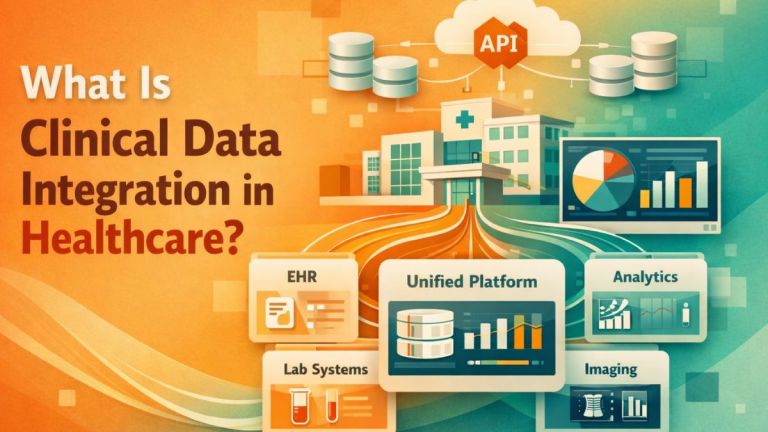
1. Centralize Data Sources for a Single Source of Truth
Why It Matters
An immense number of systems with each holding vital but separate data is the biggest challenge of healthcare organizations. EMRs manage clinical workflows, RCM tools handle billing, payers track claims, and spreadsheets fill gaps in reporting. The result is fragmentation.
Data silos cause:
- Performance reports that disagree (finance vs clinical data).
- Duplicate patient records that make it difficult to coordinate care.
- Operational blind spots in which executives are unable to get the comprehensive view.
The CIOs encounter this fragmentation as a never-ending trouble fidget. The lack of centralized data makes BI reports to be only reactive, inconsistent, and unreliable.
Fast Win Strategy
- Initiate a healthcare-native integration platform. A tool that can handle HL7, FHIR, X12, and CCD standards will bring together different systems quicker than a common middleware.
- Gather data in a central BI repository. This journal will be your “single source of truth” for data analysis.
- Agree and reconfirm inputs. Standardization gets rid of duplicate or mismatched records.
Quick Impact (Within 30 Days)
- Duplicate records reduced by 60–80%.
- Unified dashboards showcase the performance of the leadership team.
- The groundwork for predictive and AI initiatives has been laid.
Real-World Example
An example would be a hospital with 500 beds in the Northeast that made a connection between 12 different systems (EMR, radiology, RCM, and HR). Within 30 days of their executive dashboard launch, they were able to show real-time bed utilization. CFOs and COOs, who before the engagement worked on conflicting spreadsheets, found common ground in the numbers execution – thus, putting an end to their weekly disputes.
CIO Insight
A single point of truth is the first domino in the BI transformation chain. Without it, all other initiatives are at a loss. With it, CIOs are in a position to move from just discussing the numbers to steering the outcomes.
2. Automate Compliance and Regulatory Reporting
Why It Matters
Compliance reporting eats up the time of many employees throughout the year. HIPAA imposes requirements for audit logs and access controls, HITECH supports breach notifications, and CMS demands detailed reporting for reimbursement. Manual processes are:
- Slow → teams spend weeks gathering logs.
- Error-prone → gaps expose organizations to fines.
- Costly → violations can exceed $1.5 million per incident.
Fast Win Strategy
- Employ BI instruments to automate compliance dashboards.
- Allow real-time alerting of unauthorized access, encryption failures, or audit anomalies.
- Produce audit-ready documentation whenever needed.
Quick Impact (Within 30 Days)
- The time for compliance review has been shortened by 40–60%.
- Real-time knowledge of compliance posture.
- Enhanced security and lessened regulatory risk.
Real-World Example
A payer organization automated CMS and HIPAA reporting across 10 states. Preparation for the audit hours was cut from 600 to under 100 in the first month. Management gave CIO the credit for both risk reduction and cost savings.”
CIO Insight
Regulators will not give a break for digital maturity. CIOs can reduce risk by linking BI with compliance, thus they gain trust from regulators and attract the attention of the board level.
3. Launch Clinical and Operational Dashboards
Why It Matters
Without the ability to view or make decisions based on the data, what use is it? Dashboards are the need of the hour for clinical and operational teams which can convert the raw figures into actionable insights. While spreadsheets bring about delays and inconsistencies, dashboards give real-time clarity.
Some of the high-value KPIs are:
- Patient throughput (admissions, discharges, transfers).
- Claims denial rates.
- Staffing levels and overtime usage.
- Appointment no-show rates.
Fast Win Strategy
- First of all, determine 3-5 critical KPIs.
- Create real-time dashboards that can be accessed from any device.
- Functional teams (clinical, financial, operational) to the dashboards.
Quick Impact (Within 30 Days)
- Transparency into bottlenecks and resource allocation.
- Decision-making becomes faster at all levels.
- ROI from BI tools that can be measured.
Real-World Example
A behavioral health provider created dashboards for patient no-shows. Within 30 days, targeted outreach campaigns reduced missed appointments by 12%, improving access and revenue.
CIO Insight
Dashboards are the “showcase layer” of BI. Executives don’t want to hear about your warehouse — they want to see decisions being driven by data.
4. Enable Predictive Analytics for Resource Planning
Why It Matters
Predictive analytics is generally considered by CIOs as something, which is far off in the future and can only be done by advanced AI labs. However even a few simple models can give results almost immediately.
Predictive BI enables:
- Healthy ED forecasting.
- Anticipating staff shortages.
- Inventory Variable Management for Supply Chain.
Fast Win Strategy
- Pull historic data from EMR and RCM.
- Carry out simple regression or time-series forecasting.
- Get staffing and scheduling in line with forecasted demand.
Quick Impact (Within 30 Days)
- Lowered overtime expenditures.
- Improved patient flow during demand surges.
- Enhanced coordination between operations and finance.
Real-World Example
The hospital utilized the data on admissions from the past 2 years to predict the number of ED visits. Within 30 days, they lowered overtime costs by 18% and shortened the average waiting time for the patients by 22 minutes.
CIO Insight
Predictive does not necessarily mean complicated AI. Even small models can quickly demonstrate the worth of BI.
5. Empower Self-Service Analytics for Non-Technical Teams
Why It Matters
The healthcare IT department is overwhelmed with numerous requests for reports. This backlog of work is slowing the process of making decisions and consequently bothering clinicians and executives.
Fast Win Strategy
- Introduce self-service BI tools that include governed datasets.
- Prepare power users to be departmental BI champions.
- Ensure role-based security for data integrity.
Quick Impact (Within 30 Days)
- The backlog of reporting work is reduced by up to 50%.
- Decision-making becomes quicker throughout different departments.
- The leadership team starts to embrace data as a basis for decision-making.
Real-World Example
A dental care organization introduced self-service dashboards to clinical leads. In a month, the IT department’s backlog was reduced by 45%, thus the CIO’s team was able to focus on integration projects.
CIO Insight
Self-service does not bring disorder. When managed properly, it gives teams the power they need and releases the IT department from endless requests for reports.
Overcoming Common Roadblocks
Even fast wins encounter challenges:
- Data Quality Issues → Fix with automated validation.
- Cultural Resistance → Present BI as help, not a takeover.
- Integration Complexity → Rely on healthcare-native interoperability platforms.
- Scope Creep → Concentrate on 3–5 pilot wins before going further.
Measuring Success
CIOs ought to keep an eye on the following parameters after 30 days:
- The time spent on compliance and reporting that can be used elsewhere.
- The percentage of reduction of duplicate records.
- The use of the dashboard by different teams.
- The saving of money resulting from predictive planning.
- The reduction of the IT backlog by means of self-service analytics.
Putting clear metrics in place transform the return on investment of business intelligence into something easily observable and thereby, gain the support of top management further.
The Strategic Value of Business Intelligence in Healthcare
Quick wins are just the beginning. Incorporating business intelligence in healthcare eventually can deliver:
- Seamless communication across the enterprise.
- Up-to-the-minute population health analytics.
- Use of AI in clinical decision making.
- Financial gains through better payer workflows.
For Chief Information Officers, the implementation of Business Intelligence constitutes a pivotal move that transforms the IT department from being a cost center into the one that strategically drives the company towards growth.
Conclusion
In an environment characterized by complexity, regulation, and rapid changes, business intelligence in healthcare is not a choice anymore, but it is a strategic necessity.
By doing 5 fast wins in 30 days centralizing data, automating compliance, launching dashboards, enabling predictive analytics, and empowering self-service CIOs can create an immediate impact and at the same time lay the groundwork for transformation.
The message is that you do not require a huge, multi-year project to unlock the value of BI. What is required is focus, the correct integration platform, and a quick-start mindset.
Ready to see how Vorro can help you streamline BI adoption and deliver results in 30 days? Request a Demo Today.