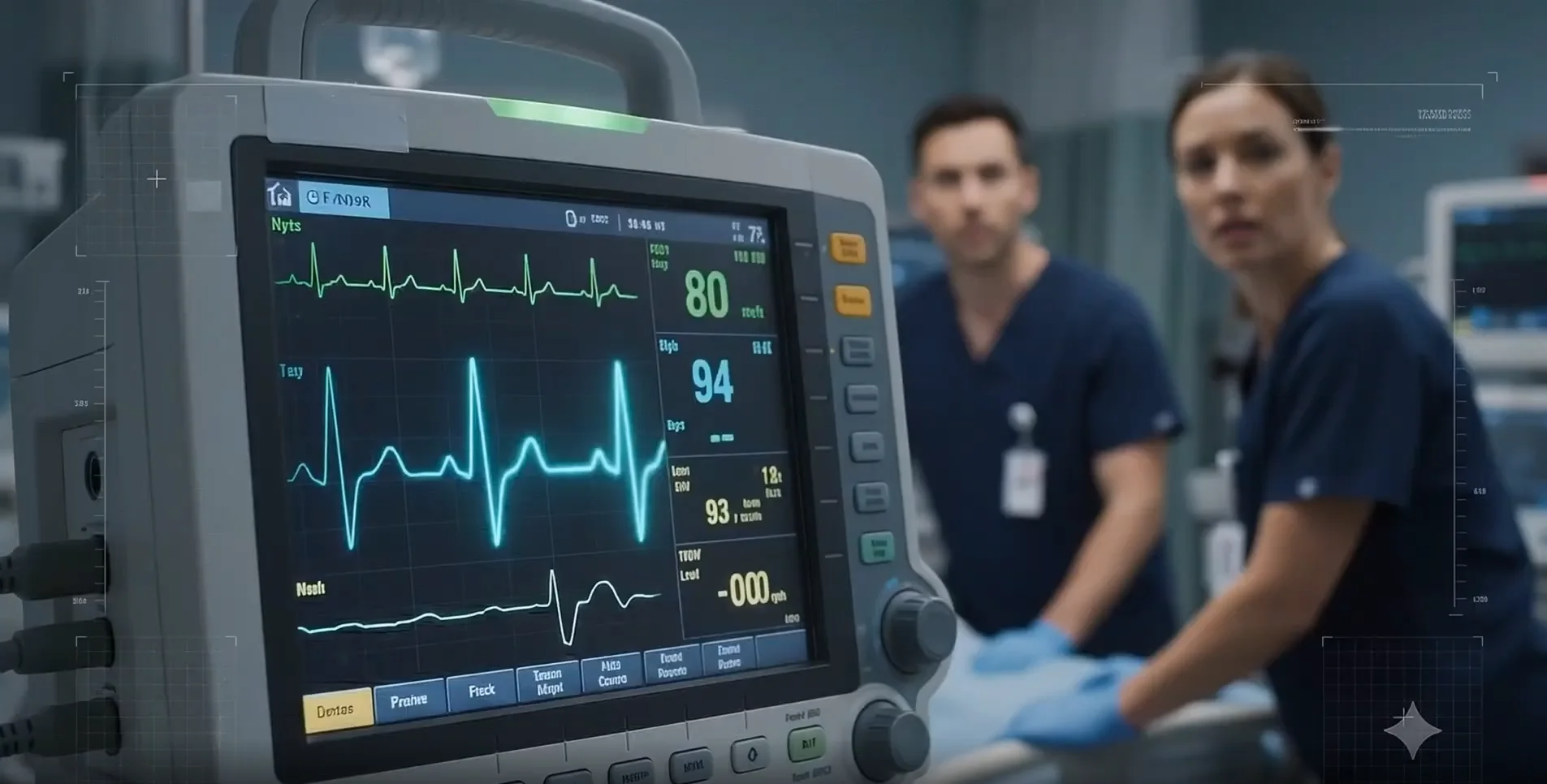
Healthcare organizations are under continuous pressure to achieve more out of less. You strike a balance between increasing patient throughput, manpower constraints, compression of the margins and regulatory pressures. Information must assist in acting quickly in real time, but is usually in locked-up systems or held at nightly batches.
The use of real-time healthcare analytics integrates into a different route. By combining clinical, operational, and financial information on one trustworthy healthcare analytics platform, you establish the platform on which it is possible to act more swiftly, make consistent decisions, and measure the results.
What is Real-Time Healthcare Analytics?
Real-time healthcare analytics implies processing and analysis of data as it is produced or received, rather than waiting to be batch-processed. It links your source systems via a healthcare data pipeline that feeds real-time information to analytics, dashboards and applications with little delay.
Successful healthcare analytics integration incorporates three capabilities. First, you take in data on EHRs, practice management systems, claims platforms, devices, and external partners. Second, you standardize and contextualize that data to get it aligned across sources and care environments. Third, you provide clinical data analytics and operational insights to those people and systems that require them, at the point of decision.
The analytics of real-time patient data are placed on this background. It aims at providing insights into individuals or cohorts (e.g. risk scores, care gaps, and care coordination needs) in a timely manner. By incorporating those insights into the clinical workflows, you transform analytics into healthcare decision intelligence rather than static reports.
Why Real-Time Healthcare Data Integration Matters
Conventional reporting deals with late and disjointed information. That causes lapses to care teams, operations leaders and revenue cycle staff. Real-time healthcare information integration alters the timeliness and fullness of information, which alters the quality of action you are able to execute.
Faster, safer clinical decisions
Clinicians should have the up-to-date information regarding medications, allergies, vital signs, lab findings and care plans. The risk of missed context is reduced when the integration of non-interoperable healthcare analytics retrieves data across multiple JEMs, EHR instantiations, and external partners into a single display. Live analytics of patient data can identify patients that are deteriorating, those with adherence challenges or tasks that need to be done and still time to do so.
More resilient operations
Capacity is needed in care delivery. Healthcare data integration prevents ADT feeds, bed management, OR schedules, staffing, and supply chain data to real-time. The operations leaders receive information on bottlenecks in time. Clinical data analytics will be able to indicate where the throughput is problematic and guide your staff, rooms, and equipment to where demand is high today rather than how it was yesterday.
Stronger financial performance
Revenue cycle teams must have clean and complete data in registration, coding, billing, and collections. With your healthcare data pipeline connected to both clinical and financial data, you will be able to identify errors sooner, eliminate duplication, and facilitate proper and timely reimbursement. Value based arrangements are also facilitated by a connected healthcare analytics platform that connects outcomes, quality measures and cost data in near real time.
Better alignment across the ecosystem
Each of the health systems, physician groups, payers, and partners has distinct systems and data models. Integration of real-time healthcare data assists you to share and analyze data in real-time. With a single version of the truth, you can support care coordination, risk contracts and partner programs, rather than having conflicting flat files and manual reconciliations.
Key Components of Healthcare Analytics Integration
The integration of healthcare analytics is far more than the transfer of data between the points of A and B. It requires design, management, and automation that consider the intricacy of healthcare data and workflows.
1. Flexible healthcare data pipeline
Data in a healthcare data pipeline should be ingested, transformed, and provided in a variety of protocols and formats. Those are HL7 v2 messages, FHIR APIs, flat files, CSV exports, X12 transactions, and device data. An efficient integration strategy gives:
- EHRs, LIS, RIS, pharmacy, billing, and HIEs connectors.
- Both real-time and batch healthcare data integration support.
- Not just scheduled jobs: Event-driven streaming data architectures.
- Project and partner data flow reusability.
2. Standardization and enrichment
Various systems define the same concept differently. A successful healthcare analytics integration must have shared vocabularies and mapping rules. You match identifiers, codes, locations and provider information to perform analytics on the entire enterprise. This includes:
- Diagnoses, procedures, lab, and medication terminology mapping.
- Index of master patients or other identity resolving techniques.
- Provider and facility and service line reference data.
- Business rules that add context to events e.g. service category or line of business.
3. Centralized healthcare analytics platform
The environment, where integrated data is stored, processed, and analyzed, is known as a healthcare analytics platform. It may entail a data lake, data warehouse and analytic tools. It should also have the support of event processing and streaming to facilitate real-time patient data analytics. Core capabilities include:
- Clinical, operational and financial unified data models.
- Data support in both structured and unstructured data.
- Analytics and data scientists accessibility through self service.
- APIs that leak information and observations back to source systems.
4. Governance and security
Integration of healthcare analytics accesses PHI and sensitive operational information. There can be no compromise over governance. You need:
- Decision making processes and roles of data stewardship.
- Role and use case access controls.
- Data movement/access audit.
- Retention, de identification and consent policies.
5. Monitoring and observability
A healthcare data pipeline needs to be monitored continuously. You monitor throughputs of messages, response time, error counts and data quality. Dashboards and alerts assist your crew to respond prior to issues impacting clinicians or patients. Observability not only decreases the time required to conduct root cause analysis, but also builds confidence in your decision intelligence outputs in healthcare.
Real-Time Patient Data Analytics Use Cases
The analytics of real-time patient data will be useful when it is not placed outside of clinical and operational workflows. You may rank use cases that are linked directly to patient outcomes, safety, throughput, or cost.
Care escalation and early warning
Transmitting vital signs, laboratory findings, and nursing evaluations into your healthcare analytics environment will allow you to notice patients whose conditions worsen. These signals are fed into scoring models or basic thresholds using the integration of real-time healthcare data. Alerts may also send to care teams within the EHR, messaging systems, or central monitoring stations, and therefore prevent conditions deteriorating.
Throughput and capacity management
Hospitals are under the usual pressure of bed, ED bay, and procedural areas. The patient data analytics campaigns in real time can demonstrate the position of the patient along the path through arrival to discharge. Healthcare data pipeline gathers the ADT messages, transport events, orders, and discharge planning notes. The analytics then point to the bottlenecks and facilitates decisions like the time to open flex units or shift the staff.
Care coordination and transitions
Clinical data analytics is useful in managing the transition between inpatient, outpatient, and post acute and home settings. Workflow can be used to initiate outreach to care managers when risk transitions are high by getting ADT event, referral data, and scheduling information. The integration of real time healthcare data with external partners can make your team aware of patients who attend external EDs or fail to receive essential follow ups.
Medication management and adherence
Adverse medication errors and low adherence have an impact on outcomes and cost. Combined medication orders, fills, and clinical outcomes are the source of a healthcare data pipeline that provides targeted interventions. Analytics of patient data can be used in real time to identify the possible high risk combinations, missed refills, or dose adjustments to enable clinicians to intervene early.
Quality measures and population health
Population health teams are known to operate using delayed reports of measure. With near real time quality tracking using healthcare analytics integration, you are able to know the gaps of care that are open and call the patients as long as they have plans to visit. Clinical data analytics have the ability to connect labs, vitals, and visit data across environments so that you can visualize measure performance in relation, not as a scorecard.
Healthcare Data Streaming Technologies
Data streaming in healthcare brings about a pattern that is not similar to the traditional batch ETL. You shift planned data retrievals to event streams that are fed in and processed by your healthcare analytics platform on a near real-time basis.
Event driven integration
Rather than receiving daily files, an event driven healthcare data pipeline receives new ADT messages, order events, or claim status change, or device readings. With every event, there is context regarding an action or change of state. These events are received, redirected and processed by your streaming infrastructure.
Message brokers and streaming platforms
In healthcare data streaming, message brokers and streaming platforms assist in decoupling consumers and producers. Events are published by source systems and subscribed to by a number of downstream systems. This trend enables scalability and reuse. Real-time patient data analytics, capacity dashboards and care management workflows can be supported by the same stream of ADT events without any target point-to-point interfaces.
Real-time transformation and enrichment
Pipelines streaming has yet to go through validation, mapping, and enrichment. The healthcare analytics integration tools of the modern technology can assist in transformation as the events run through the pipeline. You can:
- Authenticate business rules and fields.
- Codes to standard vocabularies.
- Attach reference data, e.g. provider or facility attributes.
- Content based route events, e.g., acuity or service line.
Streaming analytics and decision services
After events have been sent into your healthcare analytics platform by healthcare data streaming, you can continuously analyse the flow. That includes:
- Clinical decision support rules engines.
- Stream aggregation of census, throughput and volumes.
- Next-generation risk score prediction models that refresh as new information is received.
- APIs exacerbating the disclosures back to partner systems and EHRs
Building a Real-Time Healthcare Analytics Platform
To develop a powerful healthcare analytics system to enable real-time insights, it is important to have clear objectives and to implement the project in phases. The enablers are integration and streaming, and not objectives. You make technical decisions in line with clinical and business outcomes at the beginning.
Clarify use cases and success metrics
It is important to state the particular use cases and their beneficiaries before you design a healthcare data pipeline. Some of these may be minimizing unnecessary transfers, decreasing the ED length of stay, endorsing value based arrangements, or enhancing referral completion. In both cases, define the decisions that you want to support and the processes that you will modify. This determines at which data you require on the fly and at which data you can afford to leave in batch.
Inventory and prioritize data sources
Name existing systems, clinical, operational, and financial. Determine which ones already have streaming interfaces and those which are based on flat files or reports. In case of healthcare analytics integration, look at the high value sources like EHRs, ADT feeds, scheduling and billing. Orchestrate a steady growth as your team becomes accustomed and has confidence in the platform.
Design the integration and storage architecture
The likely combination of streaming queues, operational data stores, data lakes, and warehouses will be your healthcare analytics platform. The design should:
- Support real-time integration of healthcare data and scheduled loads.
- Disaggregated raw, editing, and presentation.
- Standard integration patterns will be used to minimize individual work.
- Auto-match storage types with workloads including reporting, data science and operational dashboards.
Embed analytics into workflows
Integrating healthcare analytics in real-time works to provide value only when insights are displayed in the tools already used by your teams. Those are EHR screens, care management systems, OR management tools and mobile apps. Introduce APIs, context aware links, or in workflow notifications to display healthcare decision intelligence at the moment of action, rather than in separate portals.
Establish governance and change management
Clinical practice, staffing, and reporting rely on a healthcare analytics platform, therefore, a governance and change management are crucial. Establish cross functional teams comprising of clinicians, operations chiefs, IT, and analytics. Concur on the definition of data, authorize new uses of data and audit the effects of new models or rules. Train and support to ensure that the teams are knowledgeable about how to interpret and trust the outcome of real-time patient data analytics.
Iterate and scale
The integration of healthcare analytics is not a single-time project. Begin with a small number of real-time use cases that are consistent to definite results, and grow. Refine business rules, modify thresholds and enhance data quality using monitoring and user feedback. With time, your healthcare data pipeline and healthcare analytics platform are considered a common asset that serves as a foundation to an increasing portfolio of initiatives.
Challenges in Real-Time Healthcare Data Processing
Live healthcare data processing creates both technical and organizational issues. The sooner they are addressed, the better.
Data quality and consistency
The source systems may have missing fields, local codes or inconsistent workflows. Teams correct these problems in a batch world by cleaning them by hand. Bad data travels faster in a streaming world and may generate incorrect alerts or fallacious analytics. To ensure that your healthcare data pipeline is valid, it must have error handling, feedback loops, and validation rules to ensure that problems are identified and corrected at the earliest stage.
Latency and performance
The healthcare data integration requires real time low latency flows between systems to your healthcare analytics system. The slowing down can be caused by complex transformation, network constraints or under sized infrastructure. You require performance monitoring, scaling streaming infrastructure, and an understanding of what good delay should be in various uses cases.
Integration complexity
The legacy systems, vendor constraints, and custom interfaces are part of healthcare ecosystems. The applications offer modern APIs in some cases and in other cases, rely on flat files or older protocols. An excellent integration approach is one that strikes a balance between the present constraints and the future flexibility. Adaptable patterns, integration teams and platform level services minimise the pressure of one off projects.
Security and compliance
Live data processing of healthcare data enhances the speed and amount of PHI transfer. That increases risk in the case of weak or inconsistent security controls. Your healthcare analytics integration strategy should match regulatory requirements on encryption, access control and auditing. Your healthcare data pipeline and analytics tools should apply role based access, least privilege principles and consistent logging.
Organizational readiness and trust
Clinical and operational behavior may be altered through real-time patient data analytics. Unless teams trust the data or models, they will not heed warnings or will go back to manual workarounds. Involvement of clinicians, logic articulation, and performance tracking with clarity contribute to the development of trust. Begin with clinical judgment-supportive but not clinical judgment-overriding use cases. With time, you develop dependency on healthcare decision intelligence because its importance is realized.
Benefits of Healthcare Decision Intelligence
Once you strap healthcare analytics integration, streaming, and workflow design, you quit stagnant reporting to healthcare decision intelligence. It implies that your organization relies on integrated information to make consistent and timely decisions at interorganizational roles and settings.
More consistent clinical practice
Decision intelligence assists in standardization of response to similar clinical situations. Guidelines, risk scores, and checklists are fed with real-time healthcare data integration into workflows to ensure that teams in units and facilities react in coherent ways. This eliminates unnecessary variation and contributes to quality and safety objectives.
Faster, more confident decisions
Clinicians and leaders obtain up-to-date and contextual data rather than outpaced snapshots. Healthcare analytics platform displays the trends, risk factors, and the history involved at the decision-making point. The decision-making process in high pressure environments is faster and more confident with real time patient data analytics and easy visualizations to assist the teams in making their decisions.
Aligned clinical, operational, and financial goals
Healthcare decision intelligence bridges the gap between clinical outcomes and operational measures to financial performance. When healthcare analytics integration links these areas, leaders can observe the impact of throughput, staffing or case mix on margins and contracts. Such alignment will favour more consistent strategies and resource allocation.
Scalable innovation
An advanced healthcare data pipeline and healthcare analytics platform provide a foundation where continuous innovation can take place. After establishing real-time healthcare data integration, it is quicker and less risky to add new models, quality programs or operational dashboards. You use prior integrations, security measures and governance procedures and do not begin anew every time.
Progress toward learning health system goals
Healthcare decision intelligence facilitates the ongoing learning. You assess the effectiveness of new procedures, online resources, or staffing designs with the help of combined data. Lessons are used in feedback of practice and system design. As time goes on, your real-time healthcare analytics integration will assist the organization to be more responsive to new challenges, regulations, and care models.
Vorro assists the health systems, provider groups and healthcare organizations to establish safe and scalable integration infrastructure that facilitates real-time integration of healthcare data as well as decision intelligence. To streamline your healthcare data architecture, fortify your healthcare data pipeline, and convert fragmented feeds into a unified healthcare analytics platform to serve clinicians and leaders, talk with Vorro.