By Akshita Kohli · March 25, 2026
You are sitting on a greater amount of clinical, operational and financial data than ever before. However, in the absence of the appropriate healthcare data integration software, that data will remain trapped in silos, slow down decision-making and compromise results. The correct platform integrates your systems and standardizes your information, and provides each stakeholder with a trusted perspective of the reality.
In order to get there, you must have definite assessment standards. You should also have a realistic perspective of what is important within the contemporary healthcare settings, whether in hospitals, clinics, labs, payers, or digital health partners. This guide takes a stroll on the fundamental functions that you ought to anticipate of healthcare data integration instruments, the way they contribute to healthcare interoperability software objectives, and what distinguishes tactical middleware and strategic clinical data integration solutions.
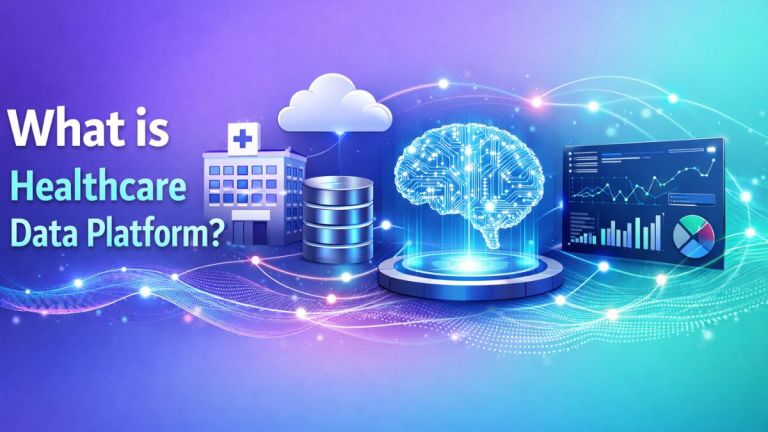
What is Healthcare Data Integration Software?
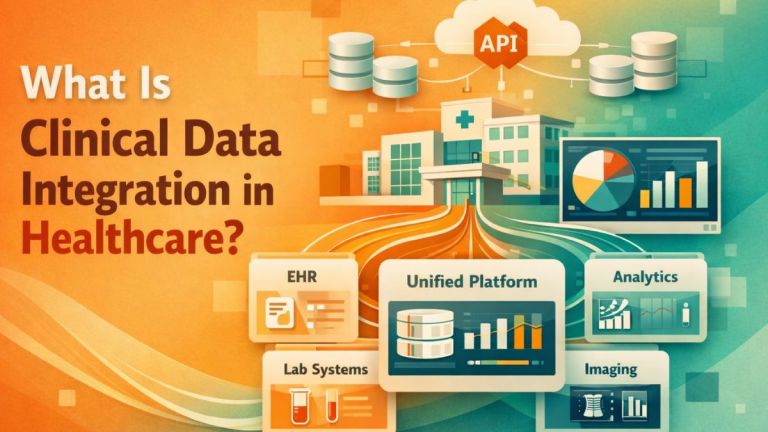
Healthcare data integration software bridges, converts, and coordinates data in clinical, operational and financial systems. It extracts data out of electronic health records, practice management systems, revenue cycle systems, lab information systems, imaging systems, digital front door, and external partners. It then standardizes and forwards that information to make each system get that which it requires, in the format it anticipates.
In essence, healthcare systems data integration resolves four nagging issues. Information exists in various forms. There are various standards used in systems. The workflows are dependent on manual processing. The stakeholders do not possess a uniform perception of patient and business information. The integration platforms and healthcare data management software minimize the friction in all four aspects.
An effective healthcare data integration platform has both support to both legacy and modern standards, real time and batch processing, and event triggered workflow. It must enable you to transport clinical and non clinical data in a secure manner, and trace the origin of the data, its destination, and the transformation that it undergoes.
In evaluating healthcare data integration tools, you look at the extent to which they serve your own ecosystem. That encompasses your existing systems, your digital health strategy in the future and your regulatory posture. Healthcare integration is not a one time project. It is a continuous ability that facilitates quality enhancement, value based care, functional resilience.
Core Features of Healthcare Data Integration Software
The data integration software that is used in healthcare must provide your team with a clear and manageable method of integrating in healthcare systems without the need to write custom programmes all the time. In the process of evaluating products, you seek a package of core capabilities that limit risk and accelerate delivery.
Flexible connectivity and adapters
Your integration platform must be wide in terms of protocol and interfaces. Those will be HL7 messaging, FHIR APIs, REST and SOAP services, file based transfers, database connections and vendor specific APIs. You ought to be in a position to be linked with EHRs, laboratories, radiological systems, billing systems, and third-party applications through included connectors or adaptable adapters.
The powerful facility of healthcare data integration platform ensures that the addition of additional endpoints is easy. You do not have to deal with one off integrations with every partner or application. Rather, you are dependent on a library of connection types, reusable configurations, and regular monitoring.
Configurable data mapping and transformation
The data do not often come in the form that your target system desires. The features of healthcare data standardization and mapping enable you to define the way fields will be mapped between systems, code conversion, and the way messages change between standards. An example includes translating local codes to standard terminologies or converting HL7 messages to FHIR resources.
Search visual mapping, visual templates of transformation, complex logic. In the majority of cases, your integration team should not do new development work to tailor message structures, values, and rules; instead, it should be configured.
Workflow orchestration
Integration in the healthcare sector is hardly ever a point to point transfer. An outcome of a lab could lead to a notification, a change to various systems, analytics events, and audit logs. Intensity, multi step processes that react to events and solve the exceptions should be facilitated by healthcare data integration software, which is designed to orchestrate the workflow.
You acquire more than connectivity. You obtain a means to plan clinical and business processes across several systems, and have a clear insight into every step.
Monitoring, alerting, and observability
When an interface malfunctions during the night, you must know ahead of time before clinicians start to feel the pain. The healthcare data integration tools are supposed to have powerful monitoring, logging and alerting capabilities. And you use dashboards and alerts to monitor the volume of messages sent, error rates, latency, and endpoint health.
Tracing of messages and detailed logs are also important. Your team must pursue one message all the way through to the end, know how it changed, and where there was an error. Such observability minimizes downtime and lessens the investigation periods.
Role based administration and self service
Integration cuts across business and clinical processes. You require definite roles and permissions. Find configuration choices that allow integration engineers, analysts and operational stakeholders to view what they require and leave sensitive controls unseen.
You desire a certain degree of self service with time. As an example, analysts can define new routing policies, or modification of mappings, within controlled limits. This liberates your most technical employees to work on the complicated work, yet maintains governance.
Also Read: Build vs Buy Healthcare Data Integration Software
Healthcare Interoperability and Data Standardization Capabilities
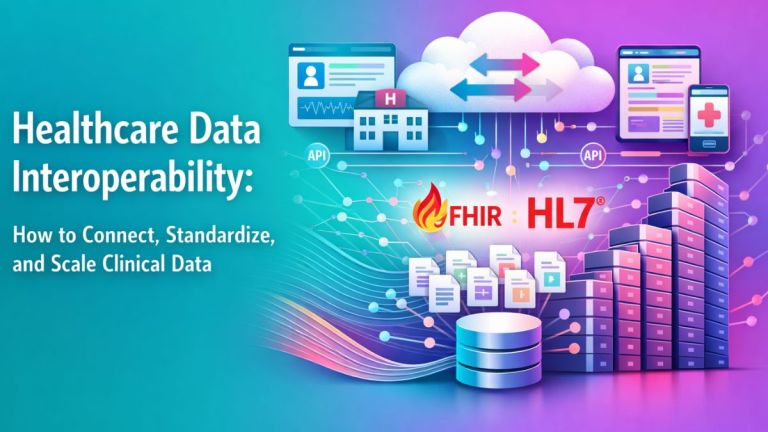
Healthcare interoperability software aims at the exchange and utilization of information between the organizational and vendors. This should be facilitated by the healthcare data integration software. It normalizes formats and semantics such that data maintains its meaning when transferred between systems.
Support for industry standards
Powerful healthcare data integration applications endorse significant healthcare norms. Those are HL7 v2 messaging, FHIR APIs, CDA documents, and typical imaging or lab formats. There should be an inbound and outbound flow through your platform that covers these standards.
The endorsement of payer based standards and common provider data feeds are also important. The more extensive your coverage is, the easier it is to interface with exchanges, registries, payers, and digital health partners.
Terminology normalization
Message format is not the only standard of healthcare data. Codes and terminologies should be normalized with the help of your integration platform. That has support of clinical vocabularies, procedure codes, and medication codes. This minimizes confusion in the event that you are pooling data between facilities and vendors.
The terminology services may reside within the platform or may be closely connected with an external resource. In any case, clinical data integration solutions must implement a consistent logic of terminology logic across all integrations requiring it, and not in customary code that is singletary.
Cross organizational interoperability patterns
Healthcare interoperability software does not only sustain internal flows. And you share information with other hospitals, referral partners, payers, and local health departments. Search on features of external trust relationship, master patient index integration, consent handling hooks and external connection templates.
You desire patterns that are both push and pull models. That comprises the subscription based notification, query based retrieval and bulk transfers where applicable. Integrate your healthcare systems with flexible data to enable you to keep up with changes in network relationships and policy.
Also Read: Real-Time Healthcare Analytics Integration
Data Quality and Governance Features in Healthcare Integration Tools
The lack of quality creates new risk in terms of interoperability. Low data quality results in clinical mishaps, payment challenges, as well as distrust in analytics. Any healthcare data management software is expected to embed the concept of quality and governance into each flow of integration.
Validation and enrichment
Alongside this, healthcare data integration software must verify the messages and records against both structural and business regulations before the message is sent to target systems. That involves validation of mandatory fields, code sets, value ranges and referential integrity. Failed records must have a distinct exception process including alerts and remediation choices.
The use of enrichment features allows one to add the missing context of records during integration. You could add on other identifiers, code translations or combine reference table data. The output is more complete and clean data to downstream systems.
Master data and identity management integration
Reliable integration is in the middle of patient and provider identity accuracy. Clinical data integration solutions ought to connect with master patient index and provider master systems or have inherent abilities. A platform must accommodate identity resolution hooks to enable every integration to be able to make reference to a unified source of truth.
This minimizes the overwriting of records, mismatched identities when you consolidate feeds between two (or more) facilities, practices or partner networks.
Data lineage and audit trails
Good governance demands transparency in the movement and altering of data. The healthcare data integration tools must the data lineage in order to trace the origin, transformation, and destination of each flow. Comprehensive audit trails allow you to answer compliance audits and other internal queries with tangible evidence.
Once a clinician/analyst questions a value, your team needs to search and find it using both integration logic and source systems. Such transparency helps to build trust and resolve problems much faster.
Policy driven governance
The governance must not be based on the tribal knowledge. Your medical data aggregation application must allow you to set up marketing policies with respect to retention, routing, masking, and access. Such policies are supposed to be applied in all the appropriate integrations.
You can give such rules as, say, the length of time to keep logs of messages or which fields to conceal under certain roles, or how to direct particular types of document. Policies based control minimizes variation and human error in the long-run.
Also Read: Healthcare Data Transformation for Value-Based Care Model
Security and Compliance Requirements for Healthcare Data Platforms
Healthcare data has a high regulatory and ethical accountability. The integration platform is in the core of sensitive flows, thus security and compliance features are not a luxury. They are fundamental criteria of selection.
End to end encryption
Data encryption in transit and rest should be done by the healthcare data integration software. It implies secure procedures of all external or internal connections as well as the strong encryption of the data that is stored, configuration, and backups.
Important management practices are also important. How the platform manages keys, rotation, and separation of duties should be understood. There should be well defined, documented controls in your security team that are in line with organizational standards.
Access control and authentication
Effective role based access control assists you in restricting the individuals who can access, manage and use integrations. Authentication is to be combined with your identity providers and single sign on services. You can then use the same login and multi factor policies in your team.
You are supposed to be able to control access to certain integrations, environments, and data views. This minimizes the risks of internal abuse or mere errors, and can defend the least privilege principle.
Compliance alignment
Healthcare data management software should facilitate requirements of compliance that are applicable to your organization. The platform must offer audit logging, retention settings, security, and documentation as defined by the healthcare regulations and data protection laws of your geographical areas of operation.
Checklists are not the only thing when it comes to compliance. The integration partner is expected to know what is needed in healthcare regulatory requirements and develop platform functionality to meet them. This decreases conflict with the inside compliance teams and the outside auditors.
Segregation of environments
The data integration tools used in healthcare must be in a position to facilitate the demarcation of development, test and production environments. You must have mechanisms to ensure that unjustified changes do not get to the live interfaces. You must also have methods of operating with representative data in a safe way when testing without sensitive information.
Find environment promotion processes, change management and configuration versioning. The combination of these features constitutes a controlled deployment pipeline which mitigates outage and security risk.
Scalability and Performance in Healthcare Data Integration Platforms
There is an increase in the number of messages, types of data, and integration points as your organization grows. The software should be able to scale healthcare data integration software without being redesigned continuously. Featuring checklists are less important than performance, resilience and flexibility.
Elastic processing capacity
The workloads of the integration tend to burst at certain times or occurrences. Variable volumes should be taken care of by your platform without delays or backlog that can influence clinical workflows. Find architectures which enable horizontal scaling, distribution of workloads and control of resources.
Monitoring integrations and latency across integrations should be observed by your team, and capacity should be adjusted in a structured manner, rather than struggling with frequent bottlenecks.
High availability and resilience
Healthcare systems data integration helps in care delivery processes and revenue cycle. Downtime causes a clinical risk and financial impact. Your integration system is supposed to accommodate high availability design, provision of failure over, and recuperation steps that are in line with your business continuity anticipations.
How does the platform react to node failures, data persistence and restarts? The operations team ought to be aware of the recovery steps and make them a routine test.
Performance monitoring and tuning
Scalability does not occur through chance. The performance measures of platform and integration should be exposed by healthcare data integration tools. You monitor processing time, queue level, resource usage, and endpoint responsiveness.
These pieces of knowledge inform tuning. An example is you may change batching strategies, or more mapping logic, or better routing to decrease latency and resource usage without reliability being compromised.
Support for hybrid and multi site deployments
A good number of healthcare organizations work in various regions and settings. You may have some systems on the premises and others on one or more clouds. Data integration software used in healthcare must be able to support models of hybrid deployment without highly complicated workarounds.
This involves safe interconnections among sites, centralized monitoring as well as regular governance. Unless there is a strong necessity you should not have entirely separate integration stacks in each facility. Integrity helps lower overheads and misalignment in operations.
How to Choose the Right Healthcare Data Integration Solution
Your choice process is required to be structured with numerous products claiming to be healthcare interoperability software or integration platform. You match platform capabilities to your strategy, limitations and schedules.
Start with your integration roadmap
Prior to comparing vendors, specify your priorities in top integration during the coming few years. As an illustration, one of your plans may be to increase virtual care, form alliances with other partners, upgrade your analytics platform, or centralize EHRs among facilities.
Those goals can be used to establish the most essential healthcare data integration platform characteristics in your setting. High volume batch processing, strong FHIR support, real time event processing, or high volume event processing may be of lower priority to your roadmap.
Assess fit with your current ecosystem
Enumerate your major systems, standards and data flows. Determine areas of failure on bringing together, generate manual work or choke new initiatives. Thereupon assess the integration capabilities of each healthcare data integration software solution in regards to how it interrelates to those systems and how it manages those pain points.
Weight solutions will be given to solutions that already integrate with your primary EHR, lab, imaging, and revenue cycle vendors. Connectors and reference implementations that are built in minimize project risk and timeframes.
Evaluate usability for your teams
The best platform will be a disaster whenever your team struggle to operate it. Involve integration engineers, analysts and operations leaders in assessments. Request them to conduct actual tasks with the use of healthcare data integration tools when demonstrating the concept.
Seek easy to use user interfaces, maps, workflow design, good documentation and training materials. cooperation between technical and clinical stakeholders: a platform that allows mutual understanding forms more sustainable integrations.
Review governance, security, and compliance support
Engage your security and compliance teams. Provide information about encryption, access control, audit logging and deployment models. Establish that the platform meets your regulatory standards and corporate sources of healthcare data management software.
Your system of governance must be in line with characteristics in the platform. Collectively, they develop a consistent strategy of developing and maintaining safe integrations.
Consider long term partnership and innovation
Healthcare systems data integration is not a one time purchase. You require an ally that makes investment in new standards, helps to develop new use cases, and is aware of the healthcare operational realities. Assess the vendor road map, healthcare concentration and customer success strategy.
Question how they facilitate migrations like on premises to cloud migrations, migration to new interoperability models or post-merger consolidation. The husband or fiancee assists you in adapting and does not bind you with the previous choices.
Align on measurable outcomes
Connect your integration investments with definite results. That could be less manual reconciliation, quicker onboarding of partners, enhanced quality of data to analytics, or more dependable clinical alerts. Identify these results at the outset, and how each clinical data integration solution can contribute to them.
This maintains discussions based on operational and patient impact, as opposed to feature count only. It also provides you with a method of measuring effectiveness post-deployment and drive onward improvement.
Vorro concentrates on healthcare data integration software that eases complexity and quickens the outcomes. In case you require a healthcare data integration solution to meet your real world clinical and operational needs, reach out to Vorro to match your integration strategy with your next phase of expansion.