By Anubhav Awasthi · December 31, 2025
Your clinicians make hundreds of decisions every shift. Each decision draws on fragments of information from EMRs, monitors, labs, imaging, and bedside assessments. When those data streams stay disconnected or delayed, risk rises and outcomes suffer.
Real-time healthcare data changes that equation. It gives your teams the clinical decision support data they need, at the moment of care, in the systems they already use. Instead of searching, exporting, or waiting, they see a current, contextual view of the patient.
To reach that state, you need more than another dashboard. You need real-time EMR integration, standards-based interoperability, and a clear plan for governance and adoption. When those pieces line up, you turn raw patient outcomes data into sustained clinical improvement.
Why Real-Time Data Matters
Real-time healthcare data is not only about speed. It is about aligning clinical decisions with the freshest and most complete patient context. As care grows more complex, the lag between data capture and data use becomes a clinical risk, not only an efficiency issue.
Studies keep reinforcing this point. Hospitals that use advanced healthcare analytics and clinical decision support see measurable gains. One analysis found a 30% relative reduction in in-hospital mortality when sepsis alerts were effectively integrated into workflows. Another study associated EMR-linked decision support with a 7% drop in inpatient complications.
To deliver similar results, your clinicians need to trust that the numbers they see reflect the current state of the patient. That trust only builds when:
- Data arrives from devices, labs, and external systems in near real time.
- Patient outcomes data is normalized and reconciled across sources.
- Signals appear inside the core EMR workflow, not in separate portals.
- Alerts follow clinically defined rules, not generic thresholds.
When those conditions hold, teams can move from retrospective review to proactive intervention. Instead of asking what happened last week, they focus on what needs attention in the next hour.
Also Read: Data Integration ROI: Platform vs In‑House Build — What American Hospitals Should Know
Clinical Use Cases
Sepsis and Deterioration Detection
Early sepsis recognition is one of the clearest examples of the value of real-time healthcare data. Sepsis often presents as a subtle pattern across vitals, labs, and nursing notes. If those data points arrive piecemeal, the pattern hides in plain sight.
Real-time EMR integration lets you aggregate vitals from bedside monitors, lactate values from labs, and med administration data. Then you apply evidence-based rules or predictive scores. One multi-hospital study reported a 12.5% relative reduction in sepsis mortality after implementing a real-time electronic sepsis alert tied to nurse workflows.
For your teams, the biggest win is clarity. They see a unified sepsis risk indicator inside the patient chart, backed by transparent logic. They act sooner, escalate faster, and document more consistently, which improves both patient outcomes data and financial performance.
Emergency Department Throughput and Triage
In the ED, minutes matter. Real-time healthcare data from triage, labs, and radiology helps you move from static queues to dynamic prioritization. Instead of relying only on arrival time and initial acuity, you route patients based on continuous risk signals.
Health systems that invested in real-time dashboards and decision support for ED flow reported average reductions of 10% to 15% in door-to-provider time and left-without-being-seen rates. Those gains do not come from more data alone. They come from integrating that data directly into triage and bed management decisions.
With integrated clinical decision support data, your ED leaders see:
- Real-time queues by acuity, arrival mode, and staffing level.
- Live status of labs, imaging, and consults for each patient.
- Escalation alerts for pain, vitals, or boarding duration.
That view helps you improve throughput without sacrificing safety, and it sets a strong foundation for broader hospital capacity management.
Chronic Disease Management and Population Health
Real-time healthcare data is not only for the hospital. In ambulatory and population health programs, timely signals help you intervene before patients land in the ED or require admission.
When you integrate claims, EMR data, remote monitoring feeds, and social risk factors, you get a more complete picture of risk. One large health system reported a 25% reduction in readmissions for heart failure patients after deploying real-time risk models and outreach workflows.
In practice, this looks like:
- Near real-time alerts when high-risk patients miss refills.
- Automatic flags when remote BP or glucose readings cross defined ranges.
- Care manager worklists fed by current patient outcomes data, not static registries.
Your teams can then focus scarce care management resources on the patients who need attention today.
Medication Safety and Antimicrobial Stewardship
Medication errors and inappropriate antibiotic use drive avoidable harm and cost. Real-time EMR integration supports safer, more precise therapy choices.
When pharmacy systems, labs, and EMRs talk in real time, you can trigger alerts for renal dosing, QT risk, or duplicate therapy at the point of ordering. A study of hospitals using advanced decision support reported a 55% reduction in serious medication errors after implementation.
For antimicrobial stewardship, real-time microbiology results, allergy data, and previous culture history let your teams narrow therapy quickly. That improves patient outcomes and reduces resistance, while also strengthening your quality measure performance.
Also Read: The Impact of AI and Automation on Healthcare Claims Processing
Technology Enablers
To make these use cases work, you need a technical foundation that supports real-time healthcare data without increasing clinician burden. The key enablers include:
Standards-Based Interoperability
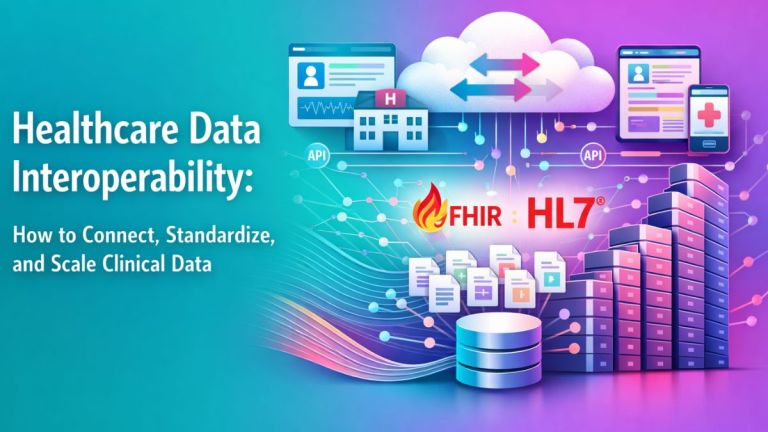
Modern interoperability standards such as HL7 FHIR and secure APIs give you a path to more flexible data exchange. They help you move from point-to-point interfaces toward a service-oriented model.
With the right integration layer, you can:
- Ingest HL7 v2 messages from lab and ADT systems in real time.
- Expose normalized patient outcomes data through FHIR APIs.
- Connect devices and third-party apps without custom builds each time.
This approach supports incremental growth. You can start with one high-value workflow, then expand as adoption and ROI grow.
Real-Time EMR Integration and Event Streaming
Real-time EMR integration sits at the center of any successful initiative. Your EMR holds orders, documentation, and a large part of your clinical signal. If your decision support relies on nightly extracts, your teams will feel the lag.
Event-driven architectures and streaming technologies address this problem. They allow you to subscribe to new orders, results, or status changes as they occur. Those events flow through a data integration platform that enriches, normalizes, and routes them to:
- Clinical decision support engines.
- Real-time analytics dashboards.
- Population health and care management tools.
The output feeds back into the EMR in the form of alerts, flags, or structured data, so clinicians never need to leave their primary system of record.
Clinical Decision Support and Analytics Engines
Real-time healthcare data has limited value without a mechanism to interpret it. Clinical decision support engines convert raw data into context-sensitive insights. Healthcare analytics platforms provide the reporting, trending, and visualization needed for leadership.
As you assess or optimize these engines, you should focus on:
- Transparency of logic and thresholds.
- Rule tuning by specialty and geographical location.
- Performance at the volume and latency your workflows require.
When analytics and decision support share the same source of truth, your improvement teams can tie interventions directly to changes in patient outcomes data.
Data Governance, Security, and Compliance
As your real-time footprint grows, so does your responsibility. It seems that the faster the information, the more it has to remain secure and HIPAA-compliant.
Strong programs include:
- Identified ownership and responsibility of data pertaining to each domain.
- Good standards regarding consent, sharing, and secondary uses.
- Constant monitoring for access, anomalies, or performance.
These areas of study safeguard your organization and foster trust within clinicians and patients alike, which is critical for achieving wide-scale acceptance of solutions in the area of real-time healthcare data.
Implementation Challenges
When it comes to moving from strategy to execution, it not only leads to holes in the areas of processes, technology, and culture but also prepares you to overcome these in advance.
Data Quality and Standardization
Real-time integration magnifies both the positives and negatives that are present. If the data that came from the source was not consistent or accurate, then the faster movement of the data multiplies the inaccuracies. Therefore, standards with regard to identifiers, units of measure, and code sets are required among the systems that are linked.
Develop a common data dictionary of key elements used in real-time data exchange in healthcare. Align around code systems such as LOINC and/or SNOMED where feasible. Validation rules need to be applied at the time of data ingestion, not merely in an analytics context.
Alert Fatigue and Workflow Fit
One of the most common risks in clinical decision support data programs is alert fatigue. If clinicians receive a high volume of low-value alerts, they override or ignore signals, which undercuts outcomes.
Studies involving warning notices issued by EMR systems showed that override rates exceeded 70% in some areas. This was related to misattribution, lack of relevant information, and poor customization. To prevent this from happening, your teams must collaborate and co-design rules with your physicians.
Strive for more focused notifications that appear at the correct point within the workflow process by providing clear actions that require less clicking. Offer loops of feedback to allow medical personnel to point out errors and improvements.
Legacy Systems and Integration Complexity
Many organizations support mixed systems that belong to modern systems as well as legacy systems. Some systems may not support APIs naturally. Some support APIs but offer data in HL7 versioning that is quite old, and in some cases, is their proprietary versions.
A robust integration platform reduces this burden. It gives you a consistent way to connect, transform, and route data between systems. Over time, you can decouple clinical workflows from the lifecycle of any single application, which supports future modernization.
Change Management and Clinical Adoption
Real-time healthcare data initiatives affect how people work, not only what data they see. Without thoughtful change management, users fall back on old habits, and your investment underperforms.
Effective programs:
- Involve clinical leaders promptly as co-owners, not solely reviewers.
- Begin with goals of problem-solving and measurable outcomes.
- Offer case-based training, as well as training that doesn’t rely on the system itself.
- Share performance information and patient testimonials.
When clinicians see that real-time EMR integration reduces manual work and improves outcomes, they become champions for the next set of use cases.
Conclusion
Real-time healthcare data is quickly becoming a core capability for health systems that want to improve quality, safety, and financial performance. By connecting clinical decision support data, EMR workflows, devices, and analytics, you create a closed feedback loop between action and outcome.
The path requires clear priorities, the right technical foundation, and strong governance. Yet the payoff is tangible. You shorten the time from signal to intervention. You strengthen your patient outcomes data. You support clinicians with information that fits their workflow instead of fighting it.
Vorro helps health systems and payers build this foundation. Our integration and interoperability solutions focus on real-time EMR integration, secure data exchange, and practical healthcare analytics enablement. If you are ready to move from fragmented feeds to connected, outcome-driven workflows, it is time to talk with Vorro about real-time data integration for better patient outcomes.