Your own pressure comes from having to handle data at increasingly faster velocities while minimizing manual processing, all while ensuring patient protection. Additionally, it appears that with every new app you build, you require a new interface.
FHIR interoperability provides a different course. Rather, you begin to have a path toward a common model, an API-based model, for patient data. You begin to integrate your EMR, your ancillary systems, and your partner apps around a common model to ensure your data flows to where it needs to go, when it needs to get there.
This goes beyond the technology choice. This strategy affects your business. By this approach, you are cutting the integration debt and staying ready for upcoming challenges.
Understanding FHIR
FHIR stands for Fast Healthcare Interoperability Resources. It is a healthcare standard for data from the organization known as HL7. FHIR describes how healthcare information can be formatted and shared between computer systems via web standards such as RESTful APIs and JSON. To break it down further, FHIR provides all computer systems with the same language for healthcare information for the patient.
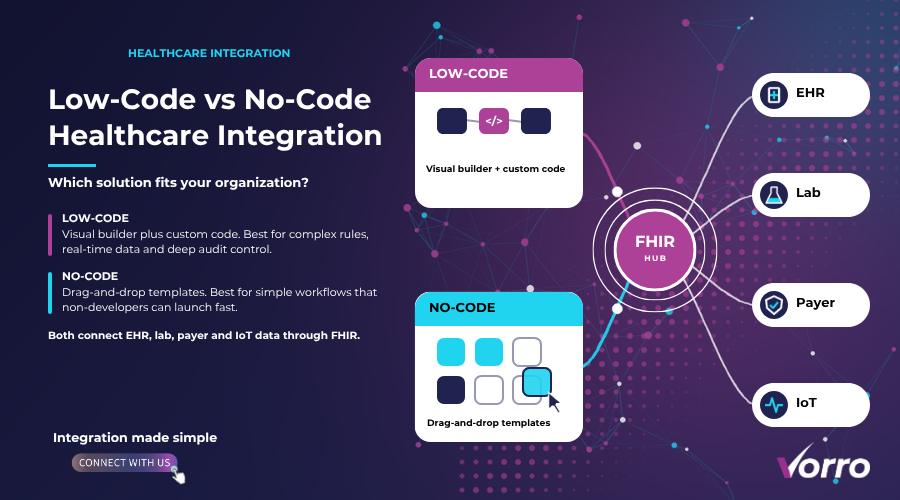
Every medical concept in FHIR resides in a €˜resource’ type such as €˜Patient’, €˜Encounter’, €˜Observation’, €˜MedicationRequest’, or €˜Claim’. FHIR Integration enables these resources to be connected across systems so that you can exchange demographic information, lab results, medications, and claims in a unified manner.
In addition to being a technology standard, FHIR in healthcare is a standard that was learned from previous versions of HL7 and from actually doing implementations. It was made with the intention of working in line with what programmers actually do with APIs.
The adoption is also increasing. In a 2023 report, the ONC reported that 87 percent of the 2015 Edition certified health IT modules supported the FHIR APIs. According to the American Medical Association, 93 percent of physicians felt that digital health tools were helpful in patient care. This builds the momentum for the interoperable API first strategy.
Key elements of the FHIR healthcare standard
- Resources: Modular building blocks such as Patient or Observation, which represent clinical and administrative data.
- Profiles: Restrictions related to resource access for certain use scenarios, like US Core profiles for the United States.
- APIs: RESTful endpoints to read, write, or search resources using HTTP methods.
- Terminologies: Links to code systems, including SNOMED-CT, LOINC, and ICD, to ensure clinical semantics are maintained.
By aligning your EMR FHIR capabilities, third-party apps, and your internal integration layer around these things, you establish repeatable patterns rather than point solutions.
FHIR vs HL7
To appreciate the benefit of FHIR integration, you must first appreciate how it differs from traditional message styles such as HL7 v2 and v3. The former promoted broad-level interoperability by setting standards related to message structures such as ADT, ORU, and ORM messages. These types of messages operate in most current healthcare information exchanges. The former are good but rather inflexible solutions.
How HL7 v2 works
The pipe-delimited messages in the HL7 version 2 messaging paradigm also contain segments like MSH, PID, or OBR; the positions of the segments are fixed. The method works well when dealing with well-organized business processes like hospital admissions and lab results but isn’t particularly helpful when interfacing with more modern apps or web services.
You regularly require tailored mapping and local standards which are specific within each organization. This leads to less interoperability and each project is unique.
How FHIR differs
FHIR employs the use of resources as well as REST APIs as opposed to the use of fixed messages. The data from FHIR employs greater granularity as well as self-description. If the app is mobile, it will be able to query the server with the aim of acquiring Allergies about the patient. You would not need to parse the whole message.
This model is appropriate for the current API methods for healthcare data integration. The model enables synchronous calling, efficient error processing, and selective data fetching. This is because of the increased efficiency and simplicity of the model.
FHIR vs HL7 at a glance
- Format: HL7 v2 line-based text messages versus JSON or XML resources over HTTP.
- Granularity: HL7 v2 groups many data points in one message. FHIR exposes smaller resources that you can query on demand.
- Extensibility: Most HL7 v2 extensions are based on local segments. FHIR has formal extensions and profiles, enabling better reutilization.
- Developer experience: HL7 v2 requires very specialized knowledge related to parsing. FHIR matches a common pattern for web development.
Most organizations will not replace HL7 v2 overnight. You bridge HL7 and FHIR, map core data elements, and phase in FHIR integration where that creates the strongest return for patient data interoperability.
Interoperability Benefits
With the shift from the traditional isolated interfaces to the more streamlined approach using the FHIR standard, the data flow within your enterprise will change and improve.
Better clinical context at the point of care
Integration of FHIR makes it easier for you to consolidate data from various EMR platforms, HIEs, and other supporting software. Care providers will be able to access a fuller picture without having to log into several websites.
The Office of the National Coordinator indicated that more than 96 percent of non-federal acute care hospitals in 2021 used a certified EHR. Nevertheless, based on the survey administered by the College of Healthcare Information Management Executives in 2022, more than 60 percent of health leaders indicated challenges of integration as factors limiting successful collaboration and information flows. This is where FHIR can guide you.
Faster onboarding of digital health partners
When growing virtual care, remote monitoring, and patient engagement, there will be exposure to more third-party vendors. Each of them will want data leaving and entering your system. This makes it easier with the FHIR strategy approach because you point the partners to the API interface rather than having to develop another HL7 interface.
This cuts short the integration cycle time, resulting in less rework. It also provides you with more control over what an app has access to, using standardized consent scopes.
Regulatory alignment and future readiness
Current federal regulations require access to APIs for patient data. Moreover, the Cures Act Final Rule by the Office of the National Coordinator (ONC) for. Health Information Technologies requires certified healthcare IT vendors to support standards-based APIs with FHIR. Recently, FHIR-based APIs have been launched by CMS. These APIs work for patient access, provider directory, and payer-to-payer exchange.
In making that investment in FHIR today, you will lower your risk of compliance and pave the way for future programs and initiatives involving quality measurements and value-based care that require strong data interchange.
Use Cases
FHIR isn’t just an abstract integration; you can identify concrete workflows where an approach with FHIR actually drives results for your organization.
1. Patient access and engagement
Cures Act information blocking rules and patient access API requirements spur innovative providers and payers to share data more openly. With FHIR APIs, you enable patient-facing apps to pull medication lists, problems, allergies, and lab results directly from your EMR FHIR servers.
In a brief released in 2022 by the ONC, it was observed that approximately 63% of physicians reported exchanging patient information electronically with patients or other providers. This can certainly increase within your own network with the use of strong FHIR integrations.
2. Cross-system clinical data exchange
Many health systems use multiple EMR platforms across hospitals, clinics, and acquired practices. FHIR supports the unification of clinical data in these platforms. You can aggregate Patient and Encounter resources into a longitudinal record, or share Observations and MedicationRequests with care management solutions in near real time.
This use case has importance for health systems managing high-risk populations. A quality program, readmission reduction, and care coordination are all dependent on timely and accurate data exchange.
3. Remote patient monitoring and connected devices
Devices produce high-frequency data. If there is no data structure in place, this data will flood healthcare providers. With FHIR connectivity, you can standardize data in terms of Observation resources and direct it towards healthcare applications or decision-support engines.
When you scale remote patient monitoring, FHIR also makes it easier to integrate the platforms used by the devices, as well as the e-commerce design of the patient storefronts that manage patient orders and fulfillment. Of course, you can still maintain the clinical data linked to the standard FHIR resources within your systems.
4. Payer and provider data sharing
Payors and providers need good data in risk-adjusted data, prior authorizations, and quality reporting. You have more specific data transfer in clinical and claims data using FHIR APIs. You shift from batch file transfer to data access on an event-driven switch or on-demand switch.
The CMS has introduced FHIR-based APIs for payers, and the industry bodies are working to provide implementation guides for specific use cases, such as prior authorization and reducing burdens. Having a FHIR integration layer allows you to leverage these efforts without having to build it every time.
5. Analytics and population health
FHIR can be the access layer for your data platform. You can feed a FHIR store into analytics engines, then align quality measures and risk models with consistent resource definitions. It reduces reconciliation effort when you trace metrics back to source systems.
As more analytics vendors support FHIR, your integration burden shifts from one-off data extracts to standardized APIs that you can manage centrally.
Implementation Challenges
Although the advantages are obvious, the integration of FHIR raises a whole host of new questions regarding design and governance. Simply deploying a FHIR server does not ensure success. You are going to need a plan regarding data quality, security, performance, and change management.
Legacy data and HL7 mapping
The majority of your data remains in the HL7 V2 transmissions or in custom specifications. You require correct mappings between these and the data in the FHIR resources. This involves value set mapping, data type, and local codes.
Without robust mapping and transformation logic in place, you will have inconsistent or incomplete information presented in your FHIR APIs. This can damage trust with the clinical community and undermine the goals you are trying to achieve through promoting the interoperability of patient information.
Security and consent management
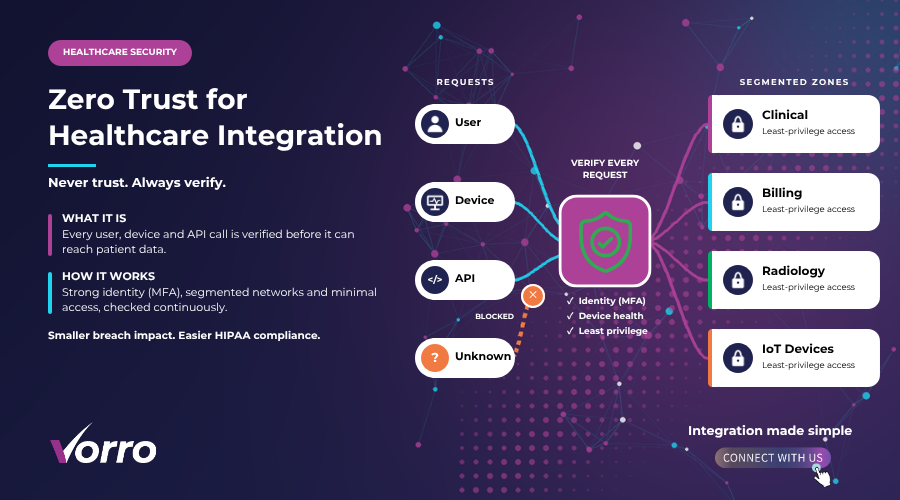
Your exposure will grow if you do not control access. You need to establish definitions of scope, authentication workflows, and consent practices that suit your risk tolerance. These include patterns in OAuth 2.0, OpenID Connect, and SMART on FHIR, and also policy-related considerations for apps that you trust and track their use.
According to a 2023 IBM Security Report, the average cost of a healthcare breach was $10.93 million. Secure FHIR APIs are not a nicety they are essential patient protection as well as essential protection for your organization.
Performance and scalability
As you make more EMR FHIR calls and integrate more apps, your environment needs to handle the increased traffic. If the FHIR servers are not properly tuned or queries are complex, they will actually impede the clinical workflow efficiency you are trying to improve.
Integration layer syncing with the message queues or event streaming can also be helpful. You move the high-volume operations out and ensure the synchronous FHIR queries target the real-time scenarios only.
Data governance and standardization
Structure is defined by FHIR, but many fields are still your choice. It is necessary to harmonize coding systems, reference rules, and profile definition within your enterprise. Lack of harmonization means different teams implement FHIR differently, and your interoperability progress will stall.
Good governance means involvement by clinical leadership, data stewardship, integration architects, and security teams. And rather than treating FHIR integration as an ancillary project, they see it within the scope of their overall data strategy enterprise.
Vendor variation in FHIR support
EMR FHIR implementations vary. Vendors support different resource sets, profiles, and search parameters. Some support write operations and subscriptions, while others are limited to read-only APIs.
You need an abstraction layer to normalize these differences for consuming applications. Without it, each app must learn each vendor’s quirk, thereby slowing down adoption and adding more maintenance work.
Conclusion
FHIR integration offers you a viable way to achieve patient data interoperability in reality. This enables you to share your EMR system and other ancillary applications, payers, partners, and connected health solutions in a shared standard way. This will decrease your reliance on point-to-point solutions for data transmission inHL7 format without negating your previousinvestments.
The way ahead demands strategic thinking, careful planning, and good governance. But the rewards are immediate. Fewer manual workarounds. Easier partner onboarding. Enhanced clinical context. Improved support for regulations and innovation.
You do not necessarily need to solve every use case at once. You can start with a focused pattern, such as a patient access API or a particular EMR FHIR integration, then expand over time. The key is a repeatable integration framework that brings order to complexity.
Vorro empowers health systems, payers, and digital health organizations in building that framework. Our integration platform and services connect HL7, FHIR, APIs, and legacy systems into a coherent interoperability layer. You gain consistency, visibility, and control over the data flows that support patient care.
If you want to move forward in patient data interoperability with a clearly defined, outcome-driven road map for both FHIR integration and API healthcare integration, then have a conversation with Vorro’s team to move your interoperability strategy forward.

Akshita is a Senior Content Writer and Marketer with over a decade of experience crafting narratives that convert, rank, and build lasting brand authority. She has worked across SaaS, FinTech, HealthTech, and Education spaces, delivering everything from HIPAA-compliant medical content to multilingual campaigns for the International Labour Organization, United Nations. Her content has reached audiences across the globe, and she has worked for Fortune 500 brands, global agencies, and startups alike. Fluent in English, Spanish, and German, Akshita brings a rare cross-cultural edge to brand communication. A literature graduate from Delhi University, she balances strategic thinking with a storyteller's instinct, but when she isn’t architecting content roadmaps, she channels her creativity into poetry and painting or dedicates her time to caring for stray animals - pursuits she credits for making her a more empathetic and perceptive communicator.