By Akshita Kohli · November 4, 2025
Introduction
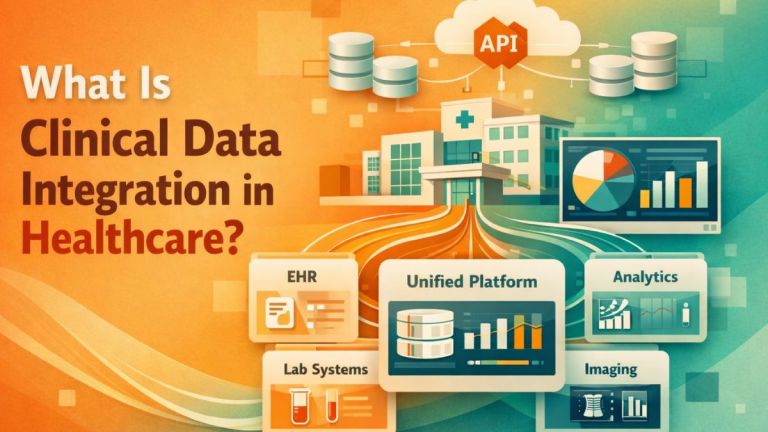
Managing the fragmentation of data and systems across their organizations is, by far, the biggest challenge Healthcare CTOs. There is a plethora of information flowing through Electronic Medical Records (EMRs), payer portals, laboratory systems, revenue cycle management platforms, Health Information Exchanges (HIEs), and emerging digital health tools — yet these systems rarely, if ever, link up seamlessly. What are the consequences? Compliance risks, operational inefficiencies, revenue leakage, and disgruntled clinicians and patients.
Healthcare iPaaS (Integration Platform as a Service) is the solution to this problem. It offers a cloud-based platform for integrating disparate applications, data sources, and workflows. While point-to-point integrations are fragile and expensive to repair, iPaaS makes interoperability scalable, secure, and compliant interoperability. It is compatible with healthcare standards such as HL7, FHIR, and X12, and can also automate workflows. On top of that, it complies with HIPAA, HITECH, and the 21st Century Cures Act.
However, theory is one thing. In fact, what CTOs really care about are the tangible results. Can healthcare iPaaS decrease compliance workload, speed up reimbursements, raise patient satisfaction, and generate ROI?
The reply is affirmative. This blog will introduce real-world healthcare iPaaS success stories from the real world. These instances illustrate how organizations have utilized iPaaS solutions to break down fragmentation, enhance compliance, increase data accuracy, and achieve efficiency and financial performance at a whole new level.
Why Healthcare iPaaS matters for CTOS
It’s quite necessary to comprehend how a healthcare integration platform as a service (iPaaS) acts as the main driver of success, even before assessing some good results that followed its implementation. For chief technology officers (CTOs), the risk is quite substantial:
- Compliance and Regulation: Encryption, audit logs, and access controls are mandatory as per HIPAA. CMS quality reporting requires that submissions be not only accurate but also made promptly. The 21st Century Cures Act forbids information blocking and, at the same time, requires interoperability. A compliance-first architecture iPaaS is the one that makes up the solutions where these demands are interwoven in every process.
- Operational Efficiency: A large number of staff hours are wasted on the side of manual compliance tasks, duplicate records, and rekeying of claims data. By using healthcare iPaaS, these processes are automated, thus the error rates and workload are being lowered.
- Financial Performance: Most of the time, denied claims, delayed reimbursements, and revenue leakage are the effects of inconsistent or incomplete data. Through iPaaS, the claims are, in the first place, standardized and then routed appropriately, making the payment cycles brief.
- Patient Experience: The patients of today are the ones who expect seamless digital access. Unified patient portals through an iPaaS, integrated telehealth, and real-time record sharing are some of the ways that iPaaS facilitates patient satisfaction and loyalty by improving them.
- Scalability: When organizations are expanding, merging, or even taking on new technologies, iPaaS offers them an integration layer that is not only compliance-ready but also does not have to be changed to fit the new requirements.
Healthcare iPaaS means a lot more than just a technical solution for CTOS. It’s a strategic platform that harnesses the power of the fragmented data to drive compliance, efficiency, and growth.
Healthcare iPaaS Success Stories
We will examine several healthcare iPaaS success stories that are anonymized and based on actual healthcare scenarios. These examples outline The Challenge → The iPaaS Approach → The Results → Lessons for CTOs.
1. Reducing Compliance Audit Prep Time by 80%
The Challenge
Compliance workload was a major headache for the hospital system of a mid-sized group of hospitals. Much of the time, to the tune of thousands of man-hours, was taken up by the preparation for audits of HIPAA access reviews, CMS reporting, and other compliance activities. In addition, it was necessary to reconcile manually the logs from EMRs, labs, and RCM systems, which made it prone to errors and burnout.
The iPaaS Approach
In light of the situation, the CTO brought in a healthcare iPaaS with integrated HIPAA protection features. The platform fetched the logs from all the systems, made them uniform, and, in fact, created immutable audit trails that could not be changed. Anomaly detection in real-time alerted compliance officers when suspicious access was detected.
The Results
- Audit prep time reduced from 6 months to 6 weeks.
- The implementation of real-time monitoring allowed compliance to be assured at a higher level.
- The employees were less burdened, therefore lowering the rate of burnout.
Lessons for CTOs
Compliance procedures should not be handled manually. It is an iPaaS with a compliance-first architecture that enables continuous audit readiness to be feasible.
2. Eliminating Duplicate Patient Records Across EMRs
The Challenge
A regional health system comprising five hospitals was dealing with duplicate patient records as a result of multiple EMRs. Patients frequently had different IDs at various facilities, which resulted in incomplete histories and compliance risks.
The iPaaS Approach
The CTO brought in iPaaS to merge data from different EMRs. HL7 and FHIR standards were implemented to normalize inputs, and a Master Patient Index (MPI) was the source of unique identifiers.
The Results
- 40% reduction in duplicate records in six months.
- Patient safety is enhanced through access to complete histories.
- Compliance reporting is made easier through accurate, unified data.
Lessons for CTOs
Data accuracy and normalization are the basics that have to be there. If not, then analytics, compliance, and patient care will all be negatively affected.
3. Cutting Denied Claims by 25%
The Challenge
Confusion due to inconsistent data between the RCM and payer portals caused a payer-provider system to have a high number of denied claims. The denials resulted in the system leaking revenue and delays in getting the money back.
The iPaaS Approach
iPaaS was utilized to make the claim data uniform, set up the validation rules, and by-passing the routing of the letters to the cases of the denied claims automatically.
The Results
- Denied claims reduced by 25%.
- Reimbursement cycles were shortened by 30 days.
- Several millions of dollars in revenue were recovered.
Lessons for CTOs
Good, standard data has a direct effect on the company. iPaaS should be seen as a financial enabler rather than just a compliance instrument.
4. Enabling a Unified Patient Engagement Portal
The Challenge
Patients were extremely annoyed with the portals that were separated: one for labs, another for billing, and yet another for telehealth. This broken experience led to low satisfaction scores and increased the number of appointments that were not followed through.
The iPaaS Approach
The CTO used iPaaS to integrate EMRs, billing, scheduling, and telehealth platforms so that the data would be available through a single patient-facing portal. FHIR APIs enabled access to up-to-the-minute data.
The Results
- Patient satisfaction scores improved by 20%.
- Missed appointments were reduced by 15%.
- The organization met the requirements of the 21st Century Cures Act.
Lessons for CTOs
The patient experience represents both compliance and a financial risk. An iPaaS acts as a unified digital engagement platform that is also regulation-compliant, and loyalty-building.
5. Scaling Predictive Analytics for Resource Planning
The Challenge
A teaching hospital experienced wildly fluctuating patient volumes. During the seasonal surges, staffing shortages and overtime costs went through the roof.
The iPaaS Approach
iPaaS connected EMR and RCM data streams to a single analytics platform. Predictive models anticipated patient demand, thus staffing could be adjusted in advance.
The Results
- Overtime costs reduced by 15%.
- Staffing was more in line with patient demand.
- The hospital became more resilient to flu seasons.
Lessons for CTOs
Integration is what makes predictive analytics possible. Forecasting cannot be done if data is not unified.
6. Streamlining Vendor Compliance Monitoring
The Challenge
A big health system was dependent on several vendors who dealt with PHI. It was a mess to keep track of certifications and monitor vendor activities.
The iPaaS Approach
The CTO leveraged iPaaS to consolidate vendor compliance information, monitor contracts, and create alarms for expirations. A unified repository captured all vendor activities.
The Results
- 100% vendor compliance maintained.
- Third-party risk exposure was lowered.
- Audits became easier due to complete vendor logs.
Lessons for CTOs
Third-party risk should be viewed as organizational risk. iPaaS enables compliance monitoring to be performed across the entire ecosystem.
7. Real-Time Incident Response
The Challenge
A hospital’s audit revealed that suspicious PHI access had gone unrecognized for weeks. The delay escalated the risk of exposure.
The iPaaS Approach
The chief technology officer installed iPaaS with real-time anomaly detection. Impersonation alerted the system instantaneously, the automated workflows deactivating the accounts and sending compliance teams the notification.
The Results
- Suspicious access flagged within minutes.
- Decrease in breach exposure.
- No regulatory penalties.
Lessons for CTOs
Proactive monitoring cannot be done without a great iPaaS. The iPaaS tool changes the CTOs’ role from reactive firefighting to real-time governance.
Strategic Themes from Success Stories
The success stories reveal distinct patterns for CTOs:
- Compliance-First Architecture: The embedding of compliance is the main idea, not the retrofitting.
- Data Accuracy: Without accuracy, integration creates risk.
- Automation: By automating, the staff burden and error rates are reduced.
- Financial ROI: The effects of iPaaS on denials, reimbursements, and cash flow are measurable.
- Patient Experience: The integration of portals and the provision of real-time access lead to patient satisfaction.
- Scalability: Platforms that are future-proof can adapt to growth and changes in regulations.
The CTO’s Playbook for iPaaS Implementation
What are the best practices for CTOs in healthcare iPaaS implementations? The answer to this question can be drawn from over 100 projects.
- Start with clear business outcomes. Connect the use of iPaaS to goals related to compliance, finance, or patients.
- Pilot value-heavy workflows. For example, automate audit logs or claims routing to demonstrate ROI in a short time.
- Engage compliance officers early. Make sure that HIPAA safeguards are included in every workflow.
- Align stakeholders. Get the clinical, financial, and IT teams involved in governance.
- Measure relentlessly. Record the labor hours saved, penalties avoided, and revenue increases.
- Design for scale. Take the platform that not only supports HL7, FHIR, X12 but also modular growth.
The Future of Healthcare iPaaS
iPaaS will be a significant part of the healthcare ecosystem, which is shifting towards interoperability mandates and value-based care models. Some of the future trends are:
- AI-driven iPaaS: Boosting predictive analytics and anomaly detection.
- RPA integration: Automation of compliance and claims departments, which are mostly repetitive, by the use of robotics.
- Blockchain-enabled trust: Ensuring data integrity and easy sharing of data among different systems.
- Global scalability: Facilitating compliance in different regions as healthcare organizations spread.
CTOs have to understand the healthcare iPaaS message: it is not merely an IT solution — it is the foundation of future-ready healthcare organizations.
Conclusion
Healthcare iPaaS is no longer a fancy term that is just talked about, but it has become essential for the business. The examples of success which are briefly mentioned here, show how it can be very effective in lessening the work related to compliance, enhancing patient safety, speeding up reimbursements, and giving a return on investment that can be measured.
The message for Chief Technology Officers is quite clear: integration should not be looked at as simply a means to link different systems, rather it should be seen as the creation of a compliance-first, scalable, and efficient ecosystem that is beneficial to patients, staff, and financial sustainability.
Ready to see how healthcare iPaaS can transform your organization? Request a Demo today.