By Anubhav Awasthi · December 30, 2025
Your data sits at the center of digital health transformation. Every clinical, operational, and financial decision now depends on data that moves cleanly across your ecosystem. If your integration strategy lags, your organization pays in clinician burnout, poor patient experience, and rising costs.
By 2026, healthcare data integration trends will decide which health systems grow and which stall. This is not only about technology. It is about how you align data, workflows, and governance with your CIO healthcare strategy.
This guide gives you a practical view of key healthcare IT trends 2026 that affect integration. You will see where to focus first, what to watch, and how to prepare your teams for the next three years.
Why Data Integration Is a CIO Priority
Integration touches every initiative on your roadmap. EHR optimization, virtual care, hospital at home, AI decision support, revenue integrity, and value based care all depend on stable, trusted data flows.
The stakes are high. One study found that poor data quality costs U.S. healthcare organizations an estimated 15% to 25% of revenue through rework, compliance issues, and operational drag. Each fragmented interface and manual work‑around adds to that burden.
At the same time, clinical demand for data keeps growing. A report from the Office of the National Coordinator noted that 4 in 5 hospitals now routinely share electronic health information with outside providers. Every new connection increases complexity if you rely on point to point integrations and brittle custom interfaces.
As CIO, you must shift integration from tactical plumbing to strategic platform. Healthcare data integration trends in 2026 point toward shared platforms, standardized services, and governance that treats data as a core asset.
Top 7 Healthcare Integration Trends for 2026
1. API First Interoperability Becomes the Default
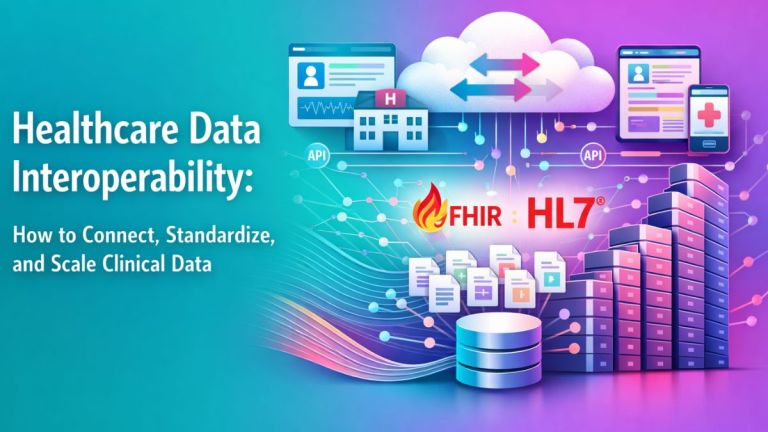
FHIR APIs are no longer a side project. Regulations around patient access and payer to payer exchange have pushed APIs into the center of interoperability trends healthcare leaders track.
By 2023, over 70% of hospitals had FHIR enabled APIs in production. That number will keep climbing as vendors retire legacy interfaces and favor API led integration patterns.
For you, this means planning for API management, security, throttling, and monitoring as core capabilities, not optional add ons. Your team will need a consistent way to expose, secure, and version APIs across EHR, revenue cycle, imaging, and ancillary systems. 2. Event Driven Architectures Replace Batch Feeds Care teams need information in near real time. Batch ADT feeds and nightly flat file transfers slow throughput and hide issues until the next day.
Event driven integration lets systems publish discrete clinical and operational events such as admissions, discharges, medication orders, and device readings. Other systems subscribe and react in real time. This supports closed loop workflows, better alerting, and more accurate care coordination.
As you evaluate integration platforms, look for native support for event streaming, queuing, and replay. Your roadmap should include a shift from large, brittle batches to smaller, reliable messages united by consistent schemas and governance policies.
3. Payer Provider Data Convergence Intensifies
Value based contracts, risk sharing, and prior authorization reforms are pushing payers and providers to share more granular data. This includes clinical notes, imaging, SDOH attributes, and utilization data.
The Centers for Medicare & Medicaid Services projects that over 13 million Medicare beneficiaries will receive care under accountable care models that depend on robust data exchange. That growth drives demand for shared data models, standardized APIs, and clear master data strategies.
You will face more integration requests from health plans and analytics vendors. A strong CIO healthcare strategy anticipates this and builds common services for identity resolution, attribution, consent management, and quality measure calculations instead of one off solutions.
4. Expansion of Virtual Care and Remote Monitoring Data
Telehealth usage cooled after the pandemic peak, but it stabilized at a level far higher than 2019. McKinsey estimated that U.S. telehealth utilization settled at 38 times pre COVID levels for some services. That means a permanent increase in external data feeds.
RPM devices, home diagnostics, and patient reported outcomes produce continuous streams of data. If those streams remain siloed in vendor portals, clinicians will ignore them. Integration into the core record, with context and filters, is essential.
Look for platforms that normalize device data, map it to clinical concepts, and deliver it through EHR native workflows. You also need retention and summarization strategies so clinicians see trends, not noise.
5. AI and Analytics Pipelines Require Higher Data Quality
As your organization tests generative tools, predictive models, and clinical decision support, integration quality becomes transparent. Every duplicate record, missing field, and inconsistent code set weakens model performance.
Gartner has reported that 9 out of 10 organizations face data quality issues that impact analytics initiatives. Healthcare is no exception.
You will need data integration patterns that include profiling, validation, standardization, and lineage tracking. The line between integration and data engineering will continue to blur. Your teams should work from a unified backlog and shared data contracts.
6. Stronger Security and Zero Trust Around Data Flows
Integration points are frequent attack surfaces. As more partners connect and more APIs expose services, you must treat each connection as untrusted until proven otherwise.
The U.S. Department of Health and Human Services reported that large healthcare data breaches affected over 134 million individuals in 2023. Many of those incidents involved third party vendors and integrations.
Integration strategies for 2026 should include granular access control, strong identity and access management, encryption in transit and at rest, and continuous monitoring for anomalous traffic. Zero trust thinking must apply across on premises, cloud, and partner networks.
7. Consolidation of Integration Platforms
Many health systems run multiple interface engines, custom scripts, and vendor specific gateways. This fragmentation increases support burden and slows change. As budgets tighten, you will feel pressure to consolidate.
Healthcare IT trends 2026 point toward unified integration platforms that support HL7 v2, FHIR, APIs, flat files, and event streams in one place. This simplifies governance and shortens delivery times.
When you evaluate consolidation, include non technical factors. Consider how vendor support, implementation partners, and internal skills will affect your ability to execute high priority projects over the next three years.
Also Read: Why No‑Code Integration Platforms Are the Future of Healthcare IT
Strategic Impact on Health Systems
These healthcare data integration trends do not live in isolation. Together, they reshape how your health system operates and competes.
On the clinical side, better interoperability trends healthcare wide support more complete patient records, safer handoffs, and more consistent adherence to care pathways. You reduce reliance on fax, portals, and manual reconciliation that frustrate clinicians.
On the operational side, consistent data across registration, scheduling, billing, and population health platforms shortens revenue cycles and supports accurate reporting. A HIMSS survey found tthatover 70% of health leaders view interoperability as critical for value based care success. Integration is the way you reach that goal.
On the strategic side, digital health transformation depends on your ability to plug in new capabilities without multi year custom interface work. If you can onboard new partners in months instead of years, you gain more room to test and refine new care models.
Finally, your talent strategy shifts. You need integration engineers who think in products, not tickets. They partner with clinical and business stakeholders, own services over time, and measure outcomes, not only message throughput.
How CIOs Should Prepare
To turn these trends into advantage, you need a structured plan. Focus on five moves over the next 12 to 24 months.
1. Define an Integration Reference Architecture
Document how data should move across your organization. Clarify which patterns you support: APIs, HL7, events, ETL, and file exchange. Assign each a clear purpose and preferred technologies.
Align this architecture with your CIO healthcare strategy, cloud roadmap, and security model. Use it to evaluate new vendor proposals, so integration requirements stay consistent and budgeted from the start.
2. Prioritize Use Cases, Not Interfaces
Instead of treating each interface as a separate project, group work around use cases. For example, focus on a complete referral workflow, or a full revenue cycle for a new service line.
This keeps your teams close to business outcomes and reduces redundant work. It also helps clinical and operational leaders understand tradeoffs and timing.
3. Invest in Data Governance and Quality
Integration quality depends on clear ownership. You need data stewards for key domains, such as patient, provider, location, and clinical concepts. They define standards, approve changes, and monitor data health.
Combine governance with automation. Use profiling tools, rules engines, and reference data to catch and correct issues as close to the source as possible. Feed those metrics back into your integration backlog.
4. Modernize Integration Platforms Incrementally
A big bang replacement of all engines is risky. Instead, phase modernization around business milestones, such as new care programs or major EHR upgrades.
Start with domains where value is clear and dependencies are manageable. For example, consolidate device integration on a modern platform before you tackle enterprise wide EHR interfaces.
5. Choose Partners Who Understand Healthcare Complexity
Healthcare data integration demands knowledge of clinical workflows, standards, and regulations. A generic integration partner will struggle with nuance around HL7 variations, consent, or payer specific rules.
Look for partners who bring a reference architecture, accelerators, and real experience bridging legacy and modern environments. They should help you move from point solutions to a cohesive integration fabric that supports long term digital health transformation.
Also Read: How Cloud Integration Is Accelerating Digital Transformation in US Health Systems
Conclusion
By 2026, healthcare data integration trends will shape which health systems deliver safe, coordinated, efficient care. APIs, event driven patterns, payer provider convergence, virtual care, AI, security, and platform consolidation all require deliberate strategy.
As CIO, you have the opportunity to turn integration from a hidden cost center into a strategic asset. That shift calls for clear architecture, strong governance, incremental modernization, and partners who understand both technology and care delivery.
Vorro helps health systems integrate complex environments with a modern, standards based platform and expert services. If you want to align your integration approach with your broader CIO healthcare strategy, talk with Vorro about your data integration roadmap.