
90% of Healthcare AI Projects Fail.
Not Because of the Model. Because of the Data.
Healthcare AI breaks down when fragmented systems and unreliable data hit production. BridgeGate™ turns disconnected healthcare data into clean, real-time infrastructure built for AI at scale.
Healthcare AI Has an Infrastructure Problem.
Most healthcare AI projects do not fail because the models are weak.
They fail because the underlying data environment is:
Fragmented Systems
Critical patient and operational data lives across disconnected environments with no unified context.
Inconsistent Terminologies
ICD, SNOMED, LOINC, CPT, local codes, and free text create model instability in production.
Delayed Infrastructure
AI systems requiring real-time decisions often rely on data pipelines built for nightly refresh cycles.
Operational Fragility
Interfaces fail silently. Feeds break. Data arrives incomplete. Teams find out too late.
Healthcare Data Was Never Designed for AI Workloads.
Healthcare systems were built for transactions and operational workflows—not modern AI orchestration. That creates major production challenges when organizations attempt to scale AI initiatives.
Typical Healthcare Environment
- —Siloed systems
- —Fragmented records
- —Inconsistent code systems
- —Batch refresh cycles
- —Limited lineage
- —Brittle integrations
What AI Actually Requires
- Normalized data
- Longitudinal context
- Real-time delivery
- Governance
- Reliability
- Scalable orchestration
Raw Healthcare Data In.
AI-Ready Infrastructure Out.
BridgeGate™ becomes the operational layer between healthcare systems and AI workloads.
Instead of building custom pipelines for every initiative, organizations establish one managed
infrastructure backbone capable of supporting multiple AI programs simultaneously.
AI teams should focus on models and outcomes –
not infrastructure maintenance.
The Five Reasons Healthcare AI Fails in Production
Healthcare systems were built for transactions and operational workflows—not modern AI orchestration. That creates major production challenges when organizations attempt to scale AI initiatives.
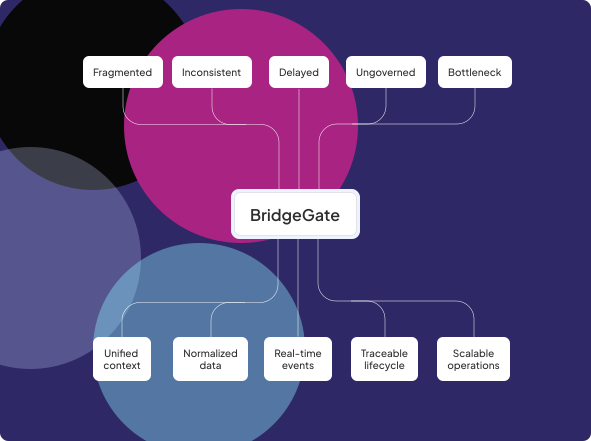
AI initiatives fail when organizations rely on disconnected systems with no unified operational context.
What BridgeGate Changes
Creates a unified managed data backbone across systems.
Fix the Data Layer Once.
Unlock Multiple AI Initiatives.
The AI vendor is rarely the problem.
The infrastructure almost always is.
Connectivity Alone Does Not Create AI Readiness.
Traditional Integration Platforms Focus On:
- Transport
- APIs
- Connectivity
- Interface tooling
AI Infrastructure Requires:
The first AI initiative justifies the investment.
The next ten inherit the infrastructure.
AI Stops Being a Collection of Pilots.
It Becomes an Operational Capability.
Without a unified infrastructure layer, every new AI initiative becomes:
- Another integration project
- Another governance review
- Another engineering backlog
With BridgeGate:
- The infrastructure already exists
- The data already flows
- The governance already exists
- The operational layer already scales
Build once. Scale every AI initiative that follows.
The infrastructure is already there.
Get an AI Readiness Assessment
If your organization is evaluating, piloting, or scaling healthcare AI, the most important question is simple:
Can your data infrastructure actually support it in production?
45-Minute Working Session
With a Vorro AI infrastructure architect.
Current-State Review
Data sources, workflows, integrations, and operational constraints.
AI Failure Diagnostic
Assessment against the five most common production failure areas.
Written Recommendations
Delivered after the session.
Infrastructure Roadmap
How a managed AI data backbone changes implementation timelines.
Frequently asked questions
A practical guide to how Vorro fits into existing healthcare infrastructure and AI initiatives.
Do we need to already be running AI?
No. In many cases, fixing the data layer before selecting AI vendors is significantly more effective.
Can Vorro coexist with existing integration environments?
Yes. BridgeGate can augment or coexist with existing infrastructure during transition phases.
Is this only relevant for clinical AI?
No. Revenue cycle, operations, patient access, analytics, and automation initiatives all depend on reliable healthcare data infrastructure.
Does Vorro replace our AI vendors?
No. Vorro enables AI systems to operate reliably in production environments.
