By vorromktgcv3 · June 25, 2024
Healthcare institutions are making great strides toward data interoperability. According to the Office of the National Coordinator for Health Information Technology (ONC), 6 in 10 hospitals engage in key aspects of interoperability, a significant increase from just a few years ago (healthit.gov).
This progress represents a pivotal shift in the way healthcare professionals and organizations approach patient data management and care coordination.
At its core, interoperability addresses a fundamental challenge in healthcare: the fragmentation of patient data across different systems and providers. It’s a vision of connected care, where a patient’s records follow seamlessly from doctor to doctor and hospital to clinic. This change eliminates repetitive data entry, reduces the risk of lost information, and promotes a patient-centric approach.
But what exactly is healthcare data interoperability, and why should it matter to you?
What is Healthcare Data Interoperability?
In simple terms, healthcare data interoperability means different systems, devices, and applications can communicate and share information seamlessly. It’s like having a universal language for health records, breaking down the barriers that have traditionally isolated medical data.
Essentially, interoperability involves exchanging data between different healthcare IT systems and software applications in a coordinated, cooperative manner. This allows the data to be integrated and collectively used, regardless of the technology or where the data resides.
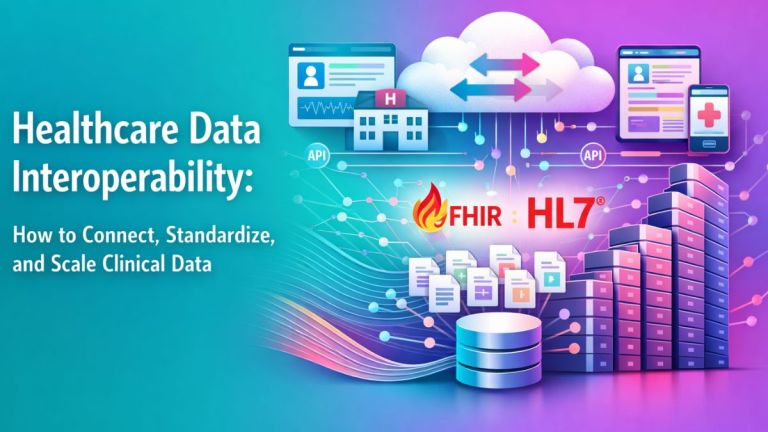
Adopting standards like Fast Healthcare Interoperability Resources (FHIR) and Health Level 7 (HL7) makes interoperability possible. These establish a common language and rules that enable smooth data exchange across varying systems.
FHIR, in particular, acts as a modern and internet-friendly standard for exchanging electronic health records. Developed by Health Level Seven International (HL7), it builds on previous data format standards while leveraging the latest web technologies, making it easier for different systems to share and consume healthcare data. Think of standards like FHIR and HL7 as translators that enable patient health information to be consistently structured, formatted, and understood across different platforms and healthcare settings.
Why is Healthcare Data Interoperability Important?
Interoperability in healthcare is crucial for several reasons. It enhances patient care coordination by enabling consistent communication and data sharing among healthcare providers. This improves care for patients with complex medical histories or chronic conditions.
During the COVID-19 pandemic, we witnessed the power of interoperability firsthand. As patients moved between facilities, the smooth exchange of critical health information supported more effective treatment and resource allocation. This seamless flow of data played a vital role in our collective response to the crisis.
However, the importance extends far beyond enhancing patient experiences. Adopting interoperability could present healthcare organizations with new avenues by streamlining workflows, reducing redundancies, and minimizing errors – a recipe for improved operational efficiency and cost savings. Furthermore, interoperable health data will power the next generation of medical research and public health initiatives by providing disease prevention and population health management breakthroughs.
Benefits of Healthcare Data Interoperability
The advantages of embracing interoperability in healthcare are extensive. But what exactly does this mean for you and your operations? Let’s look at the benefits:
Improved Care Coordination and Patient Outcomes
Continuous access to comprehensive patient data enables healthcare providers to make more informed decisions. It also helps reduce medication errors and improve care coordination. These improvements ultimately lead to better patient outcomes and increased satisfaction.
Enhanced Performance and Data-Driven Decision-Making
Interoperable data allows for seamless integration of data from various sources, enhancing performance and data-driven decision-making. This data can be analyzed using advanced analytics, machine learning, and artificial intelligence to gain valuable insights. These insights help identify areas for improvement, optimize resource allocation, and make more accurate, evidence-based decisions. By leveraging these technologies, organizations can enhance overall performance, streamline processes, and increase profitability through strategic and informed decision-making.
Better Experiences for Patients and Healthcare Providers
Eliminating the need for patients to provide the same information repeatedly and enabling access to complete patient histories improves the overall experience for patients. On the other hand, the reduced paperwork and manual data entry will decrease the workload for physicians, thereby bringing down significant levels of physician burnout.
Reduced Costs
Data interoperability in healthcare reduces overall costs by enabling seamless sharing and integration of patient information across different healthcare systems and providers. This improves care coordination, reduces duplication of tests and procedures, and minimizes administrative burdens. For instance, if a patient with chronic illness visits a primary care physician and a specialist, interoperable data ensures that both doctors have access to the same information, preventing redundant diagnostic tests and enabling a more cohesive and effective treatment plan, ultimately lowering healthcare costs.
The Four Levels of Interoperability
To achieve these benefits, healthcare organizations must address four distinct levels of interoperability:
Foundational
This first level involves securely transporting data from one system or device to another without interpretation. It’s the baseline that enables primary data exchange. For example, a physician might download a patient’s latest lab report as a PDF file from the lab’s portal and manually enter the information into the hospital’s electronic health record (EHR) system. While rudimentary, this foundational level establishes the groundwork for more advanced interoperability.
Structural
This level, known as structured transport, introduces standardization to the data exchange process. By adhering to common formats and structures, like those defined by interoperability standards such as Fast Healthcare Interoperability Resources (FHIR) and Health Level 7 (HL7), data can be organized and interpreted consistently across multiple systems. Imagine a scenario where a patient’s medication list, encoded in a standardized format, can be easily imported into a specialist’s practice management software, eliminating manual data entry and reducing the risk of errors.
Semantic
Stepping up the complexity ladder, we arrive at the semantic level of interoperability, which involves exchanging data between systems with entirely different data structures and formats. This level preserves the precise meaning and context of the information. Consider the challenge of integrating medical images from various imaging modalities and vendors into a unified viewing platform. Semantic interoperability allows the interpretation of these disparate image formats into the new system, regardless of their source.
Organizational
This level involves the seamless data exchange between various healthcare organizations, each with unique requirements, regulations, and goals. Achieving organizational-level interoperability requires policy and governance innovations, along with technological advancements. These elements ensure that consent, security, and integrated workflows move smoothly across different groups.
The Role of Regulations and Initiatives
Recognizing the transformative potential of interoperability, regulatory efforts like the 21st Century Cures Act have emerged to drive the industry toward a more connected, data-driven future. Programs like the Promoting Interoperability program, run by the Centers for Medicare & Medicaid Services (CMS) and the ONC, incentivize and support the adoption of interoperable health information technology (health IT).
Additionally, initiatives like the Trusted Exchange Framework and Common Agreement (TEFCA) aim to establish a nationwide network for secure and standardized data exchange. At the same time, the U.S. Core Data for Interoperability (USCDI) standard defines a set of common data classes and elements to facilitate interoperability.
How Does Vorro Help in Healthcare Data Interoperability
Starting the journey toward healthcare data interoperability does not have to be a daunting task. At Vorro, we offer secure and flexible interoperability solutions, enabling seamless data integration. Our BridgeGate™ platform maps and transforms data formats over any protocol, protected by robust security. With Vorro’s patented technology, you can cost-effectively connect and extend your existing systems, facilitating any-to-any data integration and transformation – no matter the size or complexity of your project.
The Future of Healthcare Data Interoperability
The future of healthcare data interoperability holds immense promise, driven by emerging technologies and a shift towards patient-centered care. Advancements in artificial intelligence and machine learning have the potential to boost the accuracy of data interpretation and translation across different systems, reducing the need for manual interventions.
Innovations like blockchain and cloud-based solutions are being explored as potential enablers of secure and decentralized data exchange. However, the most exciting frontier is enabling healthcare providers and data professionals to facilitate smooth access, management, and sharing of patient health data across various systems and settings, thereby promoting patient empowerment and control over their medical journey.
Moreover, interoperability efforts are now recognizing the value of cross-industry collaboration and data sharing, enabling healthcare organizations to leverage insights from adjacent sectors such as life sciences, consumer technology, and social determinants of health.
Conclusion
As the healthcare industry continues to evolve, welcoming healthcare data interoperability through the adoption of standards and the integration of emerging technologies will be essential for delivering high-quality and personalized care. Healthcare organizations must prioritize interoperability as a strategic imperative, fostering collaboration and investing in the necessary infrastructure to unlock the full potential of connected health information.
The future of connected healthcare features a unified, coordinated system that supports every step of a person’s journey. These systems will be designed to serve both healthcare professionals and patients.
Unlock the full potential of connected health information with Vorro’s interoperability platform. For more information, contact us.