Your healthcare data is spread across various systems, formats, and workflows. In fact, you depend on that data for clinical decisions, operations, and reporting. But, daily, you battle interface issues, manual work, and delays that cause your teams to feel the pressure.
Traditional integration tools were good to a certain extent since they facilitated system connections. However, they were designed for a relatively simple data environment. Nowadays, you have to handle not only more comprehensive clinical data but also unstructured notes, connected devices, telehealth, and you even have to satisfy regulatory requirements that are constantly increasing. Therefore, you require integration that is capable of changing, learning, and helping in making better decisions.
This is where AI healthcare data integration platforms fundamentally shift your perspective on interoperability. When AI is used in healthcare data integration, you lessen the obstacles, give your data more context, and get closer to having real-time intelligence rather than just static data pipelines between systems.
This book will introduce you to healthcare data integration platforms, explain how artificial intelligence healthcare integration changes the model, and present you with the capabilities of AI-driven healthcare integration platforms if you are willing to facilitate modern care delivery.
What Are Healthcare Data Integration Platforms
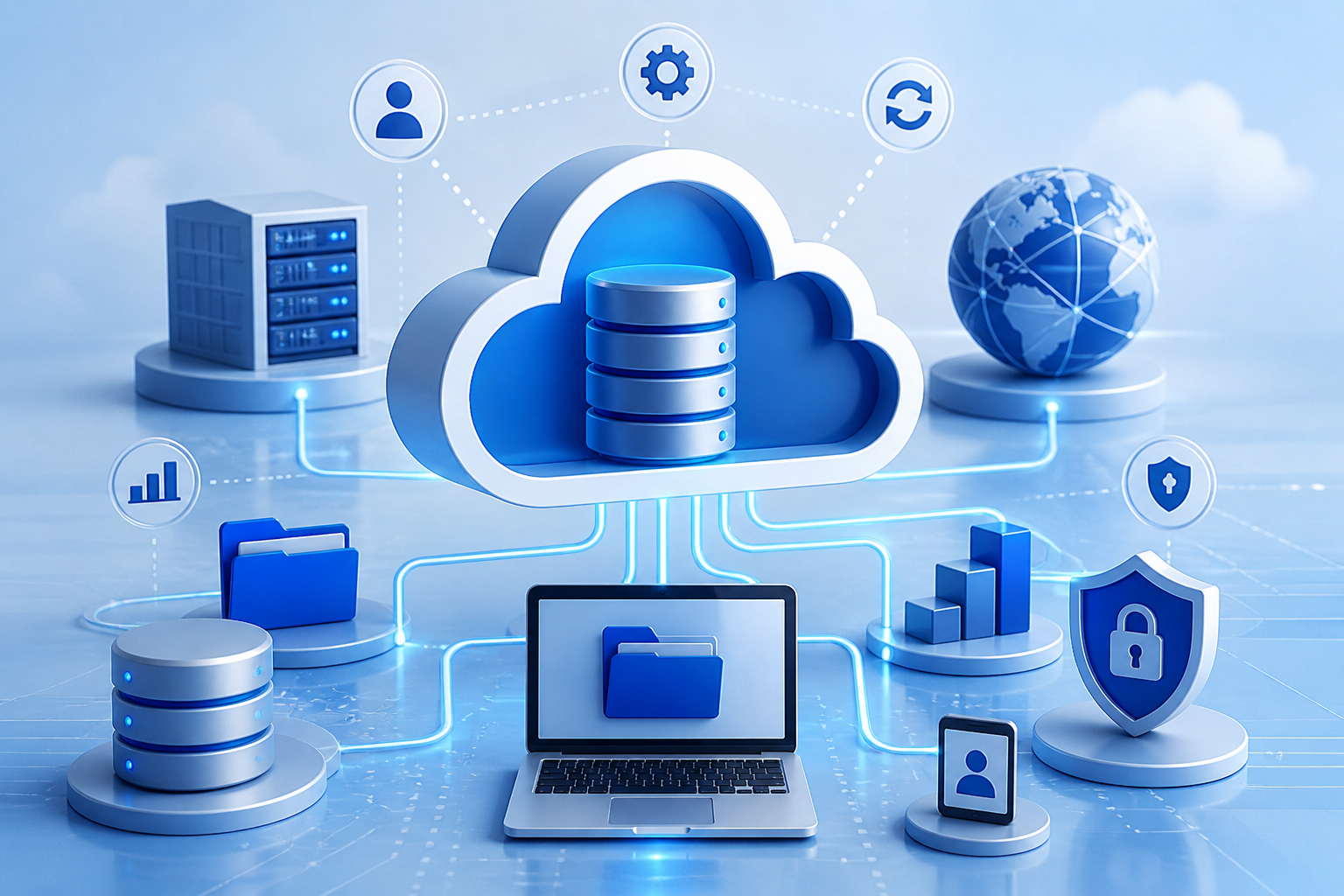
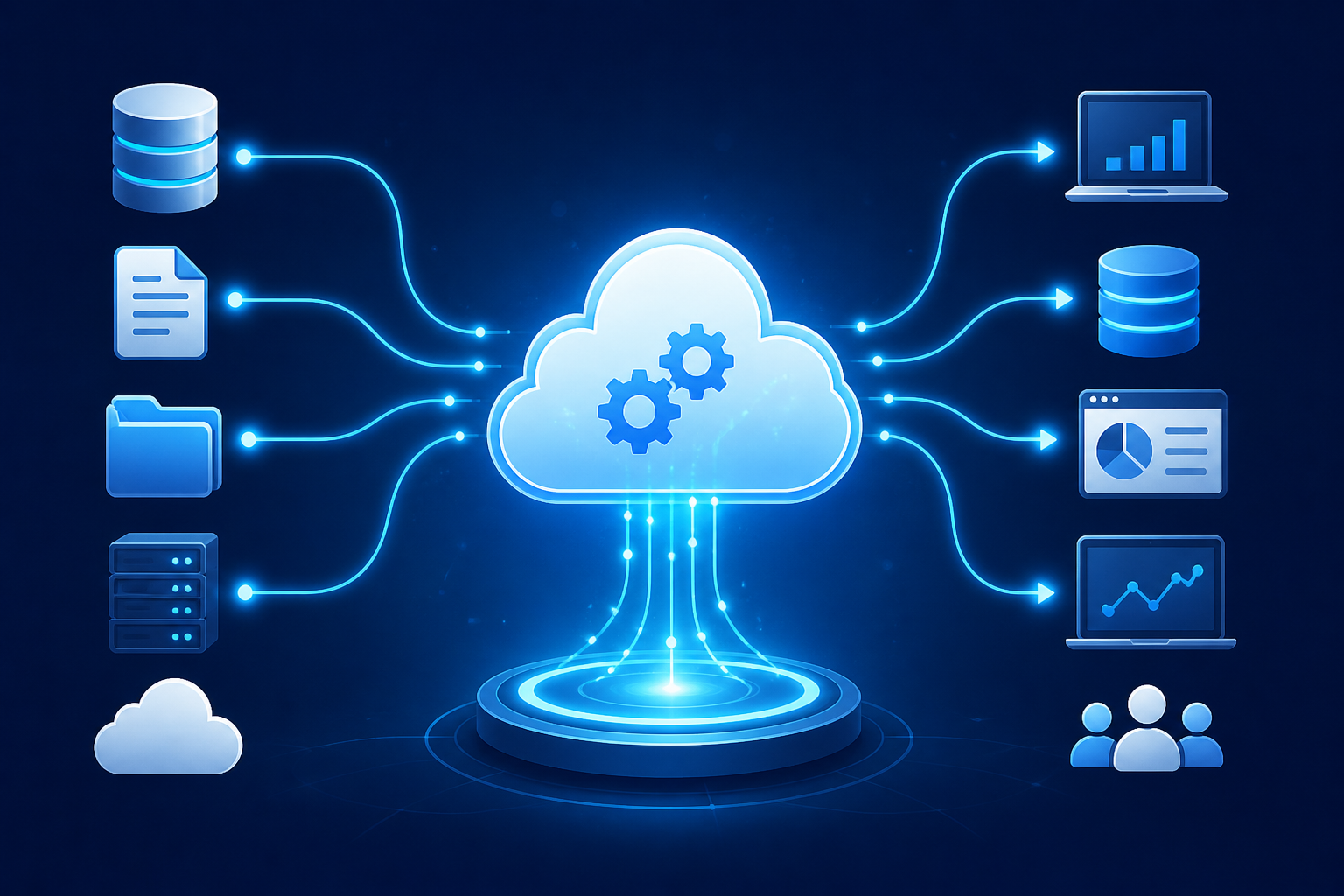
Healthcare data integration platforms enable clinical, financial, and operational systems to communicate and share data in a consistent, secure manner. These platforms receive data from various sources such as EHRs, lab systems, imaging, pharmacy, practice management, revenue cycle, CRMs, and external partners. After that, they standardize and send that data to the appropriate destinations.
Traditionally, an integration platform is concerned with:
- Linking systems that use different communication standards or versions
- Changing the messages into the required formats
- Checking that the messages conform to the structural rules
- Sending the messages to the right destinations
- Keeping track of the interfaces’ health and message flow
Such platforms rely on interface engines, mapping rules, and connectors. They are compatible with standards like HL7, FHIR, X12, DICOM, and custom APIs. Your team sets up the mappings, transformations, and business rules to enable systems to exchange data without the need for manual re-entry.
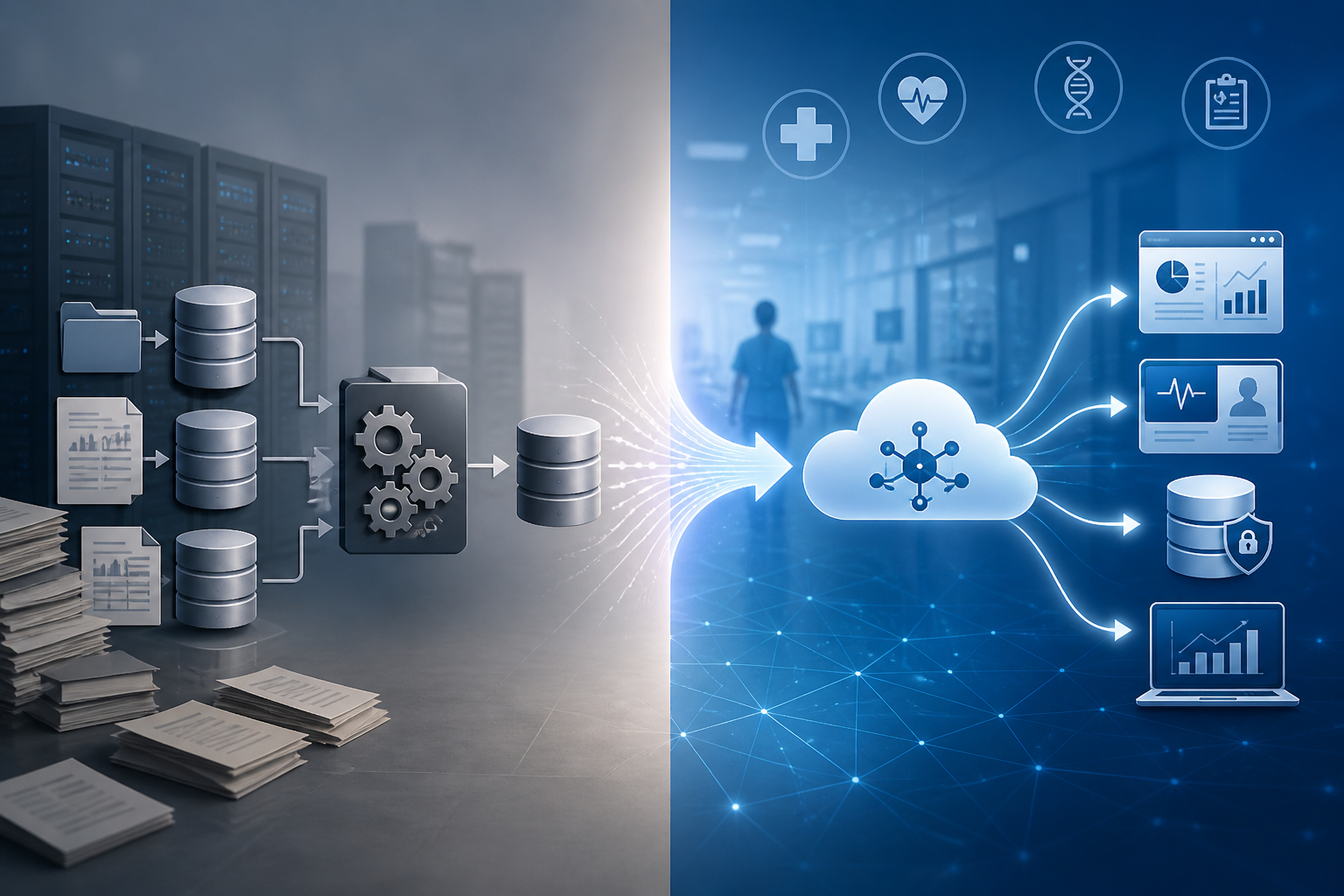
This approach was effective when data flows were somewhat limited. Presently, the amount, variety, and context of data have increased at a rate that is more than traditional tools can handle. Therefore, you require AI healthcare data integration platforms that not only understand the structure but also the content, and that assist your team in keeping up the quality amid perpetual changes.
Role of AI in Healthcare Data Integration
AI in healthcare data integration enables your system to interpret, learn, and adjust. It is not only a matter of a platform using static rules, but it also applies machine learning healthcare data integration methods to identify patterns, anticipate problems, and increase the efficiency of mappings over time.
AI is redefining the role of your integration stack in many aspects, such as:
- It analyzes past messages, mappings, and corrections and then suggests or carries out similar actions automatically.
- It comprehends the unstructured contents like notes or documents and then extracts that information into structured fields.
- It identifies irregularities in data flows, message content, or system behavior more quickly than manual checking can.
- It enables smarter routing based on clinical or operational context rather than only fixed routes.
AI driven data integration healthcare platforms provide context, not only connections. That allows you to acquire consistent meaning across different data sources, which is essential for analytics, quality measurements, and clinical decision support.
Once you introduce artificial intelligence healthcare integration to your setup, the integration platform behaves like a colleague to your integration team. It takes over the less challenging tasks, warns you of potential problems early, and facilitates the maintenance of a high level of data quality with minimum manual input.
Why Traditional Integration Platforms Fall Short
Many health systems keep using point, to, point integrations and traditional interface engines. These are tools that were made for the first generation of interoperability needs. They have a hard time if you use them for modern data scenarios and the increased expectations for timeliness and quality.
Common gaps appear in various areas.
Rigid, Rule-Heavy Configurations
Traditional tools depend on large amounts of manual mappings and hard-coded rules. Any new source, target, or field variation becomes more complex. When vendors upgrade or modify schemas, your team makes changes to rules again.
This approach keeps you continuously doing catch-up work. Furthermore, it brings risk, as each manual change can generate errors anew. AI healthcare data integration platforms learn mappings from previous ones and suggest transformations, thus cutting down on that repetitive work and risk.
Limited Understanding of Content
Legacy platforms are designed mainly to check the message structure, not the meaning. They verify that the fields are where expected, but do not understand clinical language, synonyms, local code, abbreviations, or unstructured text.
It results in inconsistent use of terms, creation of duplicate records, and missing parts in the downstream analytics.
AI, based healthcare integration platforms utilize natural language processing and entity recognition so they can identify the content from different sources, and thus they can send an enriched version to each system.
Weak Support for Unstructured Data
Most healthcare information is in the form of notes, PDFs, faxes, and other unstructured types of content. Integration tools of the past generally only treated these as attachments, with very little insight. They simply transferred the files from one system to another, without extracting any usable data.
AI driven data integration solutions make unstructured content a source of data. Machine learning healthcare data integration models are able to extract key fields, identify issues, and even flag missing information, thus making the information that otherwise would remain confined in documents more valuable.
Reactive Error Handling
Traditional systems usually react to an error after a message fails or a user reports an issue. Your support staff first examines the logs, determines the problem’s root cause, and then makes mapping changes.
This line of operation, through repeated reaction, deteriorates the speed of data transmission and might also cause stakeholders to feel frustration. Artificial intelligence healthcare integration means can do away with this issue through predictive monitoring, pattern analysis, and recommended fixes before problems can affect entire workflows.
How AI Is Transforming Healthcare Data Integration Platforms
AI powered healthcare data integration platforms change the integration model from static configuration to adaptive intelligence. Rather than merely being a channel between systems, the platform becomes a decision layer that supports quality, context, and speed.
You can observe this shift in several key areas of platform behavior.
From Static Mappings to Learning Mappings
Conventional mappings are based on clearly defined rules for every data element. When a new field or vendor is introduced, the respective team writes more rules. The employment of AI in healthcare data integration facilitates the use of learned mappings that are based on previous instances and corrections.
The platform learns the patterns of how similar systems map data to your canonical model by recognizing instances. It then makes suggestions for the mappings of the new sources. Your team checks and approves, which enhances the model over time. Hence, it takes less time to onboard new systems, and there are fewer errors.
From Siloed Data to Context-Rich Integration
AI driven healthcare integration platforms are not only devices that deliver messages from one point to another. They integrate data from multiple sources, match the records with the correct patient or provider, and utilize context when routing or transforming messages.
This enables more intelligent flows. For instance, the platform can identify that a lab result corresponds to a recent admission and therefore handle it differently from a routine one.
From Manual Monitoring to Predictive Assurance
Instead of dashboards that your team checks periodically, AI, powered data integration healthcare tools run continuous analysis on message traffic, error patterns, and throughput.
Machine learning healthcare data integration models detect anomalies that human operators would miss. They may flag subtle increases in message retries or changes in field distributions that signal upstream schema changes. You can address issues early, which reduces data interruptions.
From One-Time Transformations to Continuous Data Quality
Conventionally, the quality of data is verified only at specific points in the flow. Nevertheless, AI based healthcare data integration platforms consider quality to be a continuous process. Such a platform evaluates the quality of data, identifies recurring issues, and gradually recommends standardization steps.
The approach is a boon to enterprise data governance and keeps you clinical and operational reporting aligned without having to run isolated, one-off projects for each new initiative.
Key Capabilities Enabled by AI
It is important that when evaluating AI healthcare data integration platforms, you focus on tangible capabilities rather than just the presence of AI features that are only used in marketing language. The following features demonstrate that the platform is leveraging AI in healthcare data integration in a manner that brings value to your organization.
Intelligent Data Mapping and Transformation
AI-powered healthcare integration platforms not only analyze past message flows and transformation logic but are also able to learn how the fields correspond across systems. With the help of this knowledge, such platforms can:
- Propose mappings for new interfaces and data sources
- Detect missing or inconsistent mappings that will lead to errors downstream
- Offer suggestions for standard values for local codes and custom fields
Your team still has control, but most of the monotonous mapping work is shifted from manual configuration to supervised learning.
Automated Normalization and Standardization
Data coming from different sources may use different vocabularies and formats. Artificial intelligence healthcare integration can figure out how your company standardizes important elements like diagnoses, procedures, medications, and departments.
By implementing these standardizations, which it automatically reverts, the solution finishes the system integration:
Making it easier to compare different systems and facilitiesMassively lowering the necessity for manual data cleansing in analytics and reporting toolsMaintaining the same quality level and adhering to regulations
Patient and Entity Match at a Higher Level
It has always been a problem to match patient, provider, or facility records coming from different systems. With the help of machine learning healthcare data integration, it is possible to build intelligent matching models that simultaneously consider several attributes and learn from matches and non-matches that are already confirmed.
Furthermore, this allows the records to be matched more accurately, the production of duplicate records and fragmented medical histories can be dramatically eliminated as well as clinical safety can be increased.
Unstructured Data Extraction and Enrichment
AI powered data integration healthcare solutions leverage technologies such as natural language processing and computer vision to interpret scanned documents, faxes, and notes.
They identify and extract structured data elements such as patient identifiers, dates, orders, and diagnoses. Subsequently, the system integrates those data elements into existing records or workflows.
Therefore, it raises the utility of the information that is provided through unstructured means and alleviates the burden of clinical or administrative staff having to do manual data entry.
Predictive Monitoring and Root Cause Analysis
Artificial intelligence healthcare integration tools can identify trends across message volumes, error codes, system performance, and content patterns. Upon detecting anomalies, they do not just send a failure alert but rather present the most probable root causes.
Thus, investigation time is greatly reduced, and the team can concentrate on fixing the problem instead of searching for clues. The system can also suggest how to better configure it or which upgrades to apply so that fewer issues will occur in the future.
Configurable AI-Assisted Workflows
AI healthcare data integration platforms offer the possibility of workflows where the computer suggests actions and the human approves or changes them. For instance, the platform can propose a way to map a new field, how to normalize an odd value, or how to route a message based on context.
It is up to you to determine the limits for the system to work completely automatically or for the intervention of a human being. This hybrid approach allows you to retain the human touch and, at the same time, harness the power of AI, driven suggestions.
Benefits for Healthcare Organizations
When you introduce AI healthcare data integration platforms to your environment, you expect real benefits in clinical, operational, and strategic spheres. The value lies in the fusion of enhanced data quality with quicker, more flexible integration workflows.
Higher Data Quality and Consistency
Healthcare data integration with AI elevates semantic uniformity between the systems. You achieve more accurate coding, aligned terminologies, and a reduction of missing or wrongly directed fields. This consistency results in:
- More precise clinical decision support
- Enhanced quality and performance reporting
- Improved population health and research applications
Reduced Manual Effort for Integration Teams
Integration teams dedicate a huge chunk of their time to repetitive tasks such as mapping, testing, reviewing logs, and investigating incidents. Data integration healthcare tools powered by AI lessen the team’s load by automating patterns, based operations, and bringing to the surface the tasks that should be tackled first.
Your experts can concentrate on architecture, governance, and new projects instead of using the majority of their time for maintenance.
Faster Onboarding of New Systems and Partners
As your organization expands through partnerships, acquisitions, or program development, the need for integration also grows. AI-powered healthcare integration platforms enable you to integrate new EHR instances, remote clinics, digital health partners, and external vendors at a faster pace.
Semantic mappings, automated normalization, and step-by-step configuration, driven combined, help to significantly lower the lead time when bringing new connections live while still having complete trust in the correctness of the data.
Better Support for Real-Time and Event-Driven Use Cases
Numerous care models at present rely on data being available promptly. Some cases are care management outreach, telehealth, remote monitoring, and closed-loop communication between providers and patients.
Artificial intelligence healthcare integration can make your system capable of detecting urgent instances, interpreting content, applying routing rules, and modulating throughput at peak times. That results in the creation of self-adjusting data flows, saving the bandwidth of constant manual work.
Stronger Governance and Compliance
AI healthcare data integration platforms keep track of data movement, transformation, and standardization over the long run. They make it possible for you to identify which rules and models are associated with each interface. That is essential for audit preparedness and internal governance.
When there is a change in regulations or organizational policies, AI driven tools may be used as aids in simulating the effects of the intended changes and suggesting new mappings or revisions.
Foundation for Advanced Analytics and Innovation
How can you support advanced analytics, population health, or precision medicine if your source data is so inconsistent and fragmented? AI in healthcare data integration helps you build a much better quality foundation for data platforms, warehouses, and real-time analytics.
This foundation makes it possible for your innovation not to multiply the integration work with every new project. Your integration platform is doing most of the standardization and matching work that your analytics teams require.

Conclusion
Healthcare data integration is no longer able to operate as a set of static pipes between systems. You require platforms that can change, learn, and help you understand how data flows through your organization. AI healthcare data integration platforms satisfy this demand by using machine learning, natural language processing, and intelligent automation to resolve the traditional interoperability challenges.
When you have the right strategy for AI-powered data integration in healthcare, you can make it easier for your teams, and at the same time, raise the quality, promptness, and relevance of your data. You create an integration bedrock that not only supports clinical care today but also accommodates new models of care in the future.
Vorro is committed to smart healthcare integration that acknowledges your existing investments and, at the same time, gets you ready for the future. If you are interested in how AI-driven healthcare integration platforms can be a part of your environment, book some time with our team and find out how you can achieve stronger interoperability with less effort.
FAQs
How is AI different from traditional rules in healthcare data integration?
Traditional integration fixes rely on a set of rules that your team manually configures. AI healthcare data integration platforms learn from historical mappings, message patterns, and corrections. They employ that kind of learning to suggest transformations, spot anomalies, and automate the less creative work while your team retains control.
Where does AI provide the most value in healthcare integration today?
Some of the highest value areas include intelligent mapping, normalization of codes and terminologies, advanced patient and entity matching, and predictive monitoring of interface health. Extracting data from unstructured documents and routing messages by the clinical context are other areas where AI in healthcare data integration can be of great assistance.
Do AI-driven healthcare integration platforms replace existing interface engines?
Most AI-driven healthcare integration platforms are designed to extend and modernize existing interface engines instead of putting them to rest right away. The AI component enhances mapping, monitoring, and data quality functions. Eventually, you will be able to consolidate where it makes sense, but you can start by upgrading current processes without a complete overhaul.
In what ways can you regulate AI models that are embedded in integration platforms?
Governance includes best practice approval workflows, proper audit trails for AI, generated suggestions, and clear limits being set for automation and human review. AI healthcare integration should be in accordance with your overall data governance scheme that has policies extending to model updates, testing, and rollback protocols if necessary.
What skills does your team require for cooperating with AI-powered integration tools?
Besides other competencies, your team requires an ardent understanding of healthcare data standards, workflows, and governance.
As AI-powered data integration healthcare platforms offer user interfaces for reviewing and approving recommendations, a thorough knowledge of data science is not a must. The traits that count the most are inquisitiveness, willingness to adopt new workflows, and focus on data quality.
Vorro aids healthcare entities with smart integration solutions that inject AI into practical interoperability projects. If you want to know how this method may back up your strategy, check out Vorro and see how we have collaborated with teams such as yours.

Akshita is a Senior Content Writer and Marketer with over a decade of experience crafting narratives that convert, rank, and build lasting brand authority. She has worked across SaaS, FinTech, HealthTech, and Education spaces, delivering everything from HIPAA-compliant medical content to multilingual campaigns for the International Labour Organization, United Nations. Her content has reached audiences across the globe, and she has worked for Fortune 500 brands, global agencies, and startups alike. Fluent in English, Spanish, and German, Akshita brings a rare cross-cultural edge to brand communication. A literature graduate from Delhi University, she balances strategic thinking with a storyteller's instinct, but when she isn’t architecting content roadmaps, she channels her creativity into poetry and painting or dedicates her time to caring for stray animals - pursuits she credits for making her a more empathetic and perceptive communicator.