Healthcare organizations are under growing pressure to ensure smooth communication among different systems, but interoperability challenges in in healthcare IT integration frequently impede advancements in interoperability. As per a 2023 report by the Office of the National Coordinator for Health IT, 70% of U.S. hospitals participated in all aspects of interoperable exchange such as sending, receiving, searching, and incorporating patient data. However, only 43% did this regularly, and just 42% of clinicians regularly utilized external data during patient care.
During a time when patient-focused care is crucial, efficient and accurate exchange of information between systems is not just a luxury, but a requirement. Although modern interface engines are designed to tackle numerous challenges, integrating legacy systems still hinders the smooth flow of healthcare data exchange. This blog will examine the main obstacles to interoperability and compare current standards to the ongoing intricacy of integrating legacy systems.
The Growing Demand for Interoperability in Healthcare IT
The shift to value-based care models and government regulations like the 21st Century Cures Act have emphasized the importance of interoperability more than before. The capacity for healthcare organizations to securely share information is closely linked to better patient results, lower expenses, and increased operational efficiency. Nevertheless, achieving interoperability is not easy.
Healthcare systems face obstacles in integrating healthcare systems due to a combination of archaic and contemporary IT infrastructures. These difficulties arise from old designs, a wide range of siloed data formats, and communication protocols that don’t work together in old systems.
Legacy System Integration: An Ongoing Challenge
Integrating legacy systems continues to be a major obstacle in alleviating interoperability challenges in the healthcare IT integration. Most healthcare providers still rely on aging systems due to their dependability and the high expenses involved in upgrading them. Nevertheless, these systems frequently do not have the necessary flexibility and compatibility to adhere to contemporary healthcare standards.
Common obstacles that may arise when integrating legacy systems include:
- Many older systems leverage non-intelligent data formats that do not work with newer systems, resulting in challenges when trying to exchange information without significant reformatting or conversion.
- Old-fashioned systems have inflexible architectures that make it difficult to adapt to new technologies, unlike modern systems which can easily integrate them.
- Expensive upkeep expenses: Maintaining old systems may need a large investment in IT resources, particularly when trying to connect with up-to-date systems.
Although legacy systems pose difficulties, they frequently manage important tasks like electronic health records (EHR) or billing systems, and it is not always possible to completely replace them. Therefore, the emphasis moves towards discovering resolutions that facilitate effective communication between legacy systems and modern platforms.
The Role of Modern Standards in Overcoming Interoperability Challenges
Modern interface engines are crucial in overcoming interoperability issues that healthcare providers encounter in the present day. The purpose of new technologies like HL7’s Fast Healthcare Interoperability Resources (FHIR) standards is to enable easier and more efficient sharing of healthcare information between systems.
FHIR allows healthcare organizations to seamlessly exchange patient data among systems using APIs, connecting old and new systems. FHIR presents information in a consistent format, enabling systems to comprehensively interpret and leverage data from various origins.
Additional contemporary norms like Health Level Seven (HL7) and Digital Imaging and Communications in Medicine (DICOM) have also become fundamental in sending clinical and diagnostic data. These standards facilitate increased flexibility and precision in exchanging healthcare data, guaranteeing essential information is accessible at the required time and location.
Nevertheless, despite these improvements, numerous health centers continue to struggle with outdated systems that do not inherently comply with modern, global standards. Even though middleware and modern interface engines can act as a connection, it typically requires a significant amount of work to ensure that these systems are able to work together.
Leveraging Middleware Solutions for Legacy System Integration
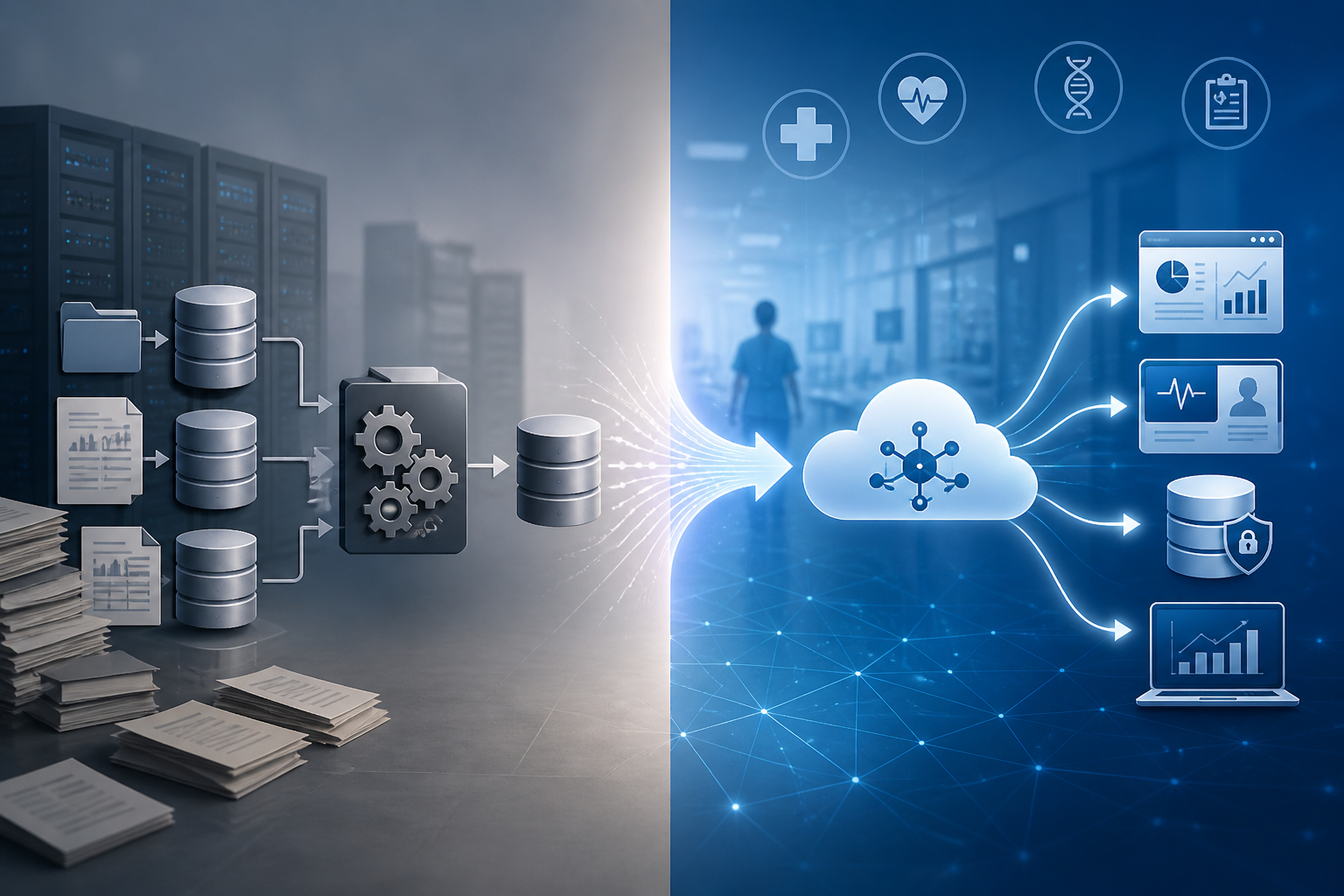
Achieving seamless integration while navigating the challenge of legacy systems often poses an operational roadblock. The best way to alleviate this problem is to have an intermediary solution layer that sits between the legacy system and newer modules. Middleware Solutions act as the perfect segue between older systems and current platforms by converting data formats and communication protocols to guarantee robust interoperability. In the context of healthcare, it enables organizations to evade the expensive process of fully replacing outdated systems while still attaining a strong level of interoperability, along with guaranteeing strict global compliance standards of data security. Deploying a middleware solution also optimizes time and money by eliminating the need for end-to-end solution update, ensuring uninterrupted operations, and more insightful results from data.
Looking Ahead: The Future of Healthcare Interoperability
As the healthcare landscape changes, it is crucial to address interoperability challenges in healthcare IT integration. The presence of outdated systems hinders complete interoperability in healthcare despite the importance of modern standards such as FHIR for facilitating the exchange of information.
However, healthcare organizations can anticipate a gradual transition to more connected, interoperable systems as middleware solutions and cloud-based integrations advance. In the future, it is probable that a combination of traditional systems and contemporary standards will exist together, supported by interface engines that are both flexible and strong.
To sum up, despite the potential solutions modern standards provide for addressing interoperability issues in healthcare IT integration, integrating legacy systems continues to pose a significant challenge. Healthcare organizations can enhance patient care and operational efficiency through the use of advanced technologies and strategic methods.
For more insights on overcoming healthcare interoperability challenges, check out our previous blog on Understanding Interoperability in Healthcare: A Comprehensive Overview here.