You have a vast quantity of clinical, financial, and operational data, yet your teams find it hard to even start at work answering the basic problems, supporting frontline decisions and coordinating care across multiple locations. It’s not data shortage that’s the problem. It is fragmentation. Healthcare data silo breakdown is no longer an option but a strategy that a multi-hospital network must implement if it wants to provide better care, reduce waste, and speed up.
What Are Data Silos in Healthcare
Data silos in healthcare are basically fragmented information pools that do not exchange data with each other. A system, a site, or a department keeps its version of the truth. Those versions rarely coincide. For hospital networks that have multiple hospitals, such silos get multiplied across facilities, service lines, and vendors.
You can witness this happening in the everyday hospital operation. A certain hospital uses a particular EHR. Another site utilizes another vendor or a different instance. The ancillary systems keep very important data about labs, imaging, pharmacy, and revenue cycle. Departmental tools take care of scheduling, bed management, referrals, and population health. Every solution contains the data in its own structure, format, and language.
Breaking down data silos in healthcare begins with understanding how large the problem is. It is not a single system or a single integration. It is the aggregate impact of:
- Different EHRs and practice management systems in various hospitals.
- Standalone departmental tools for oncology, cardiology, and behavioral health
- Separate systems for billing, claims, and contract management
- External sources such as HIE feeds, payers, and partner organizations
Without a definite healthcare data integration strategy hospital networks, chief among these pockets of data that most readily isolate themselves, eventually become harder to manage, align and trust. The net effect is a network that looks connected on paper and is very frustrating to work with in reality. The resulting frustrations stunt the networks potential for growth and success.
Why Multi-Hospital Networks Struggle With Data Silos
Everyone who is a leader in a health system knows the risk of fragmentation. But the issue continues, and, in fact, it often gets bigger with scale. Integrating data from multiple hospital systems is challenging for several fundamental reasons related to the very building and acquisition of systems.
To begin with, acquiring growth by acquisition leads to a patchwork of legacy systems. Whatever technology stack each hospital was running is what you get. It is very disruptive, expensive, and takes a long time to replace everything. As a result, you have different EHRs, several billing platforms, and point solutions specifically designed for each site, which, according to the vendors, is necessary to the operation.
Moreover, each hospital or service line operates with its own workflows and preferences. Local teams choose the tools that are most suitable for them. Quite often these tools do not have advanced interoperability features. Even in the case of existing interfaces, they demand customized work and continuous upkeep.
Third, vendor ecosystems typically promote lock-in. Interfaces are usually designed to handle basic transactions rather than facilitating high, value multi, hospital data integration. Hence, you are limited in your data access, are faced with complicated interface specifications, and experience vendor implementation inconsistencies. Hence, the integrated healthcare data systems become more of a slogan than a reality.
Fourth, internal IT teams can only do so much. They have to deal with upgrades, security, compliance, and provide support for front-line staff. Large-scale enterprise integration projects are like competitors with daily operational needs. Even when the leadership has set an integration goal, the execution gets stuck if there is no sustainable model and the right platform.
Finally, governance is often left behind as growth continues. Each site maintains its own data definitions, quality rules, and reporting logic, resulting in unmatched metrics across hospitals. A simple question like length of stay or readmission rate may even give rise to disputes about the source of the data.
You need health system data silo solutions that will not only understand the complexity of your environment but will also simplify it over time. Integrating without a clear, shared approach can make you data problem worse with every new system you add.
Impact of Data Silos on Patient Care and Operations
Data silos are not merely a technical issue.
They cause clinical risk, disrupt work, and hamper strategic performance.
If systems do not share consistent and timely data, all the teams suffer.
Clinically, partial patient information is a frequent issue. A doctor in one hospital might not have access to recent lab results, imaging, or consultant’s notes from another hospital. One system shows the medication history, but another doesn’t. In order to complete the picture, care teams get their information through phone calls, faxes, and workarounds. This not only wastes time but also is prone to errors.
Moreover, the patients’ care coordination is negatively affected.
• Discharges and admissions between hospitals, care centers and clinics require information sharing.
• Each site use separate systems and therefore the whole handoff process becomes problematic.
• Case managers and care coordinators who should be in charge of patients, are forced to spend hours gathering data.
The process of reporting and analytics is, from an operational perspective, very slow and often unreliable. The teams have to pull the data from various sources, do all the data mixing manually, and then argue over which numbers they should use. Decision-making cycles become longer than usual. Managers are not able to visualize the network level performance. When the reports finally get to the executives, the scenario on the ground has already been changed.
The financial performance is affected, too. The management of denials, the contracts of value, based care, and the planning of service lines are entirely reliant on consistent data from multiple hospitals. The breaking up of the data streams and the coding errors cause the loss of revenue opportunities, an increase in the administrative work, and the postponement of getting insight.
From the point of view of strategy, healthcare data interoperability and the existence of data silos are in a confrontational relationship. You may wish to care coordination, quality standardization, and system, level program support. However, the isolated data keeps each hospital in its own information bubble. If there are no integrated healthcare data systems, it is difficult to behave as if you are one health system.
How Data Integration Breaks Down Silos
Breaking down data silos in healthcare depends on a clearly defined integration strategy and is also backed by a right technology foundation. Connecting systems point to point is simply not enough. You need a unifying layer that at scale can receive, translate and route data across your network.
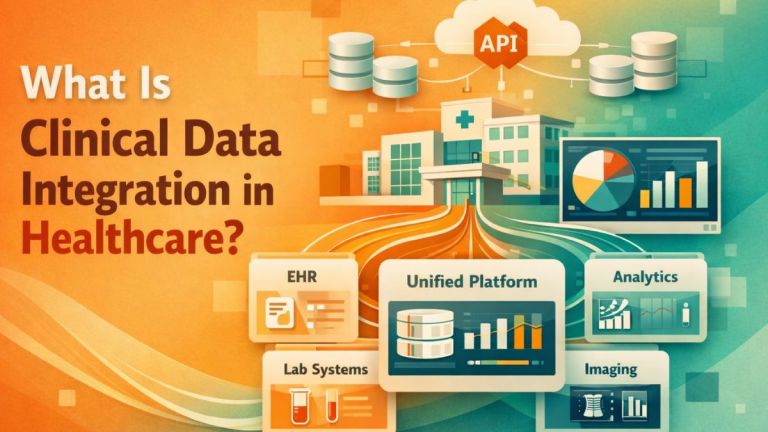
Healthcare data integration for hospital networks should initially standard interfaces but definitely cannot stop there. A central integration platform is required that:
- Uses industry standards and vendor, specific APIs to connect to each source system.
- Normalizes and maps data into common definitions and formats.
- Implements routing rules within hospitals, service lines, and external partners.
- Allows both real-time transactions and batch data flows
This type of strategy enables you to be in control of complexity rather than being overwhelmed by it. It is as if instead of creating a customized connection for each pair of systems, you choose to be able to communicate through a central integration fabric. A modification in one system will not necessitate you to build integrations again throughout the entire network.
Collaboration of data among multiple hospitals then turns into a well, executed program. You first identify the major data flows like admissions, discharges, transfers, orders, results, and documents. Then you create standard patterns for how those flows should be in your local. You keep those patterns in one place instead of having different interfaces.
Eventually, integrated healthcare data systems develop out of this framework. Shared data layers is what your EHRs, ancillary systems, and external connections are feeding. Clinical workflows, analytics, population health tools, and revenue cycle processes are supported by that layer. Each new initiative taps into an already existing integration backbone instead of going back to square one.
Most significantly, a well, established integration strategy brings the focus away from technical barriers to clinical and business results. Interoperability is no longer seen as a one time IT project but as a growing operational capability within network.
Key Benefits for Multi-Hospital Networks
One of the benefits of fully committing to breaking down data silos in healthcare across your network is that you will see advantages in both your daily routines and your long, term planning. Hence, integration turns into a means for transformation rather than a limitation.
Healthcare providers receive a fuller view of the patient. When healthcare interoperability is achieved and data silos are minimized, vital patient data is able to travel with the patient from one facility to another. Providers can review the details of recent visits, tests, and treatment plans even without having to switch between various systems or contacting other healthcare facilities.
There is wide improvement in the care coordination within and beyond your hospitals and settings. The availability of shared data facilitates referrals, discharge planning, and follow, up programs. Case managers and care teams are collaborating based on the same set of information. Patients have a clearly defined and less fragmented journey through your system.
Operational teams gain quicker and more dependable insights. When multi, hospital data integration is implemented, you have the capability to merge the data feeds into common reporting and analytics environments. Executives receive consolidated metrics across different hospitals, service lines, and care settings. Instead of relying on data that is patched together from spreadsheets, decisions can be made based on current, consistent data.
IT secures a more manageable environment. One central integration layer not only simplifies the connections but also lowers the number of custom point solutions. It is not necessary to redesign the integration process completely when you add a new hospital to the network. What you need to do is just connect that hospital the way your team already knows how to support.
From a strategic point of view, health system data silo solutions are growth and transformation enablers. You have the ability to harmonize clinical protocols, launch system, level programs, and facilitate value, based care initiatives. Integrated healthcare data systems turn into a platform for innovation rather than an obstacle to it.
Challenges and Best Practices for Implementing Integrated Data
One of the major difficulties is system diversity. You hardly ever get to work from scratch. Different hospitals will have different combinations of vendors, configurations, and data quality statuses. If you try to impose standardization abruptly, it will likely lead to resistance and disruptions in operations.
Healthcare data sharing is really not a decision that hospital networks can do on their own, they rely on technology, governance, and culture to make it happen. Those who succeed are those who view integration as a whole, team capability rather than a quick fix.
As a matter of fact, it is a practical best practice
to consider shared outcomes rather than the tools. At the same time, leaders should be aligned in agreement on goals such as the reduction of unnecessary testing, the improvement of the patient handover process, or even the standardization of certain parameters. These goals can then be used to guide integration work and help in providing a status update.
Another issue is data governance. If each hospital has its own set of definitions for fields and metrics, then no integration platform by itself can solve the problem. It is necessary to have a cross, functional governance group that specifies the standards for the main data elements, code sets, and metrics. This group should consist of representatives from clinical, operational, and IT leadership.
On the technical side, you should consider your integration platform like vital infrastructure. Spend your money on a solution that offers support for various protocols, data formats, and message types. Develop reusable integration workflow patterns for typical operations like admissions or results. Make sure those patterns are well documented so that teams across the network know how data flows.
Security and compliance are also quite important. The data systems in healthcare that have been integrated increase the surface area for data exchange. It is a must to have strong access controls, audit trails, and monitoring in place. Instead of treating security and privacy as the last step, involve the teams in these areas from the very beginning of the design process.
Change management is probably the most overlooked challenge. Interoperability in healthcare and data silos impact every role that deals with information. Clinicians, registrars, coders, analysts, and leaders all notice the integration changes. To help the adoption, you must have clear communication, training, and feedback loops.
The best approach is to see integration as a partnership among IT, clinical operations, and finance. Identify high impact use cases as a starting point. Show value. Then scale. Leverage early wins to generate trust and gain momentum for more extensive projects across the network.

Conclusion
Breaking down data silos is no longer a matter of choice but a necessity in healthcare across multi, hospital networks. Healthcare data silos reduce your ability to providing coordinated care, adapting to change, and assisting your teams. An organized strategy for hospital network healthcare data integration transforms disjointed systems into a connected base for clinical and operational decisions. It’s not about technology for its own sake. It is about a network where patient data is delivered exactly where, when, and in the format that people can trust and use it. Healthcare data integration systems provide you with this power. Health system data silo solutions then become a strategic advantage instead of a backlog item. Vorro enables data integration in multi, hospital settings through a versatile, healthcare, oriented integration platform and services. You get a central layer of interoperability, expert support, and a workable approach that honors your current setup and at the same time moves you towards a more connected future. To find out how Vorro can assist your network in lowering healthcare interoperability and breaking down data silos, book a working session with us.
FAQs
What is the first step in breaking down data silos in healthcare across a network?
First, you need to make a complete inventory of your systems, interfaces, and data flows within all the hospitals. Pinpoint the biggest value gaps for clinicians and operations, e.g., absence of discharge summaries or lab results between different sites. Leverage those findings to come up with a prioritized healthcare data integration roadmap for hospital networks that links each integration effort with a particular outcome.
How does a central integration platform differ from point to point interfaces
Point to point interfaces are direct connections between systems, and as you add more connections, this creates a complicated network that is difficult to manage. A central integration platform is like a hub for multi, hospital data integration. Each system just needs to connect once to the platform, and the platform takes care of translation, routing, and monitoring. This cuts down on complexity, accelerates the implementation of new projects, and enhances the understanding of data flows.
What role does data governance play in integrated healthcare data systems?
Data governance plays the role of ensuring that your combined data is stable, reliable, and trusted throughout the network of hospitals. The governance committee decides on the shared definitions for the key data elements, standard codes, and reporting logic. Without such a framework, even a very good technical integration would still result in conflicting metrics and misunderstandings. It is just that without effective governance, health system data silo solutions will not succeed.
How do you balance local flexibility with system-level standards?
You acknowledge the existing workflows at the local level while also standardizing the data needed for system, level decisions and patient safety. Integration patterns refer to shared requirements such as the format of admissions or results messages. Within those patterns, hospitals may preserve local differences as long as they do not hinder the achievement of the shared goals. This compromise allows you to progress towards integrated healthcare data systems without requiring every site to have identical processes.
Why opt for a specialized partner in healthcare interoperability and data silos?
A specialist partner has a thorough understanding of healthcare data standards, vendor ecosystems, and multi, hospital integration patterns. This know, how drastically lowers your learning curve and risk. By partnering with Vorro, you not only get a healthcare-focused integration platform but also a team that comprehends both the technical and operational aspects of the work. Such assistance will help you implement integration plans consistently across your network.
Vorro is a healthcare interoperability and data silo specialist for complex provider organizations. Whether it is integration strategy and design or ongoing management, Vorro offers you the means to create and maintain the connected data foundation your multi, hospital network needs. If you want to find out more about how Vorro helps to dismantle data silos in healthcare, check out Vorro.