By Akshita Kohli · November 25, 2025
The world of healthcare technology is advanced. Yet, a silent, persistent problem plagues almost every system. This is the problem of the EMR integration data silos. You see it daily. Data sits isolated in separate systems. Labs, scheduling, billing, and the main Electronic Medical Record (EMR) all operate independently. This fragmentation is not a mere technical inconvenience. It is a fundamental barrier to delivering excellent care. For Chief Medical Officers, Administrators, and IT Directors, this problem directly impacts their key metrics. It increases operational cost. It slows down clinical decision-making. Most importantly, it compromises patient outcomes.
It is a stunning fact that clinical staff can spend up to 20% of their workday searching for patient information. That time is not spent treating patients. It is spent navigating poorly connected systems. The solution is not more data. It is better, smarter connectivity. This is where strategic EMR integration steps in. This blog will explore the true cost of data fragmentation. We will detail the essential steps for successful healthcare data consolidation. Finally, we will show you exactly how unified data directly translates into superior patient outcomes. The era of patchwork systems must end. The future of care demands a single, unified view of the patient.
What is the True Impact of EMR Integration Data Silos on Your Organization?
The term “data silo” is common. But its real-world impact is often underestimated by leadership. Data silos are more than just disconnected databases. They represent organizational bottlenecks and clinical risk. When patient data is trapped, decisions become inherently flawed.
What is a Data Silo in a Healthcare Context?
In healthcare, a data silo is a system or repository. It holds patient, financial, or operational data. Critically, it does not communicate easily or automatically with other systems. Think of a cardiology-specific imaging system. Its data is rich and vital. However, it requires a manual export and upload process to reach the main EMR. That manual step is a silo. It is a point of delay. It is a point of potential human error. These silos are often unintended consequences. They arise from years of specialized software purchases. They can also come from mergers and acquisitions. Every new application added without robust EMR integration data silos prevention contributes to this problem.
The Clinical and Financial Toll of Fragmentation
The effects of fragmented data are immediate and severe.
- Diagnosis and Treatment Delays: A physician cannot see a complete history. They must wait for a faxed report or manually search a separate portal. This delay is dangerous. In critical cases, minutes matter.
- Wasted Resources and Redundancy: Multiple systems often mean duplicate data entry. Staff must enter the same patient demographic information repeatedly. This is a massive waste of salary hours. It also increases the chances of conflicting or incorrect data. This compromises patient outcomes.
- Compliance and Security Risks: Managing security and access across ten disconnected systems is exponentially harder than managing one consolidated platform. Data trapped in aging, unsupported legacy systems poses a significant compliance risk.
- Burnout and Dissatisfaction: Clinical and administrative staff become frustrated. They are spending their valuable time battling technology, not helping patients. This drives down morale and increases staff turnover.
How Can Strategic EMR Integration Achieve Healthcare Data Consolidation?
The goal is not simply to connect systems. The goal is strategic healthcare data consolidation. This means creating a seamless, bidirectional flow of information. It ensures the right data is available in the right place, at the right time, for the right person. This process moves beyond basic data exchange. It involves deep, semantic understanding between disparate technologies.
Understanding the Core Methods of EMR Integration
Successful integration often involves a layered approach. It is customized for the specific technology stack of a hospital or clinic network.
Standardized Interoperability Protocols
Integration relies heavily on industry standards. These are the “common languages” systems use to talk to each other.
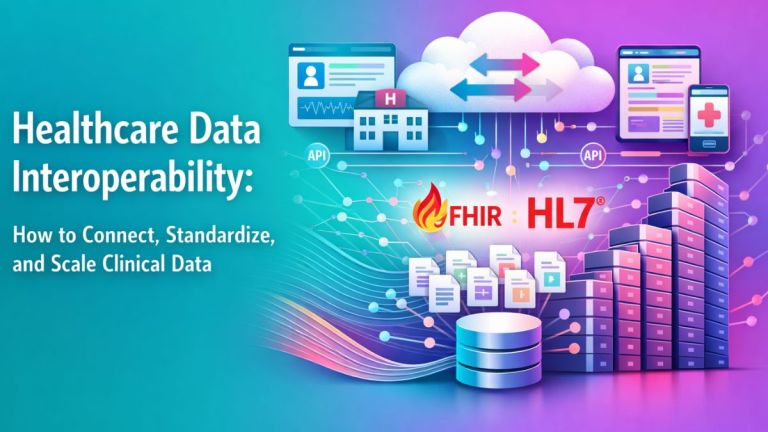
- HL7 (Health Level Seven): This is the foundational standard for clinical data exchange. Modern integration uses the Fast Healthcare Interoperability Resources (FHIR) standard. FHIR is an evolution of HL7. It uses modern web technologies to make data exchange faster and easier. It is key to overcoming EMR integration data silos.
- APIs (Application Programming Interfaces): These are defined sets of rules. They allow one system to request information or functionality from another. Robust, secure APIs are the backbone of rapid data exchange between EMRs and ancillary systems.
The Role of an Integration Engine
For large organizations, a dedicated integration engine is essential. This acts as a centralized hub.
- It translates data between different formats.
- It manages security and authentication for all data transfers.
- It monitors the flow of millions of data points daily.
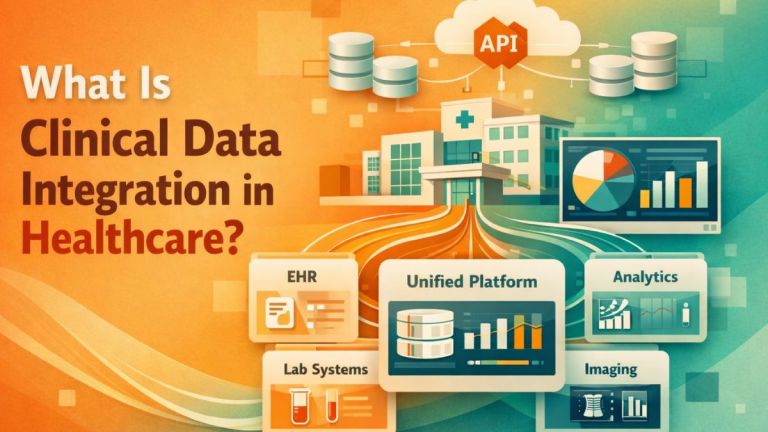
- This engine ensures that a lab result from System A is correctly formatted and sent to the patient’s chart in the EMR (System B) instantly. This is the definition of healthcare data consolidation.
What are the Critical Steps for a Successful EMR Integration Strategy?
The success of EMR integration data silos elimination is not a technical project alone. It is a strategic business initiative. It requires strong alignment between IT, clinical leadership, and operations.
Phase 1: Discovery and Prioritization
Before writing a single line of code, you must understand the current state.
- Map the Patient Journey: Trace a patient’s path through your facility. Identify every single point where data is manually entered, searched for, or transferred. These are your current silos.
- Inventory All Systems: Create a complete list. Include EMR, PACS, LIS, billing, scheduling, and every other system. Document their current integration capabilities (or lack thereof).
- Define Clinical Imperatives: Work with your CMO and clinical staff. Prioritize integrations that offer the highest clinical return. For example, integrating real-time vital signs monitoring may be a higher priority than integrating a non-critical asset management system.
Phase 2: Implementation and Validation
The implementation must be handled by experienced integration specialists. They understand the nuances of clinical workflows.
- Start Small, Scale Smart: Begin with a focused, high-impact integration. A common starting point is integrating patient admission/discharge/transfer (ADT) data. This provides immediate value to downstream systems like billing and patient portals.
- Establish a Master Patient Index (MPI): An MPI is crucial. It ensures that every patient is represented by a single, unique identifier across all integrated systems. Without a reliable MPI, true healthcare data consolidation is impossible. Data duplication and overwriting will inevitably occur.
- Rigorously Test Workflows: Integration is not just about moving data. It is about validating that the data movement supports a better workflow. Clinicians must test the system under real-world conditions. Does the integrated lab result appear in the correct EMR tab? Is the latency acceptable?
Phase 3: Governance and Maintenance
Integration is an ongoing responsibility, not a one-time project.
- Create a Data Governance Framework: Define ownership and accountability for data quality across all systems. Who is responsible for correcting errors in demographic data? This structure prevents new silos from forming.
- Continuous Monitoring: Integration engines must be monitored 24/7. Alerting systems must immediately notify IT of any failure in data transfer. A broken connection is a re-established data silo.
How Does Consolidated Data Directly Improve Patient Outcomes?
The ultimate justification for any technology investment is its impact on the patient. Eliminating EMR integration data silos fundamentally changes the way care is delivered. It moves care from reactive and fragmented to proactive and coordinated.
The Four Pillars of Improved Outcomes
1. Accelerated Diagnosis and Treatment
Imagine a trauma patient arriving in the Emergency Department. Without integration, the ED physician must wait. They wait for old records, scanned reports, and manually entered medications. With seamless EMR integration data silos removed, the entire longitudinal record is instantly available. Past allergies, complex medical history, and recent medication changes are at the clinician’s fingertips. This translates to quicker, more accurate triage and intervention. It saves lives.
2. Enhanced Safety and Error Reduction
Medication reconciliation is a prime example. Disconnected systems are a primary cause of medication errors. One study suggested that up to 40% of errors occur during patient transitions. Integrated data ensures that medication lists are automatically synchronized across all points of care (inpatient, outpatient, pharmacy). This significantly reduces the chance of prescribing an incorrect dosage or a drug that interacts negatively with an existing prescription. This is a direct, measurable improvement in patient outcomes.
3. Coordinated Care Across the Continuum
Modern care is rarely confined to one hospital. Patients see specialists, primary care, and post-acute facilities. Consolidation of healthcare data consolidation ensures every provider has the same, current picture. When a primary care physician releases a patient, the specialist’s office and the home health agency are immediately updated. This smooth transition reduces readmission rates. It improves adherence to discharge instructions.
- Example: A patient with chronic heart failure is discharged. The integrated EMR instantly transmits the discharge summary to the connected remote monitoring platform. The care team can monitor the patient’s weight and vital signs from home. This proactive intervention reduces the risk of the patient destabilizing and requiring an emergency readmission.
4. Population Health Management
For administrators and IT Directors, consolidated data unlocks new capabilities. Data silos make it nearly impossible to identify at-risk patient populations. With a unified data set, your organization can leverage analytics to:
- Identify patients who have not received a critical screening (e.g., mammogram, colonoscopy).
- Flag diabetic patients whose blood sugar readings are consistently out of range.
- Proactively outreach to these specific groups for preventative care.
This move from individual treatment to community-level health management is a powerful driver of long-term, superior patient outcomes.
Case Study Snapshot: A Network Transforms Its Data Flow
A regional hospital network in the Northeast faced significant challenges. They had recently acquired four smaller clinics. Their EMR integration data silos problem was immense. Patient records were disparate. Referring physicians often had to fax records. This created an average delay of 48 hours for specialist appointments.
The Solution: The network implemented a robust integration engine. It utilized FHIR standards to connect their core EMR with the acquired clinics’ scheduling and billing systems. They prioritized the creation of a clean Master Patient Index (MPI).
The Result:
- Patient Intake Time: Reduced by 60%.
- Referral to Appointment Time: Decreased from 48 hours to less than 4 hours.
- Clinician Satisfaction: Increased by a reported 25% due to reduced time spent on data hunting.
The key takeaway for the leadership was clear: the technology was an investment in efficiency. But it was also an investment in clinical speed. Faster data means faster diagnosis. This fundamentally shifts the trajectory of patient outcomes across the network.
Your Next Strategic Move: Bridging Silos for a Healthier Future
The move away from EMR integration data silos is no longer optional. It is a strategic imperative for any organization committed to excellence, efficiency, and superior patient outcomes. The cost of inaction is too high. It is measured in wasted time, unnecessary expenses, and compromised patient safety.
Summary of Key Takeaways
- The Problem is Strategic, Not Just Technical: Data silos represent bottlenecks that lead to clinical risk and operational waste.
- FHIR is Your Future: Leveraging modern interoperability standards like FHIR is essential for true, dynamic healthcare data consolidation.
- The MPI is Non-Negotiable: A reliable Master Patient Index is the foundation for a unified, accurate patient record across all systems.
- Outcomes are the ROI: Seamless integration directly translates to accelerated care, enhanced patient safety, and better population health management.
At Vorro, we specialize in solving these complex EMR integration data silos challenges. We work with IT Directors, CMOs, and Administrators to design an integration blueprint. This blueprint is not just about connecting systems. It is about optimizing clinical and financial workflows. Our approach is based on two decades of healthtech expertise. We ensure your data flows securely, reliably, and purposefully. We turn scattered data points into actionable intelligence.
Ready to move beyond the technical hurdles and start seeing measurable improvements in patient care? Connect with Vorro today to schedule a strategic data flow assessment.