EMR Integration Platforms: SaaS vs On-Premise Options
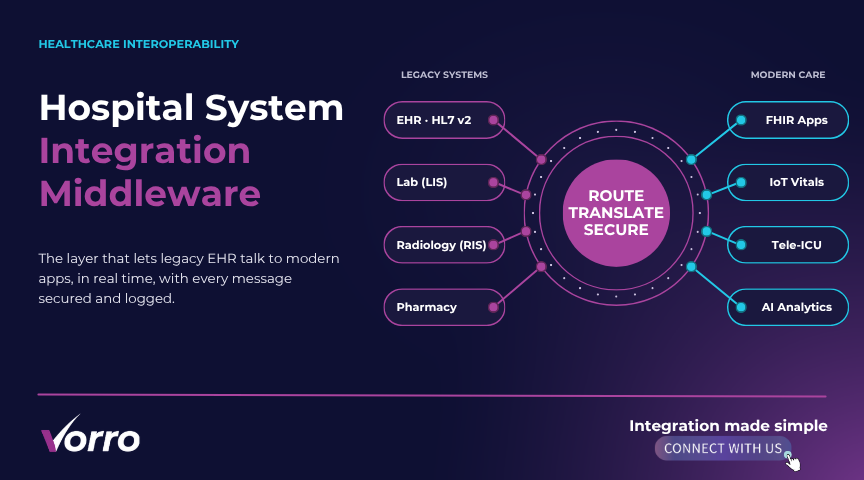
An EMR integration platform is middleware that connects disparate electronic medical record systems so patient data flows automatically instead of requiring manual re-entry across lab, billing, pharmacy, and analytics systems. The biggest decision you’ll make isn’t which vendor – it’s SaaS vs. on-premise: SaaS gives you faster deployment, automatic updates, and elastic capacity with lower upfront cost, while on-premise gives you full control over infrastructure and data residency at the cost of owning maintenance, scaling, and upgrade cycles yourself. Neither is universally “better” — the right choice depends on your compliance obligations, existing infrastructure, and internal IT capacity.
SaaS vs. On-Premise
| SaaS | On-Premise | |
|---|---|---|
| Upfront cost | Lower — subscription-based, minimal capital expenditure | Higher — hardware, licensing, and setup costs upfront |
| Control | Vendor manages infrastructure and updates | Full control over configuration, security posture, and timing of changes |
| Maintenance burden | Vendor-managed; updates and patches applied automatically | Owned internally — requires dedicated IT/DevOps capacity |
| Time to deploy | Typically faster — weeks, not months, for standard integrations | Longer — infrastructure provisioning adds to the timeline |
| Compliance ownership | Shared responsibility model — vendor manages infrastructure security, you manage access and use | You own the full compliance and audit burden, including infrastructure-level controls |
| Scalability | Elastic — capacity scales with demand automatically | Manual — capacity planning and hardware procurement required in advance |
| Data residency | Depends on vendor’s hosting regions and contractual guarantees | Full control — data never leaves infrastructure you manage |
When On-Premise Still Makes Sense
On-premise isn’t legacy thinking for every organization – it’s the right call when:
- Strict data residency requirements apply and you need certainty that patient data never leaves infrastructure you directly control, rather than relying on a vendor’s contractual guarantees
- Deep legacy system dependencies exist that a cloud-hosted platform can’t reach without complex VPN or gateway configuration
- Highly customized workflows require infrastructure-level changes that a multi-tenant SaaS platform can’t accommodate
- Existing infrastructure investment means the marginal cost of staying on-premise is lower than migrating, at least in the near term
When SaaS Wins
SaaS is the better default for most organizations, particularly when:
- Speed matters – you need to stand up a new interface or connect a new facility in weeks, not a multi-month infrastructure project
- Internal IT capacity is limited – you don’t want to dedicate engineering headcount to maintaining integration infrastructure
- Standards evolve quickly – a SaaS vendor can push support for new FHIR profiles or regulatory requirements to all customers simultaneously, rather than requiring you to plan and execute your own upgrade
- Demand is unpredictable – elastic scaling handles seasonal spikes (flu season, open enrollment) without manual capacity planning
Hybrid Approaches and Migration Considerations
Most healthcare organizations don’t make a single, permanent choice — they run a hybrid model: sensitive or highly customized systems stay on-premise, while a SaaS integration layer handles the connective work across everything else, including third-party apps and external data exchange.
If you’re considering a migration in either direction, plan for:
- A data residency and compliance review first – confirm what’s actually required by regulation vs. internal policy before ruling out SaaS
- A phased pilot – move one low-risk interface (e.g., outpatient lab results) before committing broader workflows
- Connector compatibility with legacy systems – confirm the platform can bridge to older EMRs via HL7 messaging or an API layer without requiring the legacy system to change first
- A realistic timeline – mid-size facilities typically see full deployment (planning, connector configuration, testing, training) within 3-6 months; complex legacy environments can extend that
Compare the Real Cost for Your Organization
Published pricing rarely reflects what you’ll actually pay — cost depends heavily on interface count, data volume, and support tier.
Use our TCO calculator to compare SaaS vs. on-premise total cost for your specific environment, or request a side-by-side quote scoped to your actual integration needs.
Frequently Asked Questions
How does an EMR integration platform differ from traditional point?to?point interfaces?
An integration platform provides a centralized hub that can connect multiple EMR/EHR systems, APIs, and third?party applications using standard protocols, whereas point?to?point interfaces require a separate custom connection for each pair of systems. This reduces development effort, maintenance overhead, and scalability issues.
What compliance standards should I look for when choosing an EMR integration platform?
The platform must support FHIR and HL7 messaging standards for data exchange, and be HIPAA?compliant to protect patient privacy. It should also offer audit logging, encryption at rest and in transit, and role?based access controls.
Can an EMR integration platform help improve revenue cycle management?
Yes, by automating the flow of charge capture, insurance verification, and claim submission data across clinical and billing systems, the platform reduces manual entry errors and speeds up reimbursement. Real?time data exchange also enables more accurate denials management and reporting.
How long does it typically take to implement an EMR integration platform in a mid?size hospital?
Implementation timelines vary, but most mid?size facilities see a deployment within 3 to 6 months, including planning, connector configuration, testing, and staff training. Complex custom workflows or legacy systems can extend the schedule.
Which vendors offer pre?built connectors for the most common EMR systems?
Leading vendors such as InterSystems HealthShare, Orion Health Rhapsody, Mulesoft Anypoint, and Corepoint Integration Engine provide out?of?the?box connectors for Epic, Cerner, Allscripts, and Meditech, among others.