Scalable EHR Integration Solutions: A Complete Guide for Healthcare Enterprises
What “Scalable” Actually Means for a Multi-Facility Health System
For a large or multi-facility health system, a scalable EHR integration solution means three specific things: it handles volume spikes without degrading (a flu season surge in lab orders and telehealth visits shouldn’t stall results), it maintains uptime as you add facilities or acquire practices, and it does this without a linear increase in engineering headcount – adding your fifth hospital shouldn’t require doubling your integration team. Scalability isn’t a nice-to-have feature; for a growing health system, it’s the difference between an integration layer that supports growth and one that becomes the reason growth stalls.
Where EHR Integrations Break as You Scale
Most integration failures at scale aren’t dramatic outages – they’re slow accumulation of technical debt that eventually causes one:
- Interface sprawl. Every new facility, specialty, or acquired practice adds point-to-point interfaces. Without a managed layer, the number of connections grows faster than your team’s ability to maintain them.
- Latency under load. An architecture that performs fine at normal volume can degrade sharply during demand spikes (flu season, a mass casualty event, open enrollment) if it wasn’t built for horizontal scaling.
- Maintenance cost creep. Custom Z-segments, one-off mappings, and undocumented interfaces multiply the cost of every subsequent change, even unrelated ones.
- Standards drift. Different facilities on different EHR versions, or a mix of FHIR R4 and STU3 implementations, quietly breaks assumptions your integration layer depends on.
The organizations that scale well catch these patterns early – usually by monitoring interface count and change lead time, not just uptime.
Architecture Patterns That Scale
There are three broad approaches, and the right one depends on your team size and growth trajectory, not just technical preference.
| Approach | Best For | Trade-off |
|---|---|---|
| Point-to-point interfaces | Small, stable environments with few systems | Doesn’t scale — interface count grows exponentially with each new connection |
| Self-hosted integration engine | Organizations with dedicated engineering capacity and specific customization needs | Full control, but you own uptime, scaling, and maintenance |
| Managed / cloud-native integration platform | Organizations that want scalability without growing an internal integration team | Less low-level control, but built-in connectors, auto-scaling, and vendor-managed uptime |
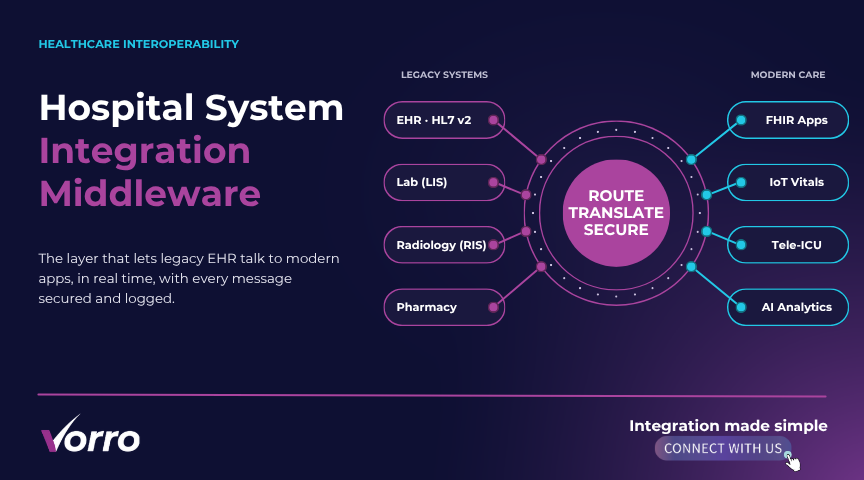
Within the managed/cloud-native category, look for platforms built on microservices – independently deployable components (a “lab results” service, an “ADT” service) that can scale individually rather than requiring the whole platform to scale together. Paired with event-driven design (a message broker pattern where an “order created” event notifies billing, pharmacy, and analytics simultaneously), this avoids the polling and bottlenecks that sink monolithic architectures under load.
When evaluating vendors in this space (managed integration platforms and engines), compare on: breadth of standards support (HL7 v2, FHIR R4, SMART on FHIR), support tier and SLA, and stated roadmap for emerging standards like FHIR R5 -rather than published pricing, which for enterprise integration platforms is typically custom-quoted based on volume and doesn’t reflect the range you’ll actually pay. Get a live demo and a quote scoped to your actual interface count before comparing costs.
Workflow Automation on Top of Integration
Scalable integration isn’t just about moving data faster – it’s the foundation that makes automation possible. Once your integration layer reliably surfaces events in real time, you can layer automation on top:
- Asynchronous processing for heavy workloads (claims adjudication, imaging processing) so nothing blocks a clinician-facing screen while it completes
- Automated alerting on clinical events (a new lab result crossing a threshold) routed directly to the right team without manual monitoring
- Denial and billing automation, where real-time visibility between the claims engine and clinical repository can surface revenue leakage points automatically rather than through a quarterly audit
This is where scalable integration pays for itself operationally, not just technically — the same event stream that keeps your system responsive under load is what makes automated workflows possible in the first place.
What This Looks Like in Practice
Illustrative example: A multi-facility health system running a tele-ICU or remote patient monitoring program needs to stream vitals from thousands of home devices simultaneously. An event-driven architecture (message broker plus auto-scaling microservices) is built specifically to keep latency low and consistent even during peak monitoring hours, rather than degrading as device count grows – which is the core promise of a scalable architecture versus a point-to-point one.
Typical benchmarks worth targeting once live: throughput sized to roughly 1.5x your observed peak load, sub-300ms latency for real-time use cases, error rates under 0.1% of transactions, and 99.9% uptime for critical interfaces. These are reasonable planning targets – your actual numbers should come from your own pilot data, not a vendor’s marketing benchmark.
Get a Scalability Assessment for Your Health System
The right architecture pattern depends on your current interface count, growth plans, and team capacity – not a generic best practice.
Request a scalability assessment to map your current integration footprint against projected growth, or talk to an integration engineer about a phased rollout plan.
Frequently Asked Questions
How can healthcare enterprises evaluate the ROI of scalable EHR integration platforms?
Calculate the total cost of ownership, including licensing, infrastructure, and maintenance, then compare it to expected savings from reduced manual data entry, faster claims processing, and improved patient throughput. Factor in indirect benefits such as better clinical decision support and compliance avoidance costs to derive a net ROI percentage.
What are the benefits of using microservices instead of a monolithic architecture for EHR integration?
Microservices enable independent scaling of high?traffic components, faster deployment cycles, and easier fault isolation, which reduces downtime during updates. They also allow teams to adopt different technology stacks for specific services, improving flexibility and future?proofing the integration layer.
Which cloud?native integration platforms support FHIR and are suitable for large hospital networks?
Platforms such as Google Cloud Healthcare API, Microsoft Azure API for FHIR, and Amazon HealthLake provide fully managed, FHIR?compliant environments with built?in scalability, security, and audit logging. They integrate with existing EHRs via RESTful APIs and can be extended with containerized microservices for custom workflows.
How do message brokers improve performance and scalability in EHR data exchange?
Message brokers like Apache Kafka or RabbitMQ decouple producers and consumers, allowing asynchronous processing and smoothing traffic spikes. They enable event?driven architectures where clinical events are streamed in real time, supporting horizontal scaling without bottlenecking the core EHR system.
What security considerations are essential when implementing scalable EHR integration solutions?
Encryption in transit and at rest, strict OAuth2/OpenID Connect authentication, and role?based access control must be enforced for all API endpoints. Additionally, audit trails, regular vulnerability scanning, and compliance with HIPAA and GDPR standards are critical to protect patient data across distributed components.