Zero Trust Architecture for Healthcare Integration: A Practical Guide
Introduction – why Zero Trust matters in healthcare integration
Imagine a hospital network where every device, from a bedside monitor to a third-party lab app, is treated like a stranger. That’s the reality today, and Zero Trust Architecture for Healthcare Integration is the only way to keep patient data safe while still sharing information quickly. You can’t afford a breach when lives are on the line.
What is Zero Trust Architecture?
Core principles
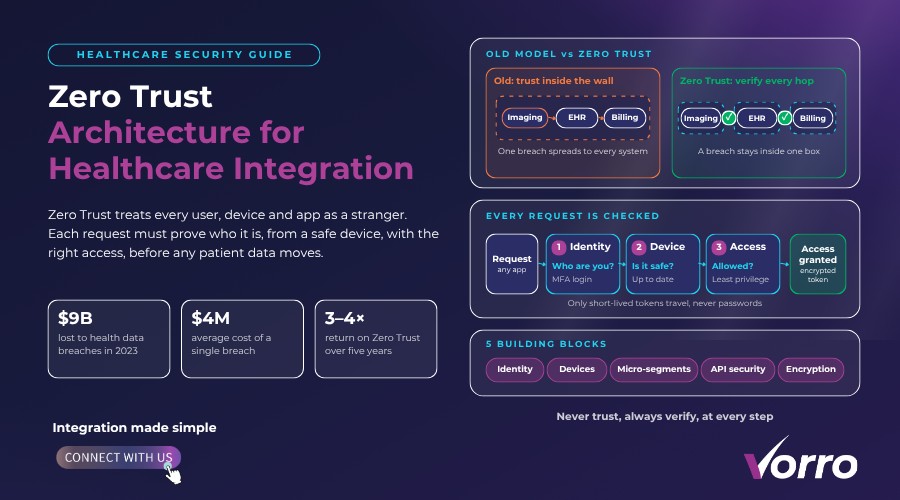
Never trust, always verify. Every request—whether from a nurse’s tablet or a cloud service—must be authenticated, authorized, and encrypted before it moves. It’s a shift from “trust but verify” to pure verification.
Why Healthcare Integration Needs Zero Trust
Risks of traditional models
Legacy trust models assume internal traffic is safe. In practice that means ransomware can hop from an imaging system straight to the EHR. Data breaches in 2023 alone cost the health sector $9 billion—proof that old defenses just don’t cut it.
Key Components for Healthcare ZTA
Identity & Access Management
Roles, roles, roles. Clinicians get just the access they need, and every login is tied to multi-factor proof.
Device posture & verification
Is the device patched? Does it run approved antivirus? If not, it’s blocked at the gate.
Network segmentation & micro-perimeters
Separate the radiology network from billing. Micro-perimeters keep lateral movement tight.
Application & API security
API gateways enforce token-based auth and rate limiting, stopping rogue calls dead in their tracks.
Data encryption & classification
Encrypt at rest and in motion, then flag PHI so it gets the highest protection level.
Step-by-Step Implementation
1?? Assess current environment & inventory
Map every system, device, and data flow. You’ll be surprised how many hidden connections exist.
2?? Define trust zones & policies
Group assets by sensitivity—clinical vs. admin—and set policies accordingly.
3?? Deploy identity-centric controls
Implement single sign-on with adaptive MFA. It’s a game-changer for user experience.
4?? Secure APIs & integration points
Use mTLS and enforce strict scopes on each endpoint.
5?? Continuous monitoring & analytics
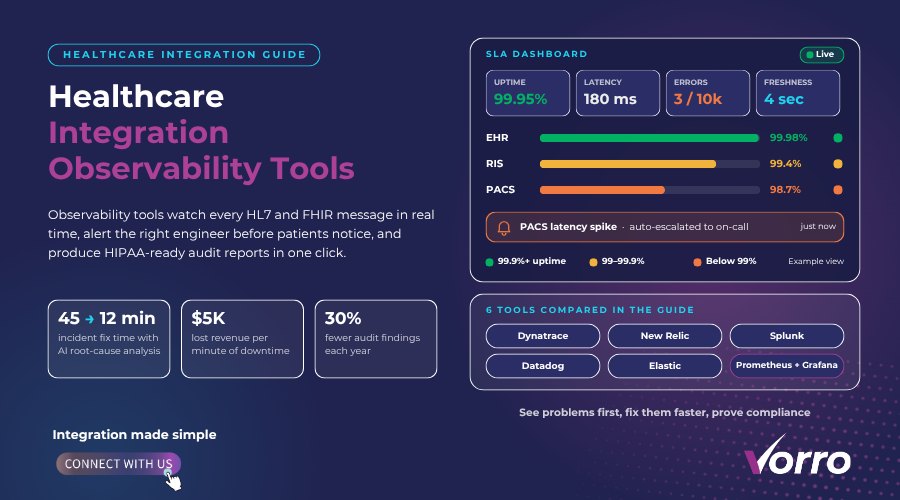
AI-driven alerts spot anomalies in seconds, not days.
API Security for Integrated Systems
Token-based auth, mTLS, rate limiting
These three safeguards keep your data pipelines clean, even when third-party labs connect.
Compliance & Regulatory Alignment
HIPAA, HITECH, NIST SP 800?207 mapping
Zero Trust controls map directly to required safeguards—audit logs, access reviews, and encryption.
Monitoring, Incident Response & Continuous Improvement
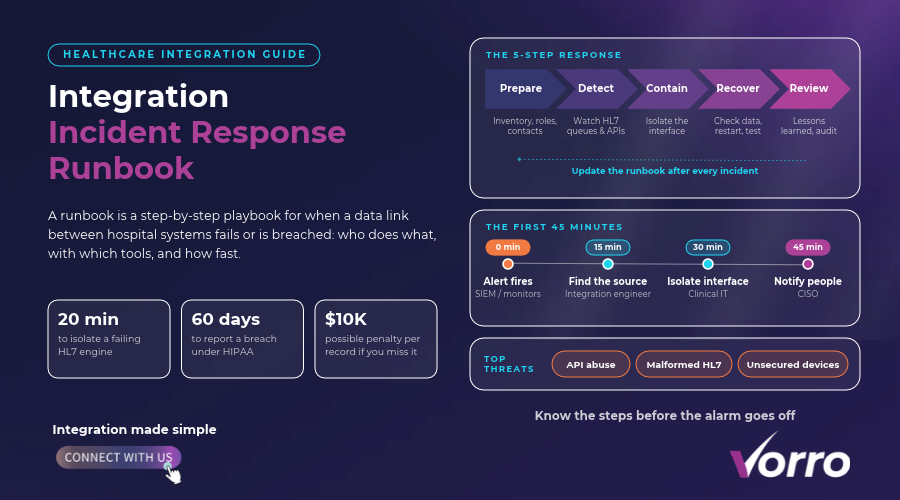
Blend SIEM with user-behavior analytics. When an alert fires, you have a playbook ready: isolate, investigate, remediate.
Real-World Integration Workflow
Example use-case: EHR ? Lab system
A physician orders a test; the EHR sends a token to the lab’s API, which returns results to a secure micro-perimeter. No credentials travel, only encrypted tokens, as outlined in Unlocking the Power of FHIR Data Mesh Architecture for Scalable Healthcare.
Vendor-Agnostic Tool Selection Matrix
Criteria: scalability, auditability, cost
Score each solution on these three axes. The best fit often lives in the open-source arena—see the Top Mirth Alternatives in 2026: Open Source & Paid Integration Engines Compared—and can be complemented by a commercial SIEM.
ROI & Cost-Benefit Analysis
Reducing breach costs, improving patient trust
One breach can cost $4 million on average. Investing $500 k in Zero Trust typically saves three-to-four times that amount over five years.
Common Pitfalls & How to Avoid Them
Over-reliance on perimeter, siloed policies
Don’t treat Zero Trust as a single firewall. Integrate policies across identity, device, and data layers.
Quick Checklist & Resources
- Catalog assets and data flows.
- Define trust zones.
- Roll out MFA and SSO.
- Secure APIs with mTLS.
- Implement continuous monitoring.
Now you have a hands-on roadmap. Adopt Zero Trust, protect patient data, and stay ahead of regulators. The future of healthcare integration is trust-free, and it starts with you.
Frequently Asked Questions
What are the first steps to begin a Zero Trust rollout for integrating Electronic Health Record (EHR) systems?
Start by inventorying all data flows, users, and devices involved in EHR exchanges. Then define trust zones, prioritize high-risk assets, and deploy identity-centric controls like multi-factor authentication before expanding segmentation and monitoring.
How does Zero Trust architecture support HIPAA and other healthcare compliance mandates?
Zero Trust enforces least-privilege access, continuous verification, and detailed audit logs, which align with HIPAA’s requirements for protected health information confidentiality, integrity, and accountability.
What is micro-segmentation and how does it safeguard patient data within a healthcare network?
Micro-segmentation creates granular, logical perimeters around applications, workloads, or data stores, limiting lateral movement so that a breach in one segment cannot easily access other patient records.
Why is device posture verification essential for clinicians’ mobile and IoT devices?
It ensures each device meets security baselines—such as up-to-date patches, encryption, and approved configurations—before it can access sensitive health systems, reducing the risk of compromised endpoints leaking data.
What key considerations should be taken when protecting health-information APIs under a Zero Trust model?
Implement strong authentication (e.g., OAuth?2.0), encrypt all traffic, enforce granular scopes for each API call, and monitor anomalies with rate-limiting and real-time analytics to detect suspicious usage.