
Understanding the Healthcare Integration Maturity Model: A Step by Step Guide
Introduction to the Healthcare Integration Maturity Model
When you first hear “Healthcare Integration Maturity Model” you probably wonder what it actually means. In short, it’s a roadmap that shows how far your organization has come in stitching together systems, data, and people, and where you need to go next. The model gives you a common language, a set of benchmarks, and a pragmatic way to drive digital health forward. And if you’re aiming for smoother patient journeys, faster billing cycles, and smarter analytics, the model is the compass you’ve been missing.
Why a maturity model matters in healthcare
Healthcare is a patchwork of EHRs, labs, imaging, billing engines, and wearables. Without a clear maturity framework, every department ends up speaking a different dialect. That leads to data silos, duplicated effort, and frustrated clinicians. A maturity model shines a light on those gaps, helps you prioritize investments, and lets you measure progress in concrete terms—like reduced integration latency or lower error rates.
Core Concepts and Terminology
Definition of HIMM
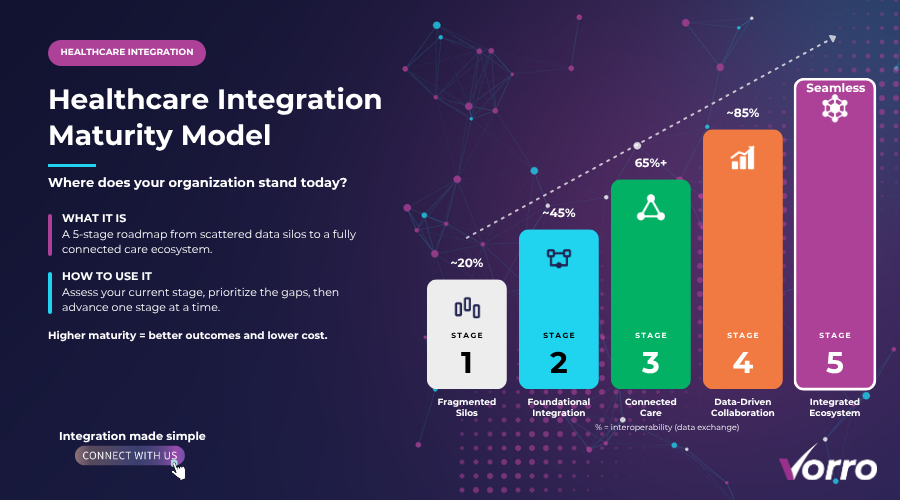
HIMM stands for Healthcare Integration Maturity Model. It’s a five?stage ladder that evaluates how well an organization integrates people, processes, technology, and data. Think of it as a health check for your integration ecosystem.
Key components
The model breaks integration down into four pillars: people (skills, roles, culture), process (governance, standards, repeatable workflows), technology (APIs, middleware, cloud platforms), and data (quality, semantics, governance). Mastery of each pillar pushes you up a stage.
The Five Stages of HIMM
Stage 1 – Ad Hoc Integration
In the ad hoc world, teams cobble together point?to?point interfaces as needs arise. You’ll see manual data entry, spreadsheet?driven mappings, and a constant firefighting mode. Integration latency can stretch beyond 48?hours, and error rates hover around 12?%.
Stage 2 – Defined Integration
At this point, you’ve documented standard interfaces and adopted a handful of integration patterns. Governance starts to appear, but it’s still uneven. Latency drops to 12–24?hours and error rates fall to 8?%.
Stage 3 – Managed Integration
Now you’re running a centralized integration platform, with monitoring dashboards and SLA enforcement. Teams follow repeatable processes, and you’ve invested in a data?quality program. Latency averages 4–6?hours, and errors dip below 4?%.
Stage 4 – Optimized Integration
Optimization means real?time data exchange, automated testing, and predictive analytics that flag issues before they surface. You’re leveraging API economies and embracing standards like FHIR across the board. Latency is under an hour, and error rates are single?digit fractions.
Stage 5 – Innovating Integration
At the top of the ladder, integration becomes a source of competitive advantage. AI?driven orchestration, dynamic service discovery, and a marketplace of reusable micro?services keep you ahead of the curve. Your organization can launch new digital services in weeks, not months.
Assessing Your Current Maturity Level
Self?assessment questionnaires
Start with a quick questionnaire that asks about governance, tooling, people skills, and data standards. A typical set includes 20 statements—rate each from 1 (never) to 5 (always). The aggregate score lands you in a stage bucket.
Benchmarking tools & frameworks
There are several free benchmarking frameworks from industry groups like HIMSS and the ONC. They let you compare your scores against peers of similar size. You’ll often discover that a regional hospital system is two stages ahead of you, even though you have a larger budget.
Sample assessment worksheet
Below is a stripped?down worksheet you can copy into Excel. Fill in the columns, total the scores, and watch the stage pop out.
| Category | Question | Score (1?5) |
|---|---|---|
| People | Team has formal integration training | |
| Process | Standard change?control for all interfaces | |
| Technology | API gateway in production | |
| Data | Master data model adopted enterprise?wide |
Step?by?Step Guide to Advance Maturity
Step 1 – Secure executive sponsorship
Without a C?suite champion, integration projects get stuck in the “nice?to?have” pile. Pitch the ROI in terms of reduced claim denials (often a 15?% dip) and faster discharge summaries. Once the CEO signs off, you’ll unlock budget and authority.
Step 2 – Map existing integration landscape
Grab a whiteboard or a digital modeling tool and plot every data flow—clinical, financial, administrative. Highlight the manual handoffs and legacy interfaces. This visual map becomes the baseline for every improvement.
Step 3 – Define target state per stage
Pick the stage you want to reach in the next 12?18 months. Draft a target?state diagram that shows new APIs, message queues, and governance checkpoints. Be specific: “All lab results will be delivered via FHIR within 30?seconds.”
Step 4 – Prioritize initiatives & create roadmap
Score each initiative on impact (e.g., cost savings) and effort (e.g., resource weeks). Use a simple 2×2 matrix to decide what goes first. Your roadmap should have quarterly milestones, not just a vague “Year?2 goal.”
Step 5 – Implement, monitor, and iterate
Deploy the first batch of integrations behind a monitoring platform that tracks latency and error rates. Hold a bi?weekly stand?up to review KPI trends. When you see a spike, pause, troubleshoot, then adjust the process.
Common Challenges & How to Overcome Them
Data silos, legacy systems, change resistance
Data silos? Start with a data?cataloging tool that surfaces who owns what. Legacy systems? Wrap them in an API façade instead of ripping them out outright. Change resistance? Celebrate quick wins—like cutting claim processing time by 20?%—and let those wins speak for themselves.
Measuring Success
KPI examples
Here are the metrics you should be tracking as you climb the HIMM ladder:
- Integration latency – average time from source event to downstream availability.
- Error rate – percentage of failed transactions per month.
- ROI – cost savings from reduced manual work divided by integration spend.
- Patient throughput – time from admission to discharge, often improves as data flows faster.
ROI calculator template
Copy the formula below into a spreadsheet. Plug in your numbers and watch the payoff.
| Item | Annual Cost | Annual Benefit |
|---|---|---|
| Integration platform license | $250,000 | |
| Reduced claim denials | $400,000 | |
| Fewer manual entries | $150,000 | |
| Net ROI | = (Benefit – Cost) / Cost |
Governance & Change Management Framework
Roles & responsibilities matrix
Clear responsibilities keep projects from drifting. Below is a quick matrix you can adapt.
| Role | Integration Governance | Change Management |
|---|---|---|
| Chief Information Officer | Approve standards | Champion cultural shift |
| Integration Architect | Design patterns | Lead training sessions |
| Data Steward | Data quality rules | Own data?ownership policies |
| Project Manager | Track milestones | Communicate status to stakeholders |
Communication plan
Start with a kickoff email that spells out the vision and key metrics. Follow up with monthly newsletters that showcase wins, like “Integration latency reduced from 12?hours to 3?hours.” End each quarter with a town?hall Q&A—people love hearing the real numbers.
Future Trends & Emerging Technologies
AI?driven integration, API ecosystems, FHIR adoption
Artificial intelligence is beginning to predict which interface will fail next, based on historical error patterns. API ecosystems are turning integration into a product line—think “integration as a service” that other hospitals can subscribe to. And FHIR? It’s moving from a nice?to?have standard to the de?facto language for real?time exchange.
Real World Case Study
Hospital system that moved from Stage 2 to Stage 4
Midwest Health, a 12?hospital system, was stuck at defined integration for years. In 2022 they hired a VP of Integration, mapped 340 interfaces, and adopted an enterprise API gateway. Within 14?months they cut integration latency from 18?hours to 45?minutes and lowered error rates from 9?% to 2?%. The ROI calculator showed a $2.3?M net benefit, mostly from faster discharge paperwork and fewer claim rework cycles.
FAQs
What is the first step to start using HIMM??Secure executive sponsorship and run a quick self?assessment to know where you stand.
How long does it take to move a stage??That depends on scope, but many organizations see a 12? to 18?month window for a one?stage jump.
Do I need a new technology stack for each stage??Not necessarily. Often it’s about re?using existing tools more intelligently—adding an API layer, for example, can propel you from Stage?2 to Stage?3.
Can small clinics benefit from HIMM??Absolutely. Even a 5?person clinic can apply the “people, process, technology, data” lens to eliminate manual chart transfers.
Is HIMM only for large hospital systems??No. The model scales; the language stays the same, only the depth of each pillar changes.
Wrapping it up
Understanding the Healthcare Integration Maturity Model gives you a clear yardstick, a practical set of steps, and a way to prove value with hard data. By assessing where you are, securing leadership buy?in, mapping your current landscape, and moving through the five stages methodically, you’ll turn integration from a cost center into a strategic advantage. Track the right KPIs, embed governance, and keep an eye on AI?driven APIs—those are the ingredients that separate the winners from the rest. So ask yourself: are you ready to move from ad?hoc fixes to real innovation? The roadmap is right here; it’s up to you to start walking it.
Frequently Asked Questions
What are the five stages of the Healthcare Integration Maturity Model and how do they differ?
The HIMM consists of Stage?1?–?Ad?Hoc Integration, Stage?2?–?Standardized Interfaces, Stage?3?–?Automated Data Exchange, Stage?4?–?Enterprise?wide Interoperability, and Stage?5?–?Predictive, AI?driven Integration. Each stage builds on the previous one, moving from manual point?to?point connections to fully automated, data?driven collaboration across the health system.
How can an organization assess its current HIMM stage?
Organizations typically conduct a self?assessment questionnaire or maturity audit that evaluates people, processes, technology, and data governance against defined criteria for each stage. The results are mapped to the HIMM framework to identify the present level and gaps to address.
What tools or frameworks are commonly used to evaluate HIMM maturity?
Common tools include the HIMSS Interoperability Toolkit, openEHR maturity checklists, and proprietary assessment platforms that score integration capabilities across the four HIMM components. Many vendors also offer benchmark dashboards that compare a hospital’s score with industry averages.
What steps can an organization take to move from Stage?2 to Stage?3 in HIMM?
To transition, organizations should standardize data models, implement an enterprise service bus or API gateway, and automate validation rules for incoming data streams. Training staff on integration best practices and establishing continuous monitoring further supports the shift to automated data exchange.
What are typical challenges faced during HIMM implementation?
Common obstacles include legacy system incompatibility, siloed data ownership, insufficient staff expertise, and lack of clear governance policies. Overcoming these requires a phased integration roadmap, stakeholder alignment, and investment in interoperable technology platforms.