Unlocking the Power of FHIR Data Mesh Architecture for Scalable Healthcare
Introduction
Ever wondered how to turn fragmented health records into a living, digital ecosystem? The answer lies in the FHIR data mesh architecture. By marrying the fast?growing FHIR standard with a data mesh mindset, providers can finally break silo walls while keeping compliance tight.
What is FHIR?
FHIR, or Fast Healthcare Interoperability Resources, is a set of RESTful APIs built around reusable resources like Patient, Observation, and Medication. Think of each resource as a Lego brick—tiny, reusable, and instantly stackable.
What is Data Mesh
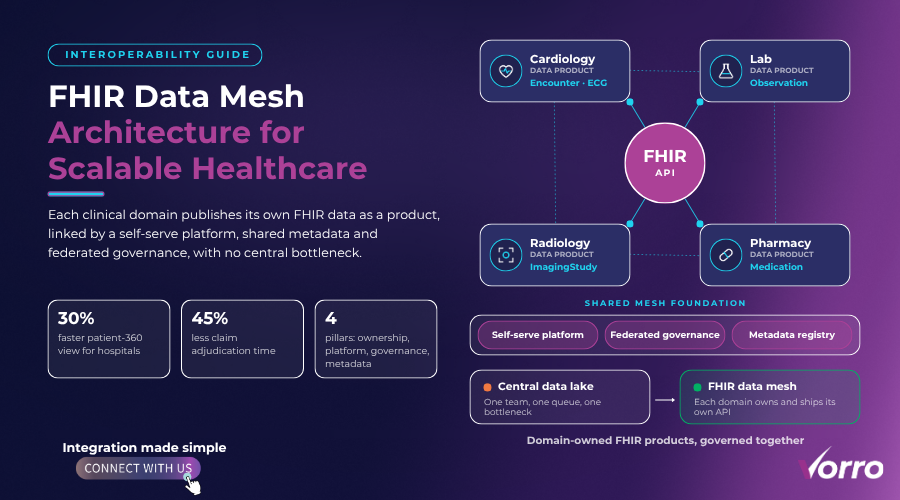
Data mesh treats data as a product owned by the domain that generates it. The four pillars—domain?oriented ownership, self?serve platform, federated governance, and rich metadata—flip the traditional data lake on its head.
Aligning FHIR with Data Mesh Architecture
Domain?Oriented Data Products
Each clinical department publishes its own FHIR?based data product. Cardiology, for example, serves Encounter and ECG resources as a ready?to?consume API.
Self?Serve Data Platform
Developers spin up FHIR endpoints on demand, using services like AWS HealthLake or Azure API for FHIR—no central IT ticket needed.
Federated Computational Governance
Policies travel with the data. Consent flags, audit trails, and HIPAA rules are enforced at the product level, not just the lake.
Role of Metadata Registries
Metadata tags tell you who owns a resource, its version, and compliance posture. Search becomes as easy as Google for health data.
Key Components of a FHIR Data Mesh
Interoperability Layer
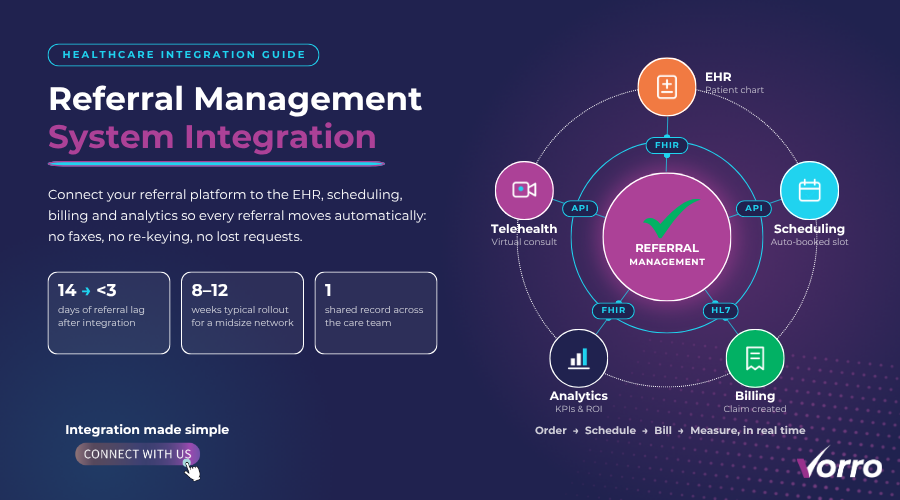
Standard FHIR APIs connect domains, enabling real?time queries across hospitals.
Data Curation & Harmonization
Profiles and extensions normalize vocabularies, so a lab code means the same thing in Boston and Seattle.
Secure Data Sharing & Privacy
Encryption?in?flight, token?based auth, and audit logs keep HIPAA and GDPR worries at bay.
Step?by?Step Implementation Guide
Assess Domain Ownership
Map every clinical silo to a product owner. You’ll know who lives with the data.
Build FHIR?Based Data Products
Use existing FHIR servers or spin up cloud?native instances. Deliver resources as versioned APIs.
Deploy a Self?Serve Mesh Platform
Choose a cloud stack—AWS HealthLake, Azure API for FHIR, or Snowflake Marketplace—and let teams publish with a click, guided by a thorough guide on choosing the right FHIR data integration platform.
Establish Governance Policies
Define consent workflows, set up automated audit pipelines, and lock down access with role?based controls.
Benefits & Real?World Use Cases
Hospitals reporting a 30% faster patient?360 view, insurers cutting claim adjudication time by 45%, and research networks sharing de?identified cohorts in seconds are seeing results thanks to top healthcare data silos solutions.
Challenges Best Practices and Mitigation Strategies
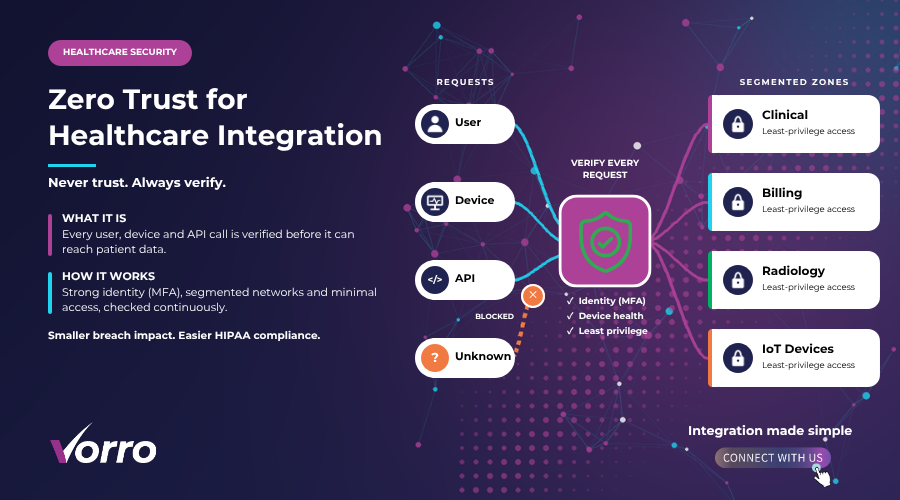
Schema drift? Version every profile. Duplicate data? Leverage metadata deduplication. Security breaches? Enforce zero?trust networking.
Future Trends: Data Mesh vs Data Fabric in Healthcare
While a data fabric still relies on centralized pipelines, a mesh pushes ownership to the edge. In the long run, the mesh wins for agility and compliance.
Quick Checklist & Resources
- Identify domain owners and define FHIR profiles.
- Pick a cloud FHIR service and enable self?service publishing.
- Set up federated governance with consent dashboards.
- Reference guides: HL7 FHIR spec, AWS HealthLake docs, Azure API for FHIR tutorials.
In short, the FHIR data mesh architecture gives you a scalable, secure, and truly interoperable health data ecosystem. Get started today, and turn data silos into a collaborative network that fuels better care.
Frequently Asked Questions
How does a FHIR data mesh improve scalability for healthcare organizations?
By treating each clinical domain as an autonomous data product, a FHIR data mesh distributes storage and processing, reducing bottlenecks of a central repository. This decentralization allows teams to add new data sources and services without impacting overall system performance.
What are the biggest challenges when integrating FHIR into a data mesh architecture?
Key challenges include ensuring consistent data standards across domains, managing security and access controls in a decentralized environment, and establishing robust governance to avoid data silos. Additionally, organizations must invest in tooling for federated queries and metadata synchronization.
Which platforms or tools are commonly used to build a FHIR?based data mesh?
Open?source solutions like HAPI FHIR combined with mesh?oriented platforms such as Kafka, Snowflake, or Datafold are popular. Cloud providers also offer managed services (e.g., AWS HealthLake, Azure API for FHIR) that can be wired into a mesh via APIs and event streams.
How does federated computational governance operate within a FHIR data mesh?
Federated governance distributes policy enforcement to each domain, allowing local teams to apply validation, privacy, and consent rules while a central catalog tracks compliance. This approach ensures consistent standards without a single point of control.
What is the purpose of a metadata registry in a FHIR data mesh?
A metadata registry catalogs the definitions, versions, and ownership of each FHIR resource across the mesh, enabling discoverability and semantic consistency. It also supports automated lineage tracking and simplifies cross?domain query composition.