Zero Trust Architecture for Healthcare Integration: A Practical Guide
Why Zero Trust is Critical for Healthcare Integration
Rising cyber threats & regulatory pressure
Every breach in a hospital feels personal. 2024 saw a 38% jump in ransomware targeting EHRs, and regulators are tightening HIPAA audits. Zero trust architecture healthcare integration isn’t a buzzword; it’s a survival plan.
Benefits over traditional perimeter security
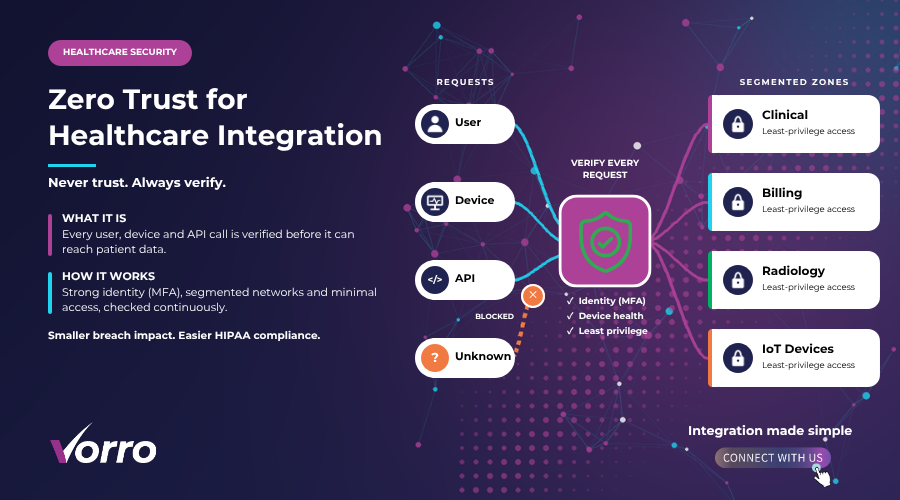
Old firewalls act like a single lock on a front door. If that lock fails, every room is exposed. Zero trust treats every request as if it came from outside, chopping breach impact by up to 70%.
Core Components of a Zero Trust Framework in Healthcare
Identity and Access Management
We start with strong IAM. Multi?factor authentication and contextual sign?ins keep rogue credentials at bay.
Micro-segmentation & Least-privilege
Segment clinical, admin, and IoT networks. Users only see what they need—no more, no less.
Continuous verification & real-time analytics
Every transaction is inspected. Anomalies trigger instant alerts, not weeks?long investigations.
Step-by-Step Implementation Roadmap
Assess current integration landscape
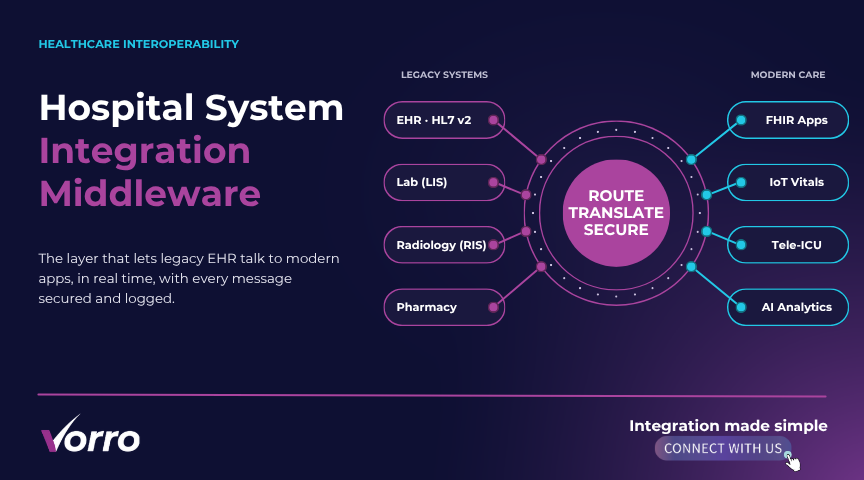
Map EHRs, APIs, and connected devices using an enterprise healthcare data transformation framework. You’ll be surprised how many shadow systems hide in plain sight.
Define trust zones and micro-segments
Create zones for radiology, billing, and patient monitoring. Then, enforce least?privilege rules per zone.
Deploy MFA, conditional access, and device posture checks
Now require MFA for any remote login and verify device health before granting access.
Encrypt and tokenise PHI in transit and at rest
Use AES?256 encryption and tokenisation for all PHI. It’s the safety net that regulators love.
Integrating Zero Trust with Healthcare APIs
API rate limiting and authentication best practices
Apply healthcare API rate limiting best practices to stop credential stuffing. Throttle calls, require OAuth 2.0, and rotate tokens regularly.
Secure API gateways and token-based access
Deploy a gateway that validates JWTs on every request, a core feature of a healthcare interoperability platform. That way no API can talk to another without proof.
Managing Third-Party Risk in a Zero Trust Model
Vendor assessment and continuous monitoring
Every vendor gets a risk score. Continuous monitoring catches a compromised partner before they touch PHI.
Secure data exchange contracts
Contracts now demand encryption, audit trails, and breach notification within 24?hours.
Compliance Alignment
Mapping Zero Trust controls to regulatory requirements
HIPAA and HITECH map directly to IAM, encryption, and audit logs. GDPR adds data?subject rights—Zero trust already covers that.
Real-World Example
Hospital network reduces breach risk by 45% after Zero Trust rollout
A Midwest health system saw a 45% drop in incidents within six months, saving roughly $2.3?million in potential fines.
Common Pitfalls & How to Avoid Them
Over-reliance on a single technology vendor
Diversify tools; avoid lock?in that can cripple your entire security stack.
Ignoring legacy device remediation
Old infusion pumps still need patching or isolation—otherwise they become backdoors.
Frequently Asked Questions
Does Zero Trust replace VPN?
No, it supplements. VPNs become just one of many access methods, all subject to Zero Trust checks.
What is the ROI timeline?
Most organizations see measurable cost avoidance within 12?18?months.
And that’s the core of a zero?trust approach for healthcare integration. By tightening identity, slicing up networks, and treating every API call like a stranger, you protect patients, satisfy regulators, and keep your budget in check.
Frequently Asked Questions
How does Zero Trust protect healthcare APIs from unauthorized access?
Zero Trust requires every API call to be authenticated, authorized, and encrypted, regardless of its origin. By enforcing least?privilege policies and continuous validation, only verified users or services can access patient data.
What steps are needed to assess third?party risk under a Zero Trust model in healthcare?
Start by inventorying all vendors and mapping their data flows, then apply the same identity verification and least?privilege controls used for internal users. Continuous monitoring and real?time risk scores help you revoke or adjust access as vendor security posture changes.
Which compliance standards (HIPAA, HITRUST) align with Zero Trust principles?
Zero Trust directly supports HIPAA’s security rule and HITRUST CSF by mandating strong access controls, encryption, and audit trails. Aligning policies with these frameworks ensures that authentication, least?privilege, and continuous monitoring meet regulatory requirements.
How can micro?segmentation be implemented for medical device networks?
Implement network segmentation at the VLAN or software?defined level to isolate medical devices from other systems, then apply strict access policies per segment. Use policies that only allow necessary traffic and continuously inspect communications for anomalies.