Low-Code vs No-Code Healthcare Integration: Which Solution Fits Your Organization?
Introduction to Low-Code and No-Code in Healthcare
Definitions and core concepts
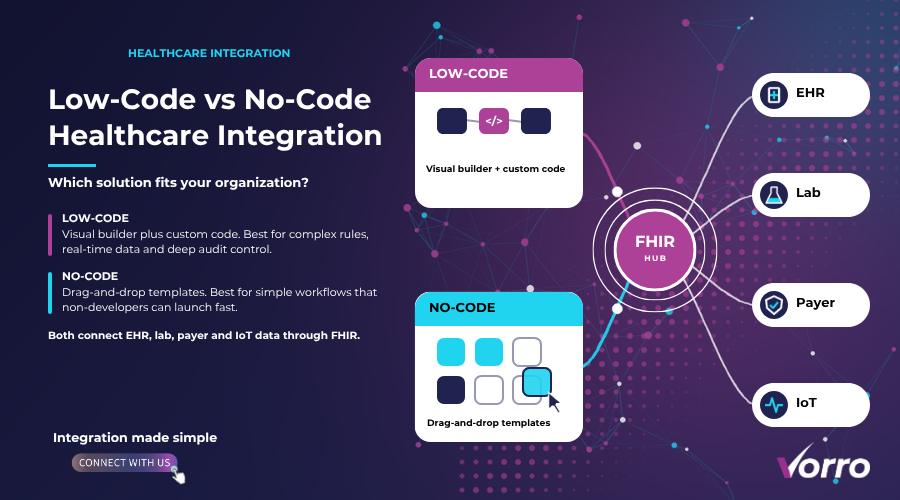
When you hear low-code vs no-code healthcare integration, you’re really hearing two ends of a spectrum that promises faster app delivery without ditching governance. Low-code platforms give you a visual canvas plus the ability to write snippets of code when you need a custom hook. No-code, on the other hand, locks you into pure drag?and?drop modules, so even a non?technical nurse can assemble a workflow.
Why integration matters in modern health systems
Data silos are the enemy of quality care, but you can explore top healthcare data silos solutions to break down barriers and boost patient care. A single patient record might sit in an EHR, a lab system, a payer portal, and an IoT wearables hub. If those pieces don’t talk, you get delayed diagnoses and lost revenue. That’s why hospitals are scrambling for integration platforms that can move HL7, FHIR, and even proprietary APIs at the speed of a clinician’s decision?making.
Key Differences Between Low-Code and No-Code Platforms
Development flexibility vs drag?and?drop simplicity
Low-code lets you mash together pre?built connectors and then drop in a tiny JavaScript function to handle edge cases. No-code trims that freedom—if the visual builder doesn’t have a block for a specific transformation, you’re stuck waiting for the vendor to add it. For a pilot project that needs a quirky insurance rule, low-code usually wins.
Required technical expertise
Imagine your IT team is juggling 30 tickets. With a low-code approach, you’ll still need a developer to maintain custom scripts. With no-code, the same team can hand the reins to a business analyst or a citizen developer healthcare integration platform champion. The trade?off? You may sacrifice some nuance in exchange for speed.
Customization limits
Low-code often supports custom UI components, conditional logic, and API throttling. No-code platforms are tighter: they enforce a set of templates that guarantee compliance but can feel like trying to fit a square peg into a round hole. If you need a bespoke patient consent flow, you’ll probably need low-code.
Time?to?market and cost implications
According to a 2023 Forrester survey, no-code projects hit production in an average of 6 weeks, while low?code averages 10 weeks. The cost gap isn’t huge—no-code licences hover around $75 per user per month versus $120 for low?code—but hidden costs like vendor lock?in can swing the ROI either way.
Compliance & Security Considerations
HIPAA?compliant architectures
Both camps claim HIPAA readiness, yet the devil is in the details. Low-code platforms often expose a sandbox where you can enforce encryption at rest and in transit yourself. No-code solutions typically bake those safeguards in, which reduces configuration errors. The key is to verify that the vendor’s Business Associate Agreement (BAA) covers all data flows you intend to build.
Data encryption, audit trails, and role?based access
When a nurse updates a medication order, you want every change logged. Low?code lets you add custom audit?trail hooks that write to a secure SIEM. No?code platforms provide out?of?the?box audit tables, but they may not let you tag every user action with a unique identifier. If your audit requirement is NIST 800?53 level, double?check the provider’s documentation.
Using citizen?developer frameworks safely
Empowering clinicians to build integrations sounds great—until someone assembles a workflow that leaks PHI to a public endpoint. Governance policies, mandatory code reviews, and sandbox environments are non?negotiable. A good practice is to limit citizen developers to no?code modules while reserving low?code for any logic that touches protected data.
Integration Capabilities
FHIR mapping tools
Here’s where the rubber meets the road. A no-code FHIR mapping tool offers pre?built resource converters: Observation to LabResult, Encounter to Episode, and you can compare options in our guide on choosing the right FHIR data integration platform. You drag a source schema onto a target canvas, click “auto?map,” and the platform generates the JSON. Low?code platforms still provide visual mapping, but they also allow you to write custom transformation scripts in Groovy or Python when the standard mapper falls short.
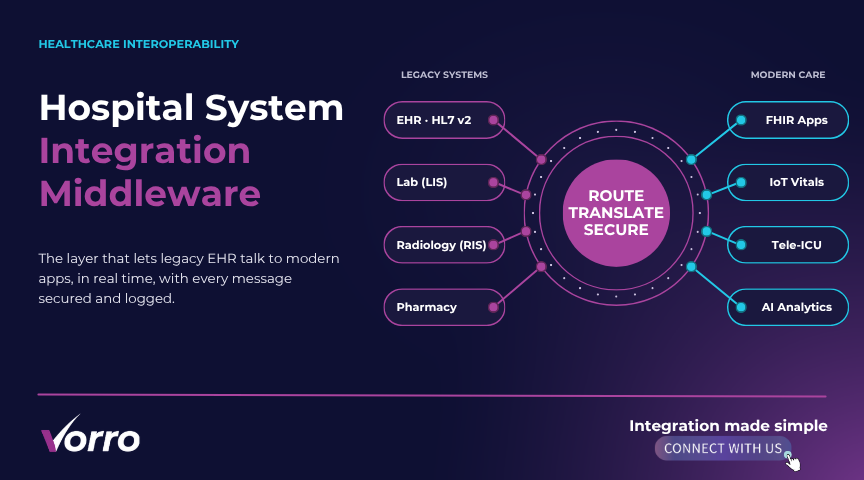
Connecting EHRs, Payers, and IoT devices
A major hospital network integrated its Epic EHR, a Medicare claims engine, and a fleet of Alexa?enabled bedside monitors—all in under four months. They used low?code for the claim adjudication logic (because it needed custom rule sets) and no?code for the bedside monitor data feed, which was pure MQTT ingest, while the team also consulted the latest guide on top Mirth alternatives in 2026 to evaluate other integration engines.
Real?time vs batch processing
Latency matters. If you’re streaming vitals from a cardiac patch, you need sub?second response times—low-code often wins because you can fine?tune queue settings. Batch loads, like nightly insurance reconciliation, are perfectly suited to no?code pipelines that run on a scheduled trigger.
ROI and Total Cost of Ownership
Licensing, maintenance, and scaling costs
Let’s do a quick math exercise. A 500?bed hospital estimates 200 active users on a no?code platform at $75 each = $150,000 annually. Add $30,000 for integration connectors and you’re at $180,000. A low?code alternative with $120 per user plus a $50,000 developer stipend bumps the bill to $290,000. However, low?code can shave 30% off integration errors, saving roughly $60,000 in rework each year.
Productivity gains for IT and clinical teams
In a case study from a regional health system, IT reported a 45% reduction in ticket volume after moving routine enrollment workflows to a no?code builder. Clinicians spent 20% less time navigating duplicate forms, translating directly into an estimated $1.2?million gain in throughput. Those numbers speak louder than any feature list.
Real?World Use Cases & Case Studies
Hospital system reducing onboarding time
A 12?hospital system used a low?code platform to create a unified patient intake service. Previously, each facility had its own HL7 v2 parser, taking 6?weeks to onboard a new payer. The low?code solution introduced a shared FHIR gateway and cut onboarding to 2?weeks—a 66% improvement.
Telehealth startup rapid MVP launch
ZoomHealth, a tele?mental?health startup, launched its MVP in 8 weeks by leveraging a no?code FHIR mapping tool to sync patient data with a national EHR network. Because the platform handled encryption, audit logging, and token refresh automatically, the founders could focus on UI/UX instead of compliance paperwork.
Choosing the Right Platform for Your Organization
Assessment checklist
- Budget: Do you have room for developer salaries or prefer per?user licensing?
- Skill set: Is there a pool of citizen developers or a seasoned integration team?
- Compliance: Do you need granular audit controls (low?code) or are out?of?the?box safeguards enough?
- Scalability: Will you handle real?time streams or batch loads primarily?
- Vendor lock?in: Evaluate data export options and API openness.
Vendor comparison criteria
Look for these must?haves: native FHIR support, HIPS?ready encryption, role?based dashboards, and a vibrant community. Also, check whether the vendor publishes latency benchmarks—some claim sub?200?ms for real?time calls, but independent testing often shows 300?400?ms.
Future Trends in Healthcare Integration
AI?enhanced low?code and citizen developer ecosystems
Next?gen platforms are embedding AI assistants that suggest connector configurations based on your data dictionary. Imagine typing “connect lab results to discharge summary” and the system auto?generates the mapping, complete with compliance annotations.
Emerging standards beyond FHIR
While FHIR dominates, the industry is eyeing OpenEHR and OMOP for research data pipelines. Low?code tools are already adding adapters, whereas many no?code vendors are still catching up. If your roadmap includes population health analytics, keep an eye on those evolving specs.
Conclusion and Quick Decision Guide
So, which side of the low-code vs no-code healthcare integration debate should you pick? If you need ultra?custom logic, real?time performance, and deep audit control, low?code is your ally. If speed, cost predictability, and citizen?developer empowerment are top priorities, a solid no?code platform—especially one with a robust no-code FHIR mapping tool—will get you there fast.
Here’s a quick cheat sheet:
- Start with a citizen developer healthcare integration platform for simple workflows.
- Upgrade to low?code when you hit customization walls or need tighter security hooks.
- Always verify the BAA and audit capabilities before signing.
- Run a small pilot, measure latency, error rates, and ROI after three months, then decide.
Remember, integration isn’t a one?size?fits?all project. Tailor the approach to your organization’s maturity, compliance appetite, and speed?to?value goals. The right mix of low?code and no?code can turn a tangled data maze into a smooth, patient?centric highway.
Frequently Asked Questions
How do low-code and no-code platforms ensure HIPAA compliance when integrating healthcare data?
Both low-code and no-code platforms offer built?in compliance modules such as audit trails, encryption, and role?based access controls that align with HIPAA requirements. Vendors often provide pre?certified connectors for EHRs and other regulated systems, but organizations must still validate the configuration against their own compliance policies.
Which approach typically delivers faster integration of electronic health records (EHR) with third?party applications?
No-code platforms usually provide the quickest turnaround because they rely on drag?and?drop interfaces and ready?made connectors that require little to no scripting. Low-code can be slightly slower but still faster than traditional coding, especially when custom logic is needed.
What are the cost differences between low-code and no-code solutions for a hospital’s integration projects?
No-code tools often have lower upfront licensing fees and reduced development costs due to minimal staffing needs. Low-code platforms may involve higher subscription rates and require developers, but they can offset expenses for complex integrations that would be costly to build from scratch.
Can clinicians without programming experience create integration workflows using no-code tools?
Yes, no-code platforms are designed for business users, enabling clinicians to assemble workflows through visual editors and pre?configured templates. However, they may still need IT oversight to ensure data security and proper system governance.
When should an organization opt for low-code instead of no-code for healthcare integration?
Choose low-code when the integration requires custom business logic, complex data transformations, or integration with legacy systems that lack standard connectors. Low-code also offers greater scalability and maintainability for enterprise?grade solutions that go beyond simple drag?and?drop use cases.