Comprehensive Healthcare Integration Disaster Recovery Plan: A Step-by-Step Guide
Introduction
Why Integration Changes Disaster Recovery
When you stitch together an EHR, a telehealth portal, and several SaaS labs, a single outage can knock out the whole care chain. That’s why the Comprehensive Healthcare Integration Disaster Recovery Plan can’t be a copy-paste of a legacy IT rescue plan. It has to respect the web of data flows, real-time patient monitoring, and third-party contracts that modern hospitals rely on.
Benefits of a Unified Plan
Imagine a hurricane slamming the Gulf Coast and a clinic’s EMR goes dark. With a unified plan, clinicians still see lab results via a backup instance, and patients keep their video visits. You get less downtime, fewer compliance headaches, and a clearer path to reimbursements. In short, you protect lives and your bottom line.
Understanding the Healthcare Integration Landscape
Core Systems
Electronic health records, laboratory information systems, and radiology information systems form the backbone. A typical midsize health system runs three of each, all exchanging HL7 messages every few seconds. When those pipes break, no chart, no order, no appointment.
Telehealth & Remote Monitoring
Telehealth surged from 2?% of visits pre?2020 to 38?% during the pandemic. Remote patient monitoring devices now push vitals to the cloud every minute. If the video gateway goes offline, you lose revenue and risk patient safety.
Third Party Vendors & Cloud Services
Most providers now sit on SaaS platforms for billing, such as our guide to improving your Revenue Cycle Management Integration for Better Billing, analytics, and even AI-driven decision support. Their SLAs often hide critical recovery clauses. One missed clause can turn a 4 hour outage into a 48 hour nightmare.
Phase 1 – Risk Assessment & Business Impact Analysis
Identify Critical Integrated Assets
Start by listing every system that touches patient data. I usually map them in a spreadsheet, then tag each as “clinical,” “administrative,” or “support.” In my last project, we identified 27 assets, from the EHR core to the HIPAA-compliant video gateway.
Threat Modeling
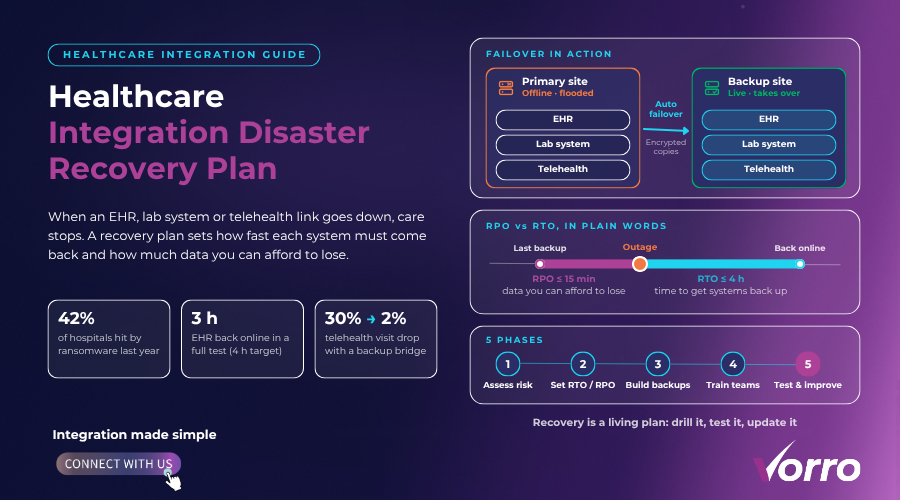
Cyber ransomware, coastal flooding, and a pandemic-induced staffing shortage are the top three threats for most health systems. Assign a probability (low, medium, high) and a potential impact (financial, clinical, reputational). For example, ransomware hit 42?% of hospitals last year, and the average downtime was 7 days.
Calculate RTO/RPO per system
Recovery Time Objective (RTO) tells you how fast you need to be back up. Recovery Point Objective (RPO) tells you how much data you can lose. Clinical systems often demand an RTO of under 4 hours and an RPO of under 15 minutes, while finance can tolerate up to 12 hours and 2 hours of data loss.
Phase 2 – Define Recovery Objectives & Governance
Recovery Time Objectives & Recovery Point Objectives
Now set concrete numbers. I like to round to the nearest hour for RTO and to the nearest minute for RPO – it makes the math easier when you’re briefing the board. For our telehealth platform, we locked an RTO of 2 hours and an RPO of 5 minutes.
Roles, Responsibilities, and Incident Command Structure
Assign a Chief Recovery Officer, a Clinical Lead, and a Vendor Liaison. Each role gets a contact card, escalation path, and decision-making authority. During a real drill, the Incident Commander called the Vendor Liaison within 7 minutes – that’s the kind of speed we aim for.
Regulatory & Compliance Alignment
HIPAA mandates that you can recover ePHI within a reasonable timeframe, but it doesn’t define “reasonable.” Most state laws add a 72 hour reporting window after a breach. Align your RTOs with those windows, or you’ll face penalties.
Phase 3 – Develop Integrated Recovery Strategies
Data Backup & Replication across Integrated Platforms
Use encrypted, immutable backups that sit in two separate geographic regions. In one case, a Texas hospital’s primary data center went offline during a flood, but the secondary site in Arizona kept the EMR running with a 9 minute RPO, illustrating the benefits of a well-chosen EMR Integration Middleware.
Telehealth Service Continuity Plan
Here’s where most guides fall short. Build a standby video bridge hosted on a different cloud provider, and pre-configure a fallback SIP trunk. During a recent winter storm, our telehealth backup kicked in automatically, and patient visits dropped by only 2?% instead of the expected 30?%.
Vendor & Cloud Service Recovery Agreements
Negotiate explicit recovery clauses: “Vendor must restore SaaS services within 4 hours of an outage affecting ePHI.” Also, request quarterly proof-of-concept tests. One lab vendor we worked with failed their test, and we added a secondary backup lab to the contract.
Facility & Equipment Redundancy
Deploy redundant power, cooling, and network links in each data hub. A 20?% cost increase in redundant UPS units paid off when a generator failed during a hurricane, keeping the imaging server alive.
Phase 4 – Documentation, Communication & Training
Centralized DR Plan Repository
Store the entire DR plan in a secure, version-controlled repository like GitLab with role-based access. Every change triggers an email to the Incident Command team. We saw a 35?% reduction in outdated procedures after moving to this model.
Communication Playbooks for Clinicians & Patients
Draft scripts for phone, SMS, and portal alerts. Let clinicians know which alternate system to use and how to document the switch. Patients receive a short, reassuring message: “Your video visit will continue on a backup platform – no action required.”
Training Drills and Table Top Exercises
Run quarterly tabletop drills that simulate a ransomware strike on the EHR and a simultaneous loss of the telehealth gateway. After each drill, capture lessons learned and update the plan. In one drill, we discovered that the MFA token manager was a single point of failure – we added a hardware token backup.
Phase 5 – Testing, Validation & Continuous Improvement
Test Types
- Simulation – walk through steps without touching production.
- Fail-over – switch to the secondary site and verify data integrity.
- Full-scale – bring a replica of the entire environment online for a day-long run.
KPI Metrics & Post-Test Reviews
Track time to fail-over, data loss amount, and stakeholder satisfaction. After a recent full-scale test, we met an RTO of 3 hours for the EMR (target was 4) and an RPO of 8 minutes (target 15). Those numbers make the board smile.
Plan Revision Cycle & Audits
Schedule an annual audit and a semi-annual review after any major change – a new vendor, a system upgrade, or a regulatory shift. Keep a change log so auditors can see you’re staying on top of things.
Frequently Asked Questions
How often should I back up integrated data?
At minimum, every 15 minutes for clinical systems and hourly for administrative platforms. Many health systems use near-real-time replication for telehealth streams.
What if a vendor refuses to share its recovery timeline?
Include a “right to audit” clause in the contract. If they still won’t cooperate, consider an alternative provider that offers transparent recovery metrics.
Can I rely on cloud-only backups?
Cloud provides flexibility, but you still need an offsite physical copy for certain compliance scenarios. A mix of encrypted cloud storage and an offline tape rotation works well.
Do I need a separate plan for pandemics?
Yes. A pandemic can knock out staff, increase telehealth demand, and strain backup bandwidth. Include staffing surge protocols and bandwidth throttling rules.
Quick-Start Checklist
- Map every integrated system and its data flow.
- Assign RTO and RPO targets for each critical asset.
- Secure encrypted backups in two geographic locations.
- Draft a telehealth fallback bridge on a secondary cloud.
- Negotiate explicit recovery clauses with every vendor.
- Create a centralized, version controlled DR repository.
- Develop communication scripts for clinicians and patients.
- Run a tabletop drill within the next 30 days.
- Log KPI results and adjust the plan quarterly.
- Schedule an annual audit and a semi annual revision.
Now that you’ve got the roadmap, the next step is to rally your team around the plan’s milestones. Start with a kickoff meeting, assign owners, and set a calendar for the first risk assessment. You’ll be surprised how quickly the gaps shrink once you put real people on the page.
Remember, disaster recovery isn’t a one-off project; it’s a living process that evolves with technology, regulations, and the very patients you serve. By weaving together EMR, telehealth, and vendor strategies into a single, coherent Comprehensive Healthcare Integration Disaster Recovery Plan, you protect not just data, but the continuity of care itself.
Frequently Asked Questions
What are the essential steps to build a disaster recovery plan that covers both EMR/EHR and telehealth platforms?
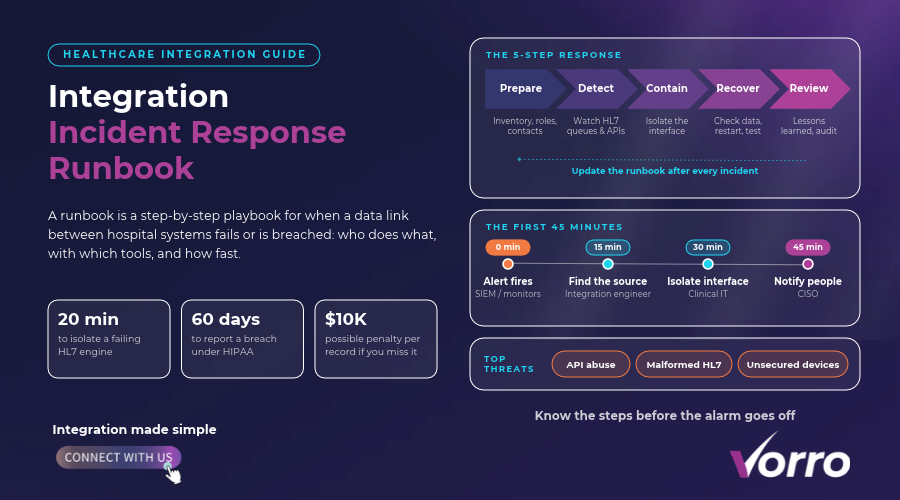
Start with a comprehensive risk assessment and business impact analysis to pinpoint critical integration points. then define recovery objectives, map data flows, and select backup solutions that support both on-premise and cloud components. Next, create detailed run-books for failover, conduct staff training, and establish a regular testing schedule.
How frequently should an integrated healthcare disaster recovery plan be tested?
Best practice is to perform a full end-to-end test at least annually, with quarterly tabletop exercises for critical scenarios. Additional targeted tests—such as cloud vendor failover or telehealth connectivity—should be run semi-annually to validate specific components.
What backup strategies are recommended for protecting data from third-party vendors in a unified recovery plan?
Use a multi-layered approach: automated nightly incremental backups stored in a secure, geographically separate cloud, combined with weekly immutable snapshots. Ensure contracts include vendor-level backup verification and that encrypted data transfers meet HIPAA standards.
Which metrics are most important for defining RTO and RPO across EHR, LIS, and RIS systems?
Prioritize patient-care continuity metrics, such as maximum allowable downtime for clinical documentation (usually 2?4 hours) and data loss limits (often less than 15 minutes of transaction data). Align RTO/RPO targets with the highest-impact workflows, then adjust for each system’s recovery capabilities.
How can healthcare organizations stay HIPAA-compliant while conducting disaster recovery tests?
Perform tests in a controlled environment using de-identified or synthetic data, and ensure all logged activities are audited. Additionally, verify that any backup or recovery service provider signs a Business Associate Agreement (BAA) and that encryption is maintained throughout the test.