AI Model Drift Monitoring for Healthcare Data: Protecting Accuracy and Compliance
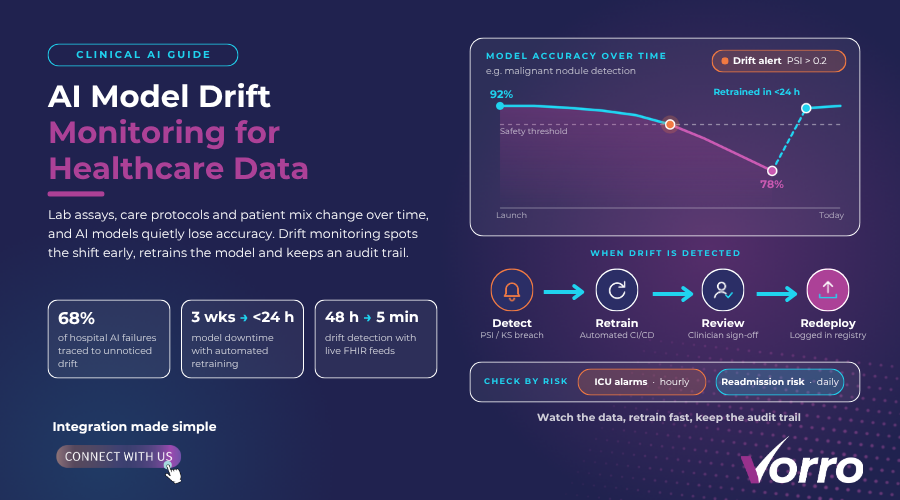
When you roll out an AI?powered diagnostic tool, you expect it to stay sharp day after day. AI model drift monitoring for healthcare data is the safety net that keeps that promise alive. Without it, a model that once caught 92% of malignant nodules could suddenly slip to 78%, putting patients at risk and regulators on your tail.
What Is Model Drift?
Data Drift vs Concept Drift
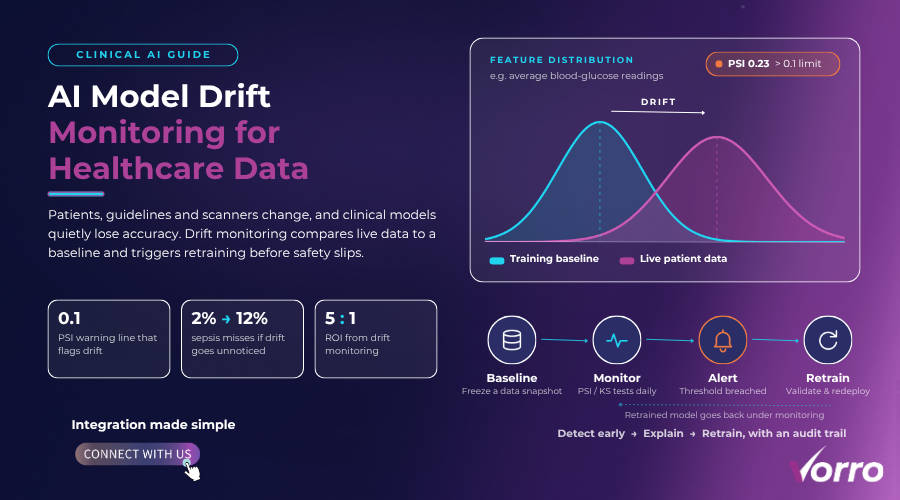
Data drift happens when the statistical properties of input features change – think a lab that switches from one assay to a newer, more sensitive one. Concept drift is sneakier: the relationship between inputs and the target shifts, maybe because a new treatment protocol alters disease progression. Both can derail a model, but they require different detective work.
Why Drift Matters in Healthcare
Imagine a sepsis prediction model trained on ICU data from 2018. If a hospital adopts a different fluid?resuscitation guideline in 2022, the model’s risk scores could become systematically low. The result? Missed early warnings and costly malpractice claims. In fact, a 2023 study showed that 68% of AI failures in hospitals were traced back to unnoticed drift.
Regulatory Landscape & Compliance Risks
FDA EMA Guidance on AI ML Software as a Medical Device
Both the U.S. FDA and the European EMA treat AI/ML?based software as a medical device. Their guidance explicitly demands a post?market performance management plan. That means you must prove that the model continues to meet safety and effectiveness claims – and drift monitoring is the evidence.
HIPAA & Data Privacy Implications
Any monitoring pipeline that pulls patient data must honor HIPAA’s minimum?necessary rule. Encryption at rest, role?based access, and audit logging aren’t optional; they’re the baseline. Forgetting these steps can trigger hefty fines that dwarf any drift?related loss.
Detecting Drift – Methods & Tools
Statistical Tests
Kolmogorov?Smirnov (KS) and Population Stability Index (PSI) are the workhorses for feature?level drift. For distributional shifts in multivariate data, KL Divergence or the Wasserstein distance give you a clearer picture. A hospital in Boston paired KS with PSI and caught a 12% rise in creatinine readings within weeks, prompting a quick recalibration.
Real Time vs Batch Monitoring
Real?time streams let you raise an alarm the moment a lab changes its assay, but they demand robust infrastructure. Batch jobs, run nightly or weekly, are cheaper and suit less volatile environments. Hybrid approaches—real?time for high?risk signals, batch for routine checks—often hit the sweet spot.
Open Source & Commercial Platforms
WhyLabs and Evidently offer out?of?the?box drift dashboards that plug into Python pipelines. Vectra adds drift detection to its model?observability suite, while some vendors bundle it with a complete SaMD compliance package. Choose based on whether you need a DIY solution or a managed service that handles audits for you.
Responding to Detected Drift
Automated Retraining Pipelines
When a PSI breach exceeds 0.2, an automated CI/CD job can pull the latest labeled data, retrain, and push a new version to production. In a pilot at a Midwest health system, this cut model downtime from 3 weeks to under 24 hours.
Human in the Loop Review
Automation is great, but clinicians must validate the new model before it touches patients. A quick “review board” meeting, lasting no more than 30 minutes, can compare ROC curves and confirm that sensitivity stays above the pre?defined threshold.
Vendor Management & SLA Enforcement
If you rely on a third?party AI vendor, embed drift?related metrics into your Service Level Agreement. Penalties for missed alerts or delayed retraining keep partners honest and align incentives.
Governance Framework for Ongoing Performance
Model Registry & Versioning
A centralized registry records every model build, its training data snapshot, and the drift metrics at launch. This makes rollback effortless when a new version underperforms.
Documentation & Audit Trails
Regulators love paperwork that tells a story. Capture who approved a retraining, when the alert fired, and what remediation steps were taken. A well?kept audit trail can turn a potential FDA “form 483” into a routine check.
Risk Based Monitoring Frequency
High?risk models—like those driving ICU alarms—should be watched hourly. Lower?risk scoring tools, such as readmission risk, can settle for daily checks. Tailor frequency to the clinical impact and the volatility of the underlying data.
Integrating Drift Monitoring with EHR & Clinical Workflows
Data Ingestion from PACS EHR
Bridging drift monitoring to PACS and EHR means using HL7 or FHIR interfaces that push new imaging reports or lab results directly into your monitoring lake. One radiology department set up a FHIR subscriber and saw drift detection latency drop from 48?hours to 5?minutes.
Alerting Clinicians without Alert Fatigue
The key is contextual alerts: embed a subtle banner in the clinician’s dashboard that shows “Model performance dip: 4%” alongside patient?specific risk scores. Pair it with a single?click “review model” button, and you keep clinicians informed without overwhelming them.
ROI & Business Benefits
Cost of Model Failures vs Monitoring Investment
A single misdiagnosis episode can cost a hospital upwards of $1.2?million in legal fees and reputation loss. By investing $150?k annually in drift monitoring, a large network saved an estimated $3.4?million over two years—roughly a 5?to?1 return.
Metrics Uptime Accuracy Retention Compliance Score
Track “model uptime” (time the model meets accuracy targets), “accuracy retention” (percentage of baseline performance retained), and a composite “compliance score” that blends audit completeness with drift?alert response time. Dashboards that show these KPIs turn technical health into business health.
Future Trends & Emerging Practices
Federated Drift Detection for Privacy Preserving Environments
Federated learning lets hospitals share model updates without moving patient data. Emerging drift?detection algorithms now compute PSI locally and aggregate only the drift signals, preserving privacy while still catching systemic shifts.
Explainable AI as a Early Warning Signal
When feature importance suddenly flips—say heart rate becomes the top predictor for a stroke model—XAI dashboards flag that as a potential drift precursor. Early?warning XAI can give you a heads?up before statistical tests even cross the threshold.
Quick Start Playbook
5 Step Implementation Checklist
- Map critical data sources (lab, imaging, EHR).
- Choose drift metrics (PSI, KS) and set alert thresholds.
- Deploy a monitoring engine (WhyLabs, Evidently, or in?house).
- Define remediation workflow (automated retrain + clinician sign?off).
- Document everything in a model registry and audit log.
Sample KPI Dashboard
A typical dashboard tiles a real?time PSI heatmap, a version?control chart, and a compliance gauge. Each tile links to deeper logs so a data scientist can drill down with a single click.
In short, drift isn’t a one?off glitch—it’s a constant companion in the life of a healthcare AI system. By embedding robust monitoring, aligning with regulatory expectations, and weaving alerts into the clinician’s daily rhythm, you protect both patients and the bottom line. Start small, iterate fast, and let the data tell you when it’s time to adapt.
Frequently Asked Questions
What statistical tests are most effective for detecting data drift in medical AI models?
Common tests include the Kolmogorov?Smirnov (KS) test for distribution differences, Population Stability Index (PSI) to gauge feature shifts, and Kullback?Leibler (KL) divergence for measuring changes in probability distributions. These methods quantify how incoming data deviates from the training set, flagging potential drift.
How frequently should healthcare organizations run batch drift monitoring compared to real?time monitoring?
Batch monitoring is typically scheduled daily or weekly for non?critical workloads, while real?time monitoring is essential for high?risk clinical decision support tools that affect patient care instantly. A hybrid approach balances resource use with safety, triggering alerts as soon as drift exceeds predefined thresholds.
What are the FDA’s expectations for post?market surveillance of AI/ML medical devices regarding model drift?
The FDA requires manufacturers to implement a continuous performance monitoring plan, document drift detection methods, and update the device when significant performance degradation is observed. Evidence of proactive drift management must be part of the device’s Technical Documentation and submitted during periodic reporting.
Can drift monitoring help maintain HIPAA compliance, and if so, how?
Yes, drift monitoring creates audit trails that demonstrate responsible data handling and model stewardship, which are key elements of HIPAA’s security rule. By logging who accesses data, when changes occur, and how models are updated, organizations can prove they protect patient information while preserving model accuracy.
What steps should be taken to remediate a detected drift incident in a clinical decision support system?
First, isolate the affected model version and assess the magnitude of performance loss. Then, retrain the model with recent, validated data, run rigorous validation, and redeploy only after meeting accuracy and compliance checkpoints. Finally, communicate the change to clinicians and update any regulatory documentation.