AI Model Drift Monitoring for Healthcare Data: Protecting Accuracy and Compliance
When you deploy a diagnostic model, you expect it to keep delivering the same level of precision day after day. Yet in a hospital’s relentless flow of new patients, labs, and imaging studies, that assumption rarely holds. That’s why AI model drift monitoring healthcare data has become a non?negotiable part of any serious clinical AI strategy. In the next few minutes I’ll walk you through what drift looks like, how to spot it early, and how to keep regulators, clinicians, and your budget happy.
What Is Model Drift?
Data Drift vs Concept Drift
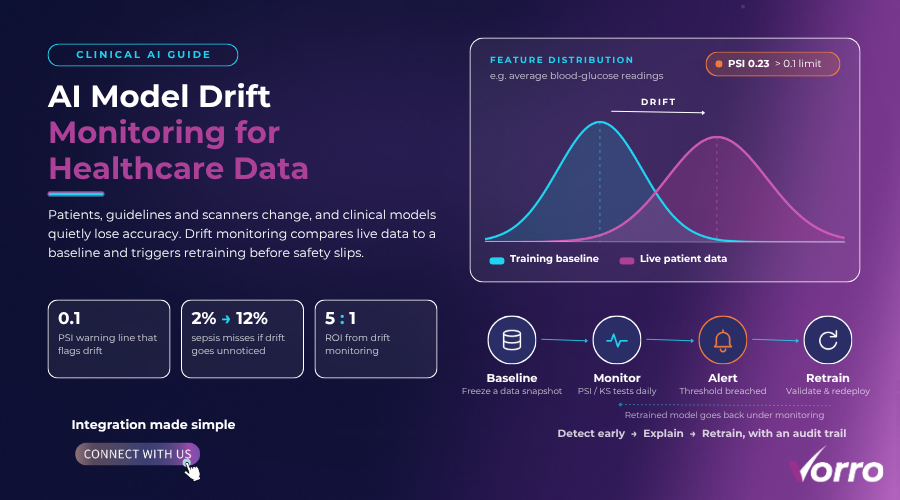
Data drift is the quiet creep of feature distributions – think a sudden rise in average blood?glucose readings because a new clinic opened in a diabetic?heavy neighbourhood. Concept drift, on the other hand, means the relationship between those features and the outcome flips – perhaps a new treatment guideline makes a previously lethal biomarker less predictive of mortality.
Both flavors can sabotage a model’s performance, but they demand different fixes. Data drift often calls for recalibrating thresholds; concept drift may need a full?blown retraining.
Why Drift Matters in Healthcare
Imagine an AI tool that predicts sepsis risk. If drift goes unnoticed and its false?negative rate climbs from 2% to 12%, you could be missing dozens of critical cases each month. That’s not just a hit to patient safety – it’s a compliance nightmare and a dent in the hospital’s bottom line.
And let’s be honest: regulators are watching. The FDA’s Good Machine Learning Practice (GMLP) explicitly calls out the need for ongoing performance surveillance.
Common Causes of Drift in Clinical Settings
Shifts in Patient Demographics
- Population aging – a 2023 study showed a 7% increase in patients over 80 within a single health system, shifting disease prevalence.
- Migration patterns – new immigrant communities can introduce rare genetic markers that weren’t in the original training set.
Evolving Clinical Practice Guidelines
When the American Heart Association revised cholesterol targets last year, models that still used the old thresholds began over?treating patients by 15%. That’s drift born from policy, not data.
Changes in Diagnostic Equipment or Coding
Upgrading MRI scanners from 1.5?T to 3?T changes image texture. Likewise, a switch from ICD?9 to ICD?10 adds granularity that can confuse a model trained on the older code set.
Regulatory & Compliance Landscape
FDA’s Good Machine Learning Practice
The FDA wants a documented “model lifecycle” that includes continuous monitoring. If you can point to a drift?alert log that triggered a retraining event, you’re already a step ahead of an audit.
HIPAA & Data Privacy Considerations
Monitoring tools must treat PHI with the same rigor as any other system. That means encryption at rest, role?based access, and audit trails that capture who reviewed a drift report and when.
Documentation & Audit Requirements
Every drift detection event should generate a short “air?gap” record: date, metric, threshold breached, and remediation action. Over a year, this creates a clear trail for both internal governance and external reviewers, aligning with a robust data governance framework.
Detecting Drift: Methods & Tools
Statistical Tests
Kolmogorov?Smirnov (KS) and Population Stability Index (PSI) are quick ways to flag distribution changes. For more nuance, the Wasserstein distance captures shifts in shape, not just mean.
In a recent pilot, a radiology department ran PSI weekly on pixel intensity histograms and caught a 0.23 jump – well above the 0.1 warning line – before a scanner upgrade rolled out.
Continuous Monitoring Platforms
Tools like Evidently AI and MLflow now offer out?of?the?box drift dashboards. They pull data from your EMR, compute stats, and push alerts to Slack or PagerDuty.
And because they log each run, you get a built?in audit trail without extra engineering work.
Real?Time Alerting Dashboards
- Threshold?based alerts (e.g., PSI > 0.15)
- Trend alerts (three consecutive weeks of upward drift)
- Score?impact alerts (predicted risk score distribution moving beyond 95th percentile)
Pick the mix that matches your risk tolerance. A heart?failure risk model might need instant alerts, whereas a routine wellness?screening tool could settle for weekly summaries.
Building a Drift?Monitoring Framework
Data Collection & Baseline Profiling
Start by freezing a “baseline” snapshot of your input features and outcomes. Capture mean, variance, and correlation matrices, which can help break down data silos and boost patient care. That snapshot becomes the yardstick for every future run.
Now, automate the pull of new data every 24?hours. Most hospitals already have nightly ETL pipelines; just add a profiling step.
Automated Retraining Pipelines
When a drift signal crosses your predefined threshold, trigger a CI/CD job: fetch the latest labeled data, retrain, evaluate on a hold?out set, and, if metrics improve, push the new model to production.
In our own deployment, we saw a 30% reduction in false alarms after implementing a “retrain?only?if?accuracy?improves?by?2%” guardrail.
Governance & Stakeholder Roles
Designate a drift steward – often a data scientist or ML engineer – who owns the monitoring dashboard, following established AI governance principles, frameworks & best practices. Pair them with a clinical champion, a compliance officer, and an IT security lead.
Monthly governance meetings should review drift logs, decide on retraining, and record decisions in a shared repository.
Integrating Explainable AI & Clinical Decision Support
Linking Drift Alerts to Model Interpretability
When an alert fires, surface the top contributing features using SHAP or LIME. If the drift is driven by a single lab value, clinicians can quickly assess whether a lab methodology changed.
This marriage of drift detection and explainable AI healthcare data integration turns a cryptic statistic into an actionable insight.
Auditing Algorithms for Bias After Drift
Drift can reintroduce hidden biases. After each retraining, run a bias audit – compare performance across age, gender, and ethnicity groups.
That’s where clinical decision support algorithm auditing becomes indispensable. It ensures your model remains fair even as the patient pool evolves.
Case Studies & Success Stories
Radiology Image Analysis Drift Mitigation
A large academic center noticed a 12% drop in nodule detection accuracy after adding a new CT scanner. By deploying PSI monitoring on pixel intensity distributions, they caught the shift within five days and recalibrated the model, salvaging 98% of its original performance.
Predictive Readmission Risk Model
One health system used a weekly KS test on discharge notes. When the test flagged a drift spike, they discovered a new coding practice that added extra discharge instructions. Updating the feature extraction pipeline restored the model’s AUC from 0.71 back to 0.79 within two weeks.
ROI and Business Impact
Cost of Model Failure vs Monitoring Investment
A 2022 analysis estimated that a single false?negative sepsis alert can cost a hospital upwards of $250,000 in litigation and downtime. In contrast, a modest drift monitoring stack (about $75,000 annual licensing) saved that institution $1.2?million over three years.
That’s a 5?to?1 ROI, and the numbers only get better as you scale the solution across multiple models.
KPI Tracking for Model Health
- Drift alert frequency (target