Healthcare Middleware Solutions: Enabling Automation and Device Connectivity
What Healthcare Middleware Does, in One Paragraph
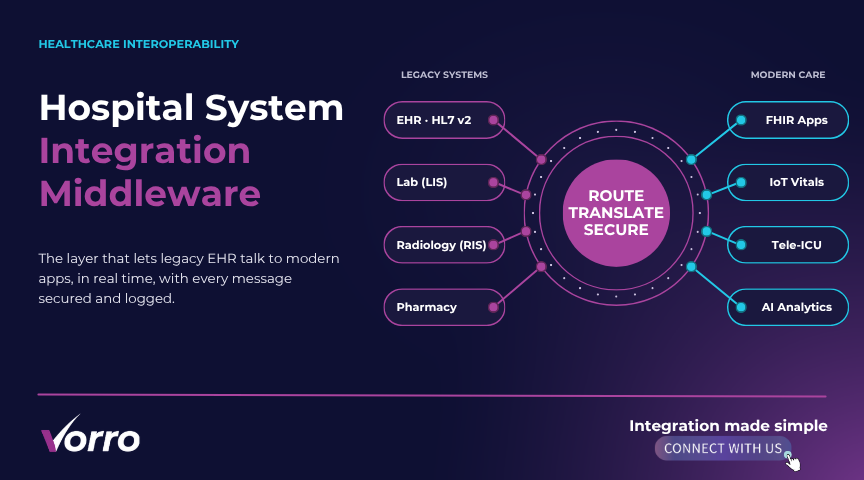
Healthcare middleware is a software layer that sits between disparate systems – EHRs, lab systems, billing engines, bedside monitors – and translates data formats, routes messages, and enforces security policies so those systems can exchange data without custom point-to-point code for every connection. A lab result arrives in HL7, middleware converts it to FHIR, encrypts the payload, and delivers it to the EHR, all without either system needing to know the other’s native format. The core value over building direct APIs yourself: middleware turns what would be a growing spider-web of custom point-to-point connections into a small number of reusable channels.
Three Core Use Cases
Device connectivity. ICU monitors, infusion pumps, and wearable sensors generate continuous streams of vitals and readings. Middleware built for device connectivity (typically over HL7/MLLP or modern APIs) ingests high-volume device data, flags anomalies against configured thresholds, and pushes real-time alerts to the care team — turning raw device output into actionable signals rather than a data dump someone has to review manually.
Workflow automation. Beyond moving data, middleware can trigger downstream actions automatically – routing a discharge summary to a patient portal, kicking off a billing workflow the moment a claim-relevant event occurs, or notifying a care coordinator when a lab result crosses a risk threshold – without a person manually initiating each step.
System-to-system routing. This is the “traffic controller” function: taking a message from any source system, transforming it into the format the destination system expects, and delivering it reliably (with retry logic and guaranteed delivery), regardless of how many systems are on either end of that exchange.
Traditional Integration Engines vs. Modern iPaaS Middleware
| Traditional Integration Engine | Modern iPaaS / Cloud-Native Middleware | |
|---|---|---|
| Examples | Mirth Connect (open-source), Orion Health | Azure Integration Services, cloud-native low-code platforms |
| Deployment | On-premise or hybrid | Cloud-native |
| Pricing model | Often free core with paid support, or enterprise licensing | Subscription or pay-as-you-go, scaling with usage |
| Scaling approach | Manual capacity planning and infrastructure management | Horizontal auto-scaling |
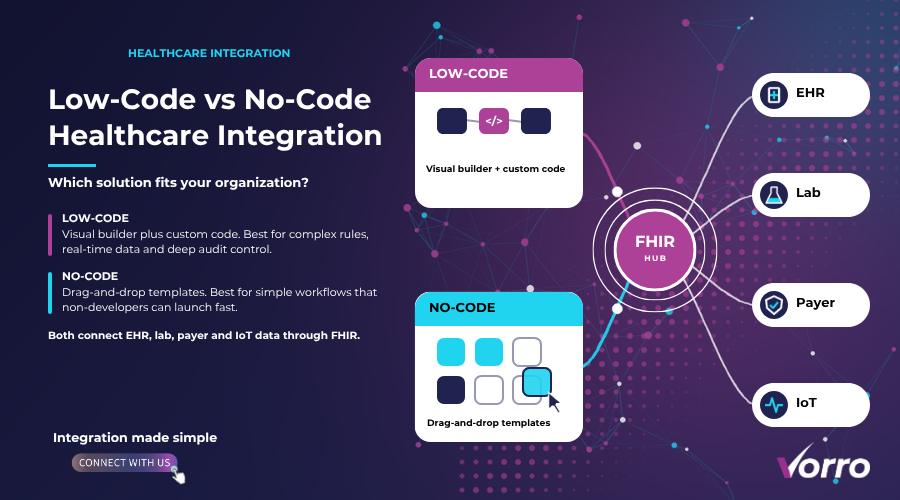
| Configuration | Typically requires integration engineers writing/maintaining scripts | Low-code flow designers let business analysts build new flows directly |
| Best fit | Organizations with existing engine investment and dedicated integration staff | Organizations that want scalability without growing an in-house integration team |
Neither category is universally superior — a traditional engine with deep customization may be the right call if you already have the engineering capacity to run it, while iPaaS middleware reduces the maintenance burden at the cost of some low-level control.
Choosing Middleware for Medical Device Connectivity
Device connectivity has requirements that general-purpose middleware doesn’t always handle well. When evaluating middleware specifically for ICU monitors, infusion pumps, or remote patient monitoring devices, confirm it supports:
- High-frequency ingestion – device data often arrives continuously, not in discrete transactional bursts like an order or a claim
- HL7 over TCP/IP or device-native protocols – many bedside devices still speak HL7 v2 directly rather than exposing a modern API
- Real-time anomaly detection and alerting – the value of device data drops sharply if it’s only reviewed retrospectively
- Low, consistent latency – a delayed vitals alert isn’t just inefficient, it’s a patient safety issue
Evaluation Checklist
When comparing middleware platforms, evaluate against these dimensions rather than feature lists alone:
- Throughput – can it handle your peak message volume (not just average volume) without degrading? Load-test with realistic volumes, not a few hundred sample messages.
- Protocol and standards support – native handling of HL7 v2/v3, FHIR, CCD, and claims formats (X12) without requiring custom adapters for standard cases
- Uptime SLA – what’s guaranteed, and what’s the vendor’s track record against that SLA?
- Security posture – TLS 1.3 or equivalent, message-level encryption, role-based access control, and immutable audit logs as baseline requirements, not premium add-ons
- Total cost of ownership – beyond the license or subscription fee, factor in implementation time, custom connector costs, and ongoing support responsiveness
A reasonable target to hold vendors to during a pilot: high message success rates and low, consistent latency under realistic load – get the vendor’s own benchmark data and validate it against your actual message volume rather than accepting marketing figures at face value.
Not Sure Which Middleware Fits Your Environment?
The right middleware choice depends on your existing systems, device mix, and internal engineering capacity – not a generic vendor ranking.
Request a middleware fit assessment to map your current integration needs against the right architecture, or talk to an integration engineer about device connectivity specifically.
Frequently Asked Questions
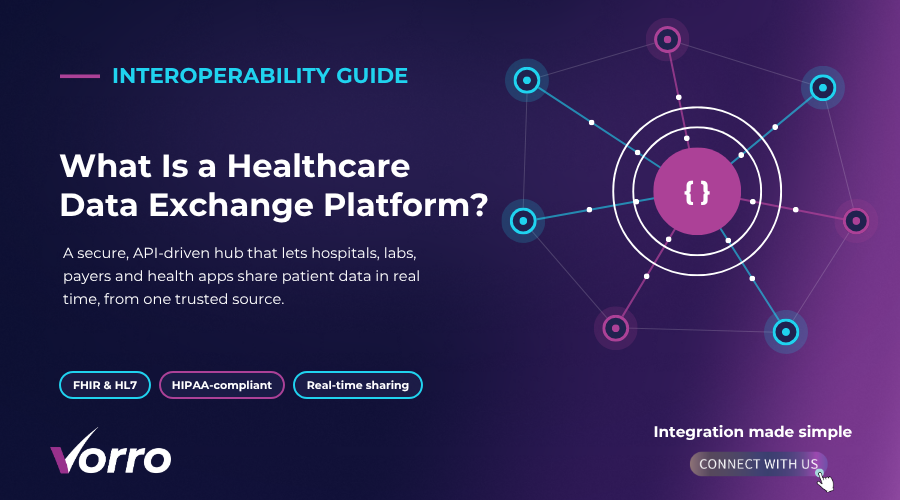
What’s the difference between middleware and a full integration platform? The terms overlap in practice, but middleware typically refers specifically to the message-routing and transformation layer, while a broader integration platform may also include analytics, monitoring dashboards, and UI components on top of that core function.
Which industry standards should healthcare middleware support? Look for native handling of HL7 v2/v3, FHIR, CCD, and DICOM (for imaging), along with support for claims formats like X12 if revenue cycle integration is in scope. Broad standards coverage reduces how often you’ll need custom adapters.
What security features are essential in healthcare middleware? End-to-end encryption, role-based access control, immutable audit logging, and alignment with HIPAA and (where applicable) GDPR or HITRUST requirements. Treat every message as PHI by default rather than selectively encrypting based on perceived sensitivity.
Do I need a dedicated team to manage middleware? Not necessarily – many cloud-native platforms offer managed services that reduce day-to-day operational burden. You’ll still want a governance lead responsible for policy, mapping decisions, and change management, even with a fully managed platform.
How quickly can I expect to see ROI from a middleware deployment? Timelines vary by organization size and existing interface complexity, but reduced integration staffing needs, lower error rates from eliminated manual re-entry, and faster claims processing are the typical drivers. Build your own ROI case from your current interface count and error rates rather than relying on industry-wide averages.
Can middleware help with GDPR compliance, not just HIPAA? Yes, if the platform offers data residency controls, consent management, and the ability to purge records on request – these aren’t universal middleware features, so confirm them specifically if GDPR applies to your organization.