Introduction
When you search for a HIE integration solution you’re really asking how to make patient data flow like traffic on a well?planned highway. I’ve seen clinics stumble over clunky interfaces, and I’ve helped them connect to HIEs with a single, cloud?based gateway. Below you’ll get the facts, the standards, and the checklist you need to pick the right platform.
What HIE Integration Involves
Definition and core components
At its core, HIE integration stitches together EHRs, labs, radiology systems, and public?health feeds. Think of an API hub, a message broker, and a security layer working 24/7.
Typical data flows
Data jumps from a physician’s chart to a lab result, then back to the caregiver’s inbox—all in seconds. In one Midwest health system, this reduced result turnaround from 48?hours to under 5.
Common Connectivity Challenges
Legacy system compatibility
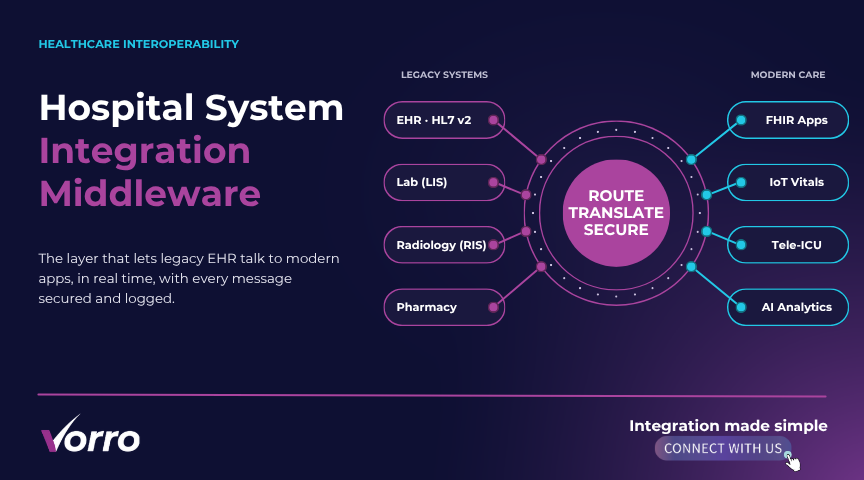
Older on?premise EHRs still speak HL7 v2, while newer apps chatter in FHIR. The mismatch can stall a project for months.
Data format mismatches
Imagine trying to merge CSV lab files with JSON imaging reports. Without a translation engine, you’ll see errors, not insights.
Security and compliance hurdles
Every breach costs an average of $4.35?million. Strong encryption and audit trails are non?negotiable.
Standards and Protocols
Overview of IHE profiles
IHE profiles—like Patient Identifier Cross?Reference—give a playbook for secure, reliable exchange. They’re the glue behind most successful HIE connectivity projects.
Role of FHIR in modern HIEs
FHIR’s RESTful design lets you connect to HIE services with simple HTTP calls, cutting integration time by up to 60%.
Interoperability best practices
Always version?control your interfaces, test with real patient bundles, and document every mapping.
What to Look for in a Solution
Cloud?based SaaS vs on?premise
Cloud SaaS gives you instant scaling; on?premise offers tighter control. Choose based on your IT appetite and budget.
Scalability and performance
Ask for a benchmark: can the platform handle 10,000 transactions per minute without lag? That’s the sweet spot for large networks.
Vendor support and governance tools
Good vendors provide a dashboard for policy enforcement, role?based access, and real?time alerts.
ROI and Cost Considerations
Licensing models
Per?transaction fees work for low volume, while subscription plans shine at scale. Mix and match to avoid surprise invoices.
Expected savings from reduced duplicate testing
One study showed a 22% drop in duplicate labs after implementing an HIE integration solution—roughly $1.3?million saved annually.
Security and Privacy Compliance
HIPAA, GDPR, and state regulations
Make sure the platform encrypts data at rest and in transit, and that audit logs meet both HIPAA and GDPR timelines.
Encryption and audit trails
End?to?end AES?256 encryption paired with immutable logs gives you the peace of mind regulators demand.
Future Trends AI?enabled Data Insights
Predictive analytics integration
Tomorrow’s HIEs will feed AI models that flag sepsis risk before a nurse even sees the vitals. Starting with a solid integration foundation makes that possible.
Key Takeaways
Choosing the right health information exchange integration platform means balancing standards, security, and cost. Look for proven IHE profiles, FHIR support, and a vendor that backs you with clear governance tools. When you get those pieces right, your organization can reap fast ROI and stay ready for AI?driven insights.
FAQs
How long does implementation usually take?
Typical projects run 3?6?months, depending on legacy system depth and required custom mappings.
What are the main cost drivers?
Licensing, data volume, and any necessary on?premise hardware are the big tickets.
Is on?premise ever better for security?
If you handle extremely sensitive data and have a strong internal security team, on?premise can give you tighter control.
Can I start small and scale later?
Absolutely. Most SaaS solutions let you add transaction capacity and new endpoints as your network grows.
What support do vendors usually provide?
Look for 24/7 help desks, regular software updates, and a dedicated integration manager to steer you through the first go?live.