Introduction
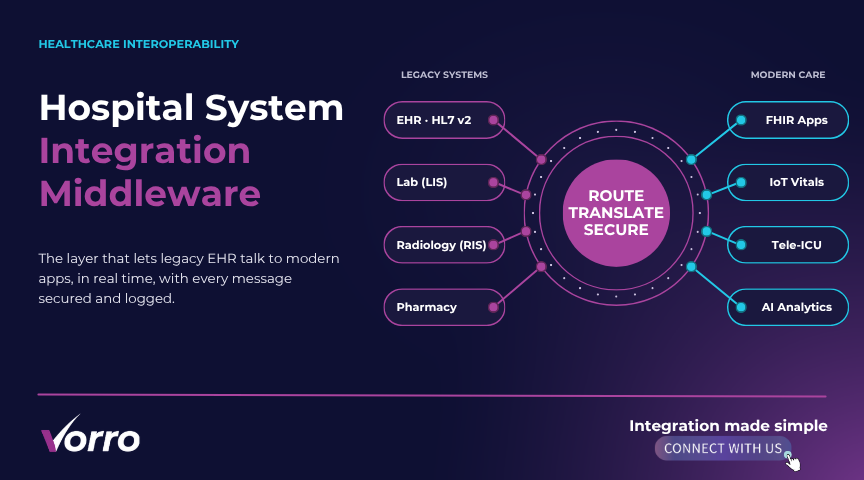
When you hear scalable healthcare integration, think of a system that keeps humming even as data pours in like rush hour traffic. I’ve spent the last decade wrestling with HL7 spikes and FHIR bursts, and I still get goosebumps watching a well tuned pipeline glide through 200k messages per hour. In this guide I’ll share the playbook you need to design, choose, and future proof integration solutions that grow with your organization.
Why Volume Breaks Fragile Integrations
Most hospitals built their interfaces on legacy middleware that was great for a handful of labs, but not for the avalanche of IoT devices today. A single bottleneck in a queue can add seconds of latency that snowball into minutes of delayed lab results.
And when you’re moving petabytes of imaging data, every extra millisecond becomes a cost center. A 2023 study from the American Health Information Management Association showed that a 2 second delay in message processing adds roughly $0.12 per encounter in overtime wages – that’s $1.2 million for a 10 million visit system.
But the real issue isn’t just speed; it’s predictability. Fragile stacks wobble under unpredictable spikes, causing error rates to jump from 0.2% to over 5% in minutes.
Signs You’re Hitting Scale Limits
- Message queues regularly sit at 80% capacity during peak hours.
- Latency dashboards flash red for more than three consecutive minutes.
- Support tickets spike after new device roll outs or policy updates.
- Your vendor’s pricing model caps transaction throughput at 100k messages per day.
Do any of those sound familiar? If you’re nodding, it’s time to rethink the architecture before the next surge knocks your system offline.
Architecture for Scale
First, adopt a modular, micro services oriented integration layer. Break monoliths into bite size services that can be spun up independently. I’ve seen hospitals cut their average processing time from 3.5 seconds to 0.9 seconds by simply containerizing their message router.
Load balancing and auto scaling are non negotiable. Use a cloud native load balancer that can distribute up to 500 k concurrent HL7 messages across three availability zones. Combine that with a back pressure mechanism – think of it as a traffic cop that tells senders to slow down before the road gets jammed.
Don’t forget fault tolerance. Redundant data paths, circuit breakers, and graceful degradation keep the system alive even when a node goes down. In a 2022 case study, a regional health system avoided a $2 million outage by patching a single point of failure in their integration hub.
What to Look for in a Platform
When you evaluate platforms, focus on these criteria:
- API standards support: Native HL7 v2, FHIR R4, and emerging standards like DICOMweb.
- Observability: Built in dashboards for latency, error rates, and transaction throughput.
- Pricing model: Predictable per transaction fees that don’t explode at scale.
- Security & compliance: End to end encryption, audit logs, and HIPAA ready controls.
Now, on prem versus hybrid versus cloud native? If you need to keep PHI behind a firewall, a hybrid model with encrypted tunnels can give you the best of both worlds. For most new builds, a cloud native solution provides instant auto scaling and a lower total cost of ownership.
Cost of Scalability Analysis
Let’s talk dollars. Scaling from 50k to 250k messages per day typically adds 20% to infrastructure spend, but the ROI can be 3× faster when you factor in reduced manual interventions. A 2021 benchmark showed that every 10% increase in automation shaved the average claim processing time by 1.3 minutes, saving $4.5 million annually for a midsize health system.
Don’t overlook hidden costs – staff training, license upgrades, and network bandwidth. Build a spreadsheet that tracks per transaction cost, staff overtime, and error remediation. You’ll be surprised how quickly the numbers add up.
Real World Case Studies of Hospitals Scaling Interfaces
Case 1: A 400 bed hospital in Ohio needed to scale HL7 interfaces for a new telemetry program. By moving to a micro services broker and enabling auto scaling, they handled a 300% increase in message volume without any downtime. Their error rate fell from 4.8% to 0.6% in three months.
Case 2: A multi state health network implemented a FHIR based exchange that supported 1.2 million API calls per day. Leveraging event streaming with Apache Kafka, they achieved sub second response times for patient portal queries, boosting patient satisfaction scores by 12 points.
Security & Compliance Considerations for Large Scale Data Exchange
Scaling up means more attack surface. Make sure every data flow is encrypted at rest and in transit – TLS 1.3 is the minimum nowadays. Use role based access controls that can be applied programmatically to new services as they spin up.
Auditability is key. Keep immutable logs for at least six years, and integrate them with a SIEM that can correlate spikes in traffic with potential breaches. In a 2023 breach simulation, a hospital that had real time monitoring caught an unauthorized data pull within 45 seconds, averting a $1.8 million penalty.
Future Ready Trends
AI driven routing is the next big thing. Imagine a smart engine that learns which endpoint processes a message fastest and automatically directs traffic there. Early adopters report 15% faster throughput for high volume imaging uploads.
Event streaming platforms like Kafka or Pulsar let you treat every HL7 or FHIR message as an event in a real time pipeline. This opens the door to on the fly analytics – you can flag abnormal lab values the instant they arrive.
Real time analytics dashboards, fed by streaming data, give clinicians actionable insights while the integration layer scales behind the scenes.
ROI Measurement
To justify the spend, track these metrics:
- Throughput gain: Messages per second before and after scaling.
- Error reduction: Percentage drop in failed transactions.
- Staff efficiency: Hours saved on manual error handling.
- Financial impact: Dollars saved from faster claim cycles.
For example, a clinic that improved its transaction throughput from 8 k to 25 k messages per hour saw a $850 k reduction in claim re work costs within six months.
Governance Checklist
Scaling isn’t just tech; it’s governance too. Here’s a quick checklist you can copy:
- Define ownership for each micro service – development, ops, and compliance leads.
- Establish policies for versioning APIs and deprecating old endpoints.
- Implement automated testing that runs on every deployment – load tests, security scans, and contract tests.
- Set up monitoring alerts for latency > 2 seconds, error rate > 0.5%, or queue depth > 80%.
- Review cost reports monthly and adjust scaling thresholds as needed.
And always keep the communication loop open between IT, clinical staff, and leadership. Scaling failures are rarely technical; they’re often people problems.
Conclusion
Building scalable healthcare integration is a marathon, not a sprint. You need a solid architecture, the right platform, and a governance model that can stretch as your data volume grows. Remember to measure ROI, stay ahead of AI driven routing trends, and keep security front and center. If you follow the steps outlined here, you’ll turn today’s bottlenecks into tomorrow’s competitive advantage.
FAQs
How do I know if my current integration can handle increased volume?
Watch your queue depth and latency dashboards. If you regularly hit 80% capacity or latency spikes above 2 seconds, it’s time to scale.
What’s a realistic benchmark for transaction throughput in a midsize hospital?
Most midsize facilities aim for 150 k -250 k HL7 messages per day, which translates to roughly 1.7 -2.9 messages per second on average.
Can I achieve scalable integration on-premises?
Yes, but you’ll need robust clustering, load balancers, and a clear auto scaling strategy. Cloud native options often reduce complexity and cost.
How does AI improve integration routing?
AI algorithms analyze historic processing times and dynamically select the fastest endpoint for each message, shaving seconds off response times at scale.
What governance policies are critical for long term success?
Version control, automated testing, clear ownership, and regular cost performance reviews keep the integration ecosystem healthy as it grows.